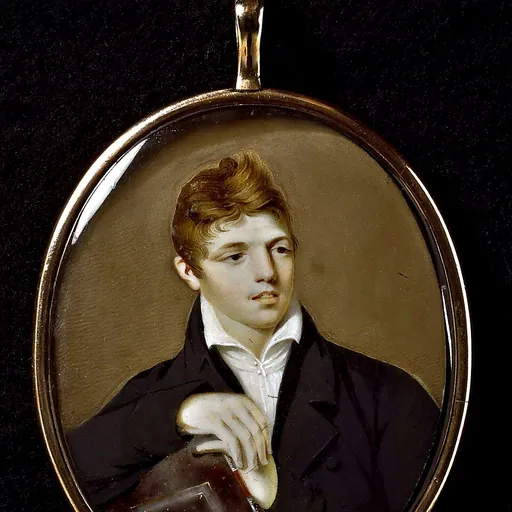
About Charles Busby
Lived 1786 – 1834 (aged 47–48). Charles Busby was a British architect.
Charles Augustin Busby (27 June 1786 – 18 September 1834) was an English architect.
He created many buildings in and around Brighton, Sussex, such as Brunswick Square and St Margaret's Church. His style usually included Romanesque-style pillars to his buildings.
He entered into an architectural partnership with fellow architect Amon Henry Wilds and his apprentice David J. Field. This has been called a decisive movement in his career. It was a partnership suggested by Thomas Read Kemp who was developing property in Brighton. Busby became key in the development of Brighton, not just as an architect but also investing in development himself.
Family Busby was born in London on 27 June 1786. He was the eldest of seven children born to the composer, musician and author Thomas Busby and Priscilla (née Angier). His parents socialised with people such as William Blake, Byron, Merlin the Ingenius Mechanic, Henry Vassal-Fox, 3rd Baron Holland and his wife Elizabeth Fox, Baroness Holland. It is said that they were politically radical.
Books published In 1808 Busby published his first book called 'A Series of Designs for Villas and Country Houses adapted with Economy to the Comforts and to the Elegancies of Modern Life. In the preface to this book Busby attacked the fashion for Egyptian architecture: "Of all the vanities which a sickly fashion has produced, the Egyptian style in modern Archi-tecture appears the most absurd". He preferred the simplicity of Greek architecture.
He was also responsible for the Commercial Rooms, Bristol (1810), built in his favoured Grecian style. It was his first important commission. Busby's plans were accepted in a public competition in 1810. The building was completed the following year. At the time it was considered to be the best classical church in Brighton. which was built as a self-contained settlement surrounded by open fields.
In late 1824 Busby signed a contract with the Reverend Thomas Scutt, who was a landowner of more than 300 acres to the west of Brighton, to develop a new town, in 35 acres of land, in the Regency style. It would be named Brunswick Town. It was developed between 1824 and 1834, the time of his death. In 1824 he had advocated hot running water for his houses in Brunswick Square.
Don’t just read it —
keep it.
Full-length biographies made to live with: read them, listen on the way to work, watch them tonight.
- E-book
- Audio
- Video
Instant download · yours to keep · every purchase keeps this site free
Important facts
People in Charles Busby's life
Named in this biography and alive at the same time



Related people
Same field, nearest in time


Contemporaries
People whose lives overlapped Charles Busby's



Frequently asked questions
Who was Charles Busby?
British architect (1786–1834)
When was Charles Busby born?
Charles Busby was born in 1786 in London.
When did Charles Busby die?
Charles Busby died in 1834 in Brighton.
What was Charles Busby's occupation?
Charles Busby was an architect.
What nationality was Charles Busby?
Charles Busby was British.
Sources & further reading
· DBpedia: Charles Busby (architect)
Cite this page
APA: Biography.guide. (2026). Charles Busby. https://biography.guide/charles-busby/
MLA: "Charles Busby." Biography.guide, https://biography.guide/charles-busby/.
Chicago: "Charles Busby." Biography.guide. https://biography.guide/charles-busby/.
Data last updated: 2026-09-21 · Spot an error? Report a correction.
Portrait: Wikimedia Commons · author & licence
Page generated 2026-09-27 04:59 UTC