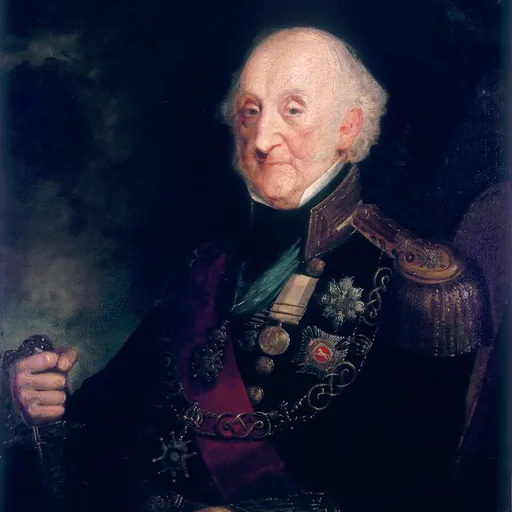
About Charles Bullen
Lived 1769 – 1853 (aged 83). Charles Bullen was a British naval officer.
Admiral Sir Charles Bullen (10 September 1769 – 2 July 1853) was a highly efficient and successful naval officer who served in the Royal Navy during the French Revolutionary and Napoleonic Wars and distinguished himself at the Glorious First of June, the battle of Camperdown and the battle of Trafalgar.
Early life Charles Bullen was born in Newcastle in 1769 but spent much of his early childhood in Weymouth, Dorset. His father, John Bullen, also served in the Royal Navy and was the Surgeon General on the North American Station between 1779 and 1781. Charles' mother, Ruth (née Liddel), was a cousin of Lord Eldon who served as Lord Chancellor of Great Britain between 1801 and 1806 and again between 1807 and 1827.
Career
American Revolutionary War
When his father was appointed Surgeon-General to the North American station in 1779, the 10-year-old Charles went with him aboard HMS Europe, which arrived in New York City on 25 August.
Peace Charles stayed ashore until 1786 and finished his schooling.
French Revolutionary War
When war broke out, Bullen returned to HMS Culloden, which was still under the command of Thomas Rich and sailed for the West Indies where they took part in the unsuccessful invasion of Martinique. Returning home in March 1794, Bullen transferred to HMS Ramillies in which he took part in the Atlantic campaign of May 1794 and the battle of the Glorious First of June. The captain, Henry Harvey, was subsequently promoted and replaced by Sir Richard Hussey Bickerton, who took the ship to the West Indies. Bullen continued to serve in Ramillies in the waters around the West Indies and Newfoundland until the end of 1795 when she returned to English waters, joining the North Sea Fleet under Admiral Duncan. Towards the end of 1796, Bullen re-joined Admiral Peyton in his then flagship, the 64-gun, third rate, Overyssel. This appointment didn't last long however and by Christmas, Bullen was again on half pay. Carnegie, who had some sympathy with the rebels, resigned following suppression of the mutiny but Bullen remained on board under the new captain, James Walker and together they fought at the battle of Camperdown later that year, the crew of the Monmouth fighting hard to absolve themselves of their part in mutiny.
Camperdown
The battle of Camperdown took place on 11 October 1797. As the Monmouth was bearing down on the Dutch fleet, Captain Walker spoke to the crew, "My lads, you see your enemy; I'll lay you close aboard and give you an opportunity of washing the stain off your characters in the blood of your foes. Now go to your quarters and do your duty". He was praised for marshalling the evacuation of the ship and controlling the survivors in the water until they could be rescued by the boats of HMS Veteran, HMS Russell and other neighbouring vessels. Bullen was promoted to commander for his actions and returned to his Dorset home on half pay, where he spent the next three and a half years with his wife and family. The previous captain, Jahleel Brenton was injured when a block fell on his head, and Bullen, who was conveniently close by in Weymouth, commanded the vessel between 8 May and 3 June in 1803. Patrolling the waters off Cherbourg, Bullen captured 23 merchantmen and the frigate sent to protect them. Between 14 July 1803 and 15 May 1804, Bullen commanded the Plymouth division of Sea Fencibles, protecting the south-west of England from an invasion which, fortunately, never came. Britannia fell in 5th behind and, with no particular role allocated, attacked three ships, including the and the 130-gun Santissima Trinidad, before turning to pursue the enemy's flying van. After the battle, Britannia was still relatively undamaged, despite having suffered 52 casualties, and so she was able to aid other more seriously damaged ships in the storm which followed. Bullen brought three ships back to England and received prize money in excess of £3000, along with the usual awards from the Lloyd's Patriotic Fund of the gold medal and sword given to Trafalgar captains. His ship was paid off on 20 June, and Bullen spent the next 15 months on half pay. The latter action also led to the capture of five vessels sheltering under the 14 gun battery. Bullen also assisted in a boat action off Rosas, which resulted in the taking of seven merchantmen and their three armed escorts. Consequently, on 1 January 1811, Bullen took command of Fane's ship, HMS Cambrian. Bullen continued to support the Spanish in operations along the Catalan coast, destroying the shore batteries at Palamos and St Phillion in April that year. Returning to the bay of Rosas, Bullen captured 19 merchant vessels off Cadaques before sailing south to Tarragona in April, where, together with other ships from the squadron he aided the early defence during the siege, at one point risking running his ship aground by taking it close in shore to deliver broadsides on the enemy. Later, whilst serving in a battery ashore in Selva, he was badly wounded.
Later service
Bullen did not go to sea again until 10 November 1814 when he was appointed to HMS Akbar as flag captain to Admiral Thomas Byam Martin, helping to supervise the partition of naval supplies at Antwerp. Admiral Charles Bullen died aged 84 on 2 July 1853, the last surviving captain of the British fleet at Trafalgar.
Don’t just read it —
keep it.
Full-length biographies made to live with: read them, listen on the way to work, watch them tonight.
- E-book
- Audio
- Video
Instant download · yours to keep · every purchase keeps this site free
Important facts
People in Charles Bullen's life
Named in this biography and alive at the same time



Related people
Same field, nearest in time





Contemporaries
People whose lives overlapped Charles Bullen's




Frequently asked questions
Who was Charles Bullen?
British Royal Navy admiral (1769-1853)
When was Charles Bullen born?
Charles Bullen was born on 10 September 1769 in Newcastle upon Tyne.
When did Charles Bullen die?
Charles Bullen died on 28 February 1853 in Shirley.
What was Charles Bullen's occupation?
Charles Bullen was a naval officer.
What nationality was Charles Bullen?
Charles Bullen was British.
Sources & further reading
Cite this page
APA: Biography.guide. (2026). Charles Bullen. https://biography.guide/charles-bullen/
MLA: "Charles Bullen." Biography.guide, https://biography.guide/charles-bullen/.
Chicago: "Charles Bullen." Biography.guide. https://biography.guide/charles-bullen/.
Data last updated: 2026-09-22 · Spot an error? Report a correction.
Portrait: Wikimedia Commons · author & licence
Page generated 2026-09-27 05:04 UTC