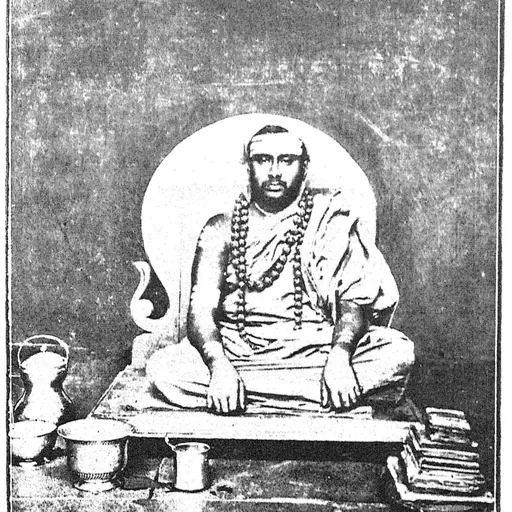
About Chandrasekhara Bharati III
Lived 1892 – 1954 (aged 61). Chandrasekhara Bharati III was an Indian philosopher.
Swami Chandrasekhara Bharati (born Narasimha Sastri; 1892–1954) was the Jagadguru Sankaracarya of Sringeri Sharada Peetham in 1912–1954. He was one of the well known spiritual figures in Hinduism during the 20th century. He is considered a Jivanmukta (Sanskrit for one liberated while alive).
Biography
Narasimha Sastri, who became Jagadguru Shankaraachaarya Swami Chandrashekhara Bharati was born to Gopala Sastri and Lakshmamma in Sringeri on Ashvayuja krishna Ekadashi (the eleventh day of the fortnight in the month of Ashvayuja) in the Hindu lunar year Nandana (corresponding to October 16, 1892). He was the last of his parents' twelve children and the only one who survived past infancy. A noted feature of his life was that his birth, upanayanam, sannyasa and videha mukti (death), all happened on Sundays. Vellore Subrahmanya Sastri and Mimamsa Shiromani Vaidyanatha Sastri taught him Purva Mimamsa by texts such as the Bhatta Dipika. of Swami Chandrasekhara Bharati. He received the saffron robes, the sacred staff, and the kamandala (water pot) from Satyananda. He was thus ordained in the dashanami tradition of Adi Shankaracharya.
Kumbhabhishekam and Digvijayam
In 1916, the Kumbhabhishekam (consecration) of the Sharada Temple in Sringeri was performed by Swami Chandrashekhara Bharati. In 1924, he left Sringeri on his first Digvijayam (tour). He first reached Mysore and consecrated a temple at the house of his Guru. It was named Abhinava Shankaralaya. Then, from Mysore, the Sankaracarya proceeded to Satyamangalam via Nanjanagud and Chamrajanagar. He then toured the southern parts of the Tamil country including Thirunelveli and Kanyakumari. He then toured Thiruvananthapuram and Kaladi in Travancore. At Kaladi, in 1927 he established a Vedanta Pathashala (an institution for higher studies in Vedanta). He then returned to Sringeri after visiting a few more places in Karnataka and Travancore.
Avadhuta Sthiti and naming his successor
After returning to Sringeri, Swami Chandrashekhara Bharati assumed the Avadhuta Sthiti (the state of being an Avadhuta). He was absorbed in the inward bliss of the Atma. To enable himself to spend more time in meditation and contemplation of the Self, he named a successor to the Peetham: a vatu named Srinivasa Sastri. On May 22, 1931, he initiated Srinivasa Sastri into Sannyasa and gave him the yoga patta of Sri Abhinava Vidyatirtha. In 1938, Swami Chandrashekhara Bharati undertook a yatra (pilgrimage) to Bangalore, Mysore and Kaladi. After returning to Sringeri, he resumed his classes on Vedanta and wrote thought-provoking and erudite articles in Asthikamathasanjeevini, a journal published by the Matha. He granted interviews to genuine seekers and gave darshan to the public.
Final years and videha mukti
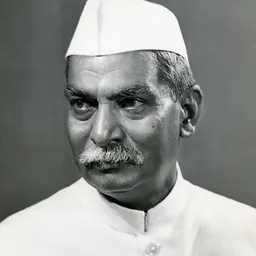
After 1945, Swami Chandrashekhara Bharati gradually withdrew from all activities. However, his fame had spread far and wide. On August 24, 1954, the first President of India, Dr. Rajendra Prasad, visited Sringeri to pay homage to the Sankaracharya. The President, a pious man having deep faith in the Hindu scriptures, discussed with Swami Chandrashekhara Bharathi in Sanskrit itself, on Dharma and other allied subjects.
A few days later, the Jagadguru took samadhi. On Sunday, September 26, 1954, he got up early in the morning and walked towards Tunga River; a servant followed at a slight distance. He stepped into the water without heeding the servant's warning about the depth of water at that spot, and advancing further into the current had a dip. Then he did Pranayama, and dipped again. The servant saw the Acharya's body floating down the current. In consternation the servant plunged into the river, caught hold of the Acharya, but in the effort lost his consciousness. A gentleman who happened to hear the shouts of the servant, brought the two ashore. The servant was soon restored to life but ‘nothing could be done in the other case’. It was reported that his body was in an erect sitting posture with legs crossed as at the time of contemplation and was straightened out only in an attempt to restore respiration and that there was no sign of drowning or of suffocation or of any struggles for life. The Jagadguru's mortal remains found their resting place in a samadhi just by the side of that of his great guru in Narasimhavanam. The anniversary of the day will ever fall on the Mahalaya New Moon day, the day of the annual Abhiseka of Sri Sharada preparatory to the Navaratri celebrations. His birth, Upanayanam, Sanyasa and Videha Mukti were all on Sundays.
Works
Swami Chandrashekhara Bharati composed a few poems and wrote a famous commentary. His main works are: Gururaja Sukti Malika containing 36 compositions in about 400 pages. Printed in Sanskrit and Tamil Sri Sharada Dandakam in Sanskrit, extolling the presiding deity of Sringeri- Sri Sharadamba Bhashya (commentary) on Vivekachoodamani, an Advaita treatise attributed to Sri Adyashankaracharya
Don’t just read it —
keep it.
Full-length biographies made to live with: read them, listen on the way to work, watch them tonight.
- E-book
- Audio
- Video
Instant download · yours to keep · every purchase keeps this site free
Important facts
People in Chandrasekhara Bharati III's life
Named in this biography and alive at the same time
Related people
Same field, nearest in time



Contemporaries
People whose lives overlapped Chandrasekhara Bharati III's

Frequently asked questions
Who was Chandrasekhara Bharati III?
Indian Jagadguru
When was Chandrasekhara Bharati III born?
Chandrasekhara Bharati III was born on 16 October 1892 in Shringeri.
When did Chandrasekhara Bharati III die?
Chandrasekhara Bharati III died on 26 September 1954 in India, Sringeri.
What was Chandrasekhara Bharati III's occupation?
Chandrasekhara Bharati III was a philosopher.
What nationality was Chandrasekhara Bharati III?
Chandrasekhara Bharati III was Indian.
Sources & further reading
· Wikipedia: Chandrasekhara Bharati III
· DBpedia: Chandrashekhara Bharati III
Cite this page
APA: Biography.guide. (2026). Chandrasekhara Bharati III. https://biography.guide/chandrasekhara-bharati-iii/
MLA: "Chandrasekhara Bharati III." Biography.guide, https://biography.guide/chandrasekhara-bharati-iii/.
Chicago: "Chandrasekhara Bharati III." Biography.guide. https://biography.guide/chandrasekhara-bharati-iii/.
Data last updated: 2026-09-23 · Spot an error? Report a correction.
Portrait: Wikimedia Commons · author & licence
Page generated 2026-09-27 05:07 UTC