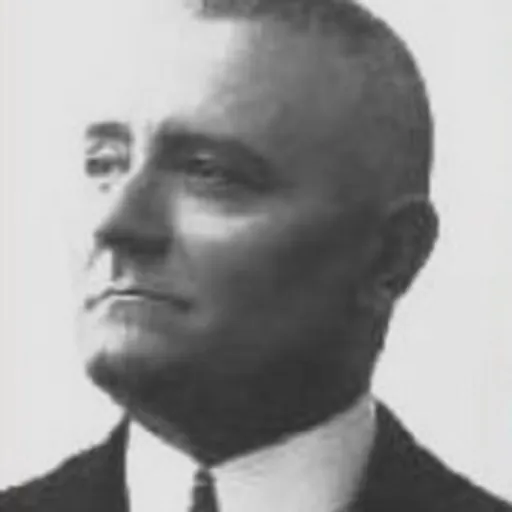
About Cesare Mori
Lived 1871 – 1942 (aged 70). Cesare Mori was an Italian politician and police officer.
Cesare Mori (; 22 December 1871 – 5 July 1942) was a prefect (prefetto) before and during the Italian Fascism period. He is known in Italy as the "Iron Prefect" (Prefetto di Ferro) because of his iron-fisted campaigns against the Sicilian Mafia in the second half of the 1920s. The 1977 film I Am the Law, directed by Pasquale Squitieri, is about his fight against the Mafia when he was prefect in Sicily. Mori is also known for being the first to ever destroy the influence of the Mafia within Italy.
Early years Mori was born in Pavia in Lombardy and grew up in an orphanage and was only recognised by his natural parents in October 1879 at the age of seven. He studied at the Turin Military Academy; however, he married a girl, Angelina Salvi, who did not have the dowry stipulated by military regulations of the time, and had to resign. He joined the police, serving first in Ravenna, then Castelvetrano in the province of Trapani (Sicily) – where he made his name capturing the bandit Paolo Grisalfi – before moving to Florence in 1915 as vice-quaestor.
At the end of the First World War, the situation of Sicilian criminality got worse when war veterans joined gangs of bandits. In 1919 Mori was sent back to Sicily as the head of special forces against brigandage. In his roundups, Mori distinguished himself for his energetic and radical methods. At Caltabellotta he arrested more than 300 people in one night. The press wrote of a "lethal blow to the Mafia", but Mori said to a member of his staff :
These people haven't understood yet that brigands and the Mafia are two different things. We have hit the first, who are undoubtedly the most visible aspect of Sicilian criminality, but not the most dangerous one. The true lethal blow to the Mafia will be delivered when we are able to make roundups not only among Prickly Pears, but in prefectures, police headquarters, employers' mansions, and why not, some ministries.
Appointed in Sicily His reputation as a man of action caused his recall to active service in 1924 by the Minister of the Interior, Luigi Federzoni. In the same year, Mori joined the Fascist Party. He was next appointed prefect of Trapani. Arriving in June 1924, he stayed there until 20 October 1925, when Mussolini appointed him prefect of Palermo, with special powers over the entire island of Sicily and the mission of eradicating the Mafia by any means possible. In a telegram Mussolini wrote to Mori:
Your Excellency has carte blanche, the authority of the State must absolutely, I repeat absolutely, be re-established in Sicily. Should the laws currently in effect hinder you, that will be no problem, we shall make new laws.
Mussolini's drive against the Mafia, the story goes, followed an official visit to Sicily in May 1924 during which he felt insulted by the Mafioso Francesco Cuccia, who publicly proclaimed that Mussolini did not need a police escort because the mere presence of Cuccia would protect him. Mussolini felt humiliated and outraged. However, according to scholar Christopher Duggan, the reason was more political rather than personal. The Mafia threatened and undermined his power in Sicily, and a successful campaign would strengthen him as the new leader, thus legitimising and strengthening his rule.
Fight against the Mafia
Mori took up his post in Palermo in November 1925 and remained in office until 1929. Within the first two months he arrested over five hundred men, a number that would only grow in the following years. In January 1926, he undertook what was probably his most famous action, the occupation of the village of Gangi, a stronghold of various criminal gangs. Using carabinieri and police forces he ordered house-to-house searches, picking up bandits, small-time Mafia members and various suspects who were on the run. Due to the necessity of the nature of the mafia, he was forced to discreetly collect large amounts of evidence and subsequently make arrests en masse to avoid large numbers of mafiosi going into hiding. As he poetically states, "These operations were carried out in considerable numbers and on a large scale: and the rapidity with which they succeeded one another and the exactness of evidence on which they were based completely strangled the criminal associations which for so many years had flourished with impunity. And the whole island chanted a hymn of liberation." These sweeping mass arrests, earned him the nickname of "Iron Prefect".
Mori understood the basis of Mafia power. In order to defeat the phenomenon, he felt it necessary to "forge a direct bond between the population and the state, to annul the system of mediation under which citizens could not approach the authorities except through middlemen..., receiving as a favour that which is due them as their right." Mori's methods were sometimes similar to those of the Mafia. He did not just arrest the bandits, but sought to humiliate them as well. If he could display a strong central authority to rival the Mafia, people would see that the Mafia was not their only option for protection. That led to massive amounts of paperwork in order to prepare for the trials, which may have been partially responsible for his dismissal. Mussolini had already nominated Mori as a senator in 1928, and in June 1929 he was relieved of his duties. The Fascist propaganda proudly announced that the Mafia had been defeated.
Final years As a senator, Mori continued to follow Sicilian affairs closely, and made sure he was always well informed; but he no longer had much political influence. He wrote his memoirs in 1932. Five years later he openly expressed concerns about Mussolini's new alliance with Adolf Hitler, and was isolated inside the Fascist Party from that time on. He retired to Udine in 1941 (though he never formally left the senate), and he died in Udine one year later. By this stage he was a largely forgotten figure in a country preoccupied with the Second World War.
Impact At the time and since, the general perception was that Mori had smashed the Mafia. Sicily's murder rate sharply declined in the early 1930s. The Mafia pentito Antonio Calderone said that Mori's crackdown had hit the Mafia hard. Some Mafiosi escaped and moved abroad (especially to the United States), such as Joseph Bonanno. Other Mafiosi remained in Sicily and either turned over their fellow Mafiosi (or low-level bandits) to the police or simply went quiet and sought accommodation with the Fascist authorities until the end of the regime in Italy.
With the invasion of Sicily in 1943 and the collapse of the Fascist regime, the Mafia re-established itself, sometimes with the help or ignorance of the Allied Military Government of Occupied Territories (AMGOT). AMGOT needed the support of local elites in order to govern. Because of their local authority, their record of persecution under the Fascist regime, and their willingness to cooperate with the Allies, noted Mafiosi, such as Calogero Vizzini and Giuseppe Genco Russo, were appointed to head local administrations in many of the towns in western Sicily.
The neo-fascist politician Giorgio Almirante wrote in Il Borghese in the 1970s that Sicilian society was really transformed by the full destruction of the Mafia in the 1930s, but the destruction of World War II and the imposition of "antifascism", which criticised everything achieved by Fascism, even against mafiosi, together with the return of the (Allies-sponsored) Mafia bosses, who had taken refuge in the United States, was responsible for the Mafia's resurgence in postwar Sicily.
Some 21st-century writers questioned the effectiveness and value of the methods used by Mori against the Mafia. While his methods were certainly effective, at least in the short term, Timothy Newark has written that they mainly targeted the small-time criminals of Sicily and left the big-timers, the real Mafia bosses, relatively unscathed, which drove the Mafia underground but failed to stamp it out. Judith Chubb says, "Fascism succeeded in stamping out the Mafia as a criminal organization by providing a more efficient substitute. It succeeded in monopolizing political power and the use of violence without, however, transforming the social and economic conditions in which the Mafia had flourished. It was thus no surprise that the Mafia re-emerged as soon as Fascism fell." Mori's campaign against the Mafia was the subject of a 1977 film, Il prefetto di ferro, directed by Pasquale Squitieri, starring Giuliano Gemma and Claudia Cardinale, with music by Ennio Morricone. In 2012, the Italian public broadcaster RAI produced Cesare Mori - Il prefetto di ferro.
Autobiography Mori, Cesare (1933), The last struggle with the Mafia, London/New York: Putnam
Don’t just read it —
keep it.
Full-length biographies made to live with: read them, listen on the way to work, watch them tonight.
- E-book
- Audio
- Video
Instant download · yours to keep · every purchase keeps this site free
Important facts
People in Cesare Mori's life
Named in this biography and alive at the same time





Related people
Same field, nearest in time





Contemporaries
People whose lives overlapped Cesare Mori's


Frequently asked questions
Who was Cesare Mori?
Italian prefect and politician (1871-1942)
When was Cesare Mori born?
Cesare Mori was born on 22 December 1871 in Pavia.
When did Cesare Mori die?
Cesare Mori died on 5 July 1942 in Udine.
What was Cesare Mori's occupation?
Cesare Mori was a politician and police officer.
What nationality was Cesare Mori?
Cesare Mori was Italian.
Sources & further reading
Cite this page
APA: Biography.guide. (2026). Cesare Mori. https://biography.guide/cesare-mori/
MLA: "Cesare Mori." Biography.guide, https://biography.guide/cesare-mori/.
Chicago: "Cesare Mori." Biography.guide. https://biography.guide/cesare-mori/.
Data last updated: 2026-09-21 · Spot an error? Report a correction.
Portrait: Wikimedia Commons · author & licence
Page generated 2026-09-27 05:00 UTC