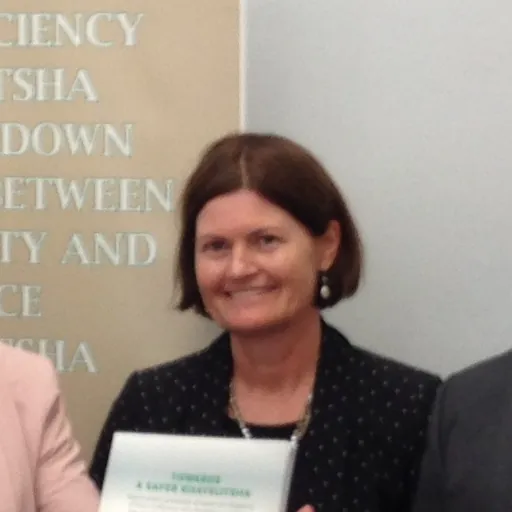
About Catherine O’Regan
Born 1957. Catherine O’Regan is a South African lawyer, university teacher, judge and jurist.
Catherine "Kate" O'Regan (born 17 September 1957) is a former judge of the Constitutional Court of South Africa. From 2013 to 2014 she was a commissioner of the Khayelitsha Commission and is now the inaugural director of the Bonavero Institute of Human Rights at the University of Oxford.
Early life
O'Regan was born in Liverpool, England, into a large Catholic family of Irish immigrants. She moved to Cape Town when she was seven. Her mother was a dentist and her father was a doctor. The upper campus of the University of Cape Town, where O'Regan studied for five years, worked as a lecturer at the start of her career, and is now an honorary professor. O'Regan studied at the University of Cape Town from 1975 to 1980, earning a B.A. and LL.B. She was taught briefly by Arthur Chaskalson, who had recently founded the Legal Resources Centre, and ran UCT's legal aid project, working with Mahomed Navsa of the University of the Western Cape. on land claims legislation, working with Geoff Budlender, Aninka Claassens and Derek Hanekom; and served as a trustee of the Legal Resources Centre Trust. She and Yvonne Mokgoro were the only female judges on the Court for its first 13 years.
O'Regan's first majority judgment was S v Bhulwana; S v Gwadiso, where the Court for the first time suspended an order of constitutional invalidity. In 1998, she co-authored Fedsure Life Assurance Ltd v Greater Johannesburg Transitional Metropolitan Council, the Court's founding judgment on the rule of law and legality review. The first major judgment of which she was the sole author was Premier, Mpumalanga, still the leading authority on the doctrine of legitimate expectations (on which O'Regan also wrote in Ed-U-College, again in the context of the government's withdrawal of school subsidies). O'Regan's judgment in Dawood v Minister of Home Affairs, delivered in 2000, established for the first time that the right to family life is constitutionally protected and that the conferral of broad discretionary powers on government officials can be unconstitutional. But by far her most-cited contribution to administrative law is her 2004 judgment in Bato Star v Minister of Environmental Affairs and Tourism, which sets out South African law's approach to reasonableness review and judicial deference.
O'Regan's judgment in ACDP v Electoral Commission, dealing with the African Christian Democratic Party's application to contest the 2006 local government elections, introduced the doctrine of substantial compliance into South African law. Her judgment in Richter v Minister of Home Affairs, also on political rights, extended the right to vote to South African citizens living abroad.
O'Regan wrote several judgments on labour law, in which she had specialised as an attorney and academic. She wrote two judgments—one in 1999 and one in 2007—in the ongoing litigation between the South African National Defence Union and the South African National Defence Force, as well as NUMSA v Bader Bop, a judgment dealing with the subject of her PhD thesis: the right to strike. Her 2001 judgment on the relationship between administrative law and labour law, Fredericks v MEC for Education and Training, Eastern Cape, has effectively been overturned —to almost unanimous disapproval by commentators. In Sidumo v Rustenburg Platinum Mines Ltd, O'Regan wrote separately to emphasise, in agreement with the majority judgment of Navsa AJ, her law-clinic colleague of thirty years earlier, that administrative law applies to labour law disputes.
In the law of delict, O'Regan's contribution has been significant. In 2002, she wrote Khumalo v Holomisa, one of the Court's first judgments on defamation law and arguably its only judgment applying the Bill of Rights directly to private parties. In 2004, she delivered the Metrorail judgment, which holds that Metrorail has a duty to ensure the safety of commuters on its trains and is regarded as an "exemplar" by international commentators for its protection of the right to personal security. And in 2005, most famously, O'Regan gave judgment in K v Minister of Safety and Security, finding the state liable to compensate a plaintiff who was raped by a police officer. The judgment's radical expansion of the test for vicarious liability, following Bazley v Curry and Lister v Hesley Hall Ltd, was celebrated by women's rights groups but criticised by some academics. It has been approved and applied by the Court subsequently. The judgment is also still cited for its approach to the development of the common law and the use of comparative law. Finally, in Steenkamp NO v Provincial Tender Board, another case on the delictual liability of public authorities, O'Regan co-wrote a dissent (with Langa CJ) that would have held the state liable for pure economic loss caused to the winner of an unlawfully awarded tender.
In discrimination law, O'Regan co-authored Prinsloo v Van der Linde, which established the connection between the right to equality and dignity, and penned a unanimous judgment in the 2003 follow-up to Satchwell v President of the Republic of South Africa. Better known are her two dissents. In Minister of Home Affairs v Fourie, she strongly criticised the majority for referring the regulation of same-sex marriage to Parliament rather than providing immediate relief. And her dissent in the earlier S v Jordan (co-authored with Sachs J) held that the criminalisation of sex work (and not its solicitation) unfairly discriminates on the basis of gender and is therefore unconstitutional.
O'Regan's fifteen-year term ended in October 2009. Her last judgment for the Court, Mazibuko v City of Johannesburg, on the right to water, proved highly controversial. For some, it was a perceptively restrained summation of the Court's socio-economic rights jurisprudence; for others, it was a "disappointing" and "profoundly conservative" failure by the Court to come to the aid of South Africa's poorest communities.
Nevertheless, O'Regan was hailed on her retirement as a "stalwart" of the Court, "among its most industrious, as well as progressive, members". In the view of Johann Kriegler, her long-standing colleague, she was "the most outstanding success of the Constitutional Court". Edwin Cameron has said she is "one of the finest minds ever appointed as a judge in South Africa". After O'Regan retired, along with Pius Langa, Yvonne Mokgoro and Albie Sachs, these four founding members of the Court were replaced by President Jacob Zuma's first raft of senior judicial appointees. This significant change in the Court's composition was seen by some as marking the start of its decline.
Acting DCJ
From February to May 2008, O'Regan acted as Deputy Chief Justice in the absence of Dikgang Moseneke. This perceived capitulation by the ruling African National Congress to pressure from China was widely condemned, including by then Minister of Health Barbara Hogan. O'Regan also spoke out, publicly agreeing with Hogan and expressing her "dismay" that "human rights does not seem to enter into the picture of some foreign affairs decisions that are made". O'Regan was heavily criticised by the government and the Black Lawyers Association, which threatened to lay a misconduct complaint against her for "concern[ing] herself with politics". She has four honorary doctorates (from the University of KwaZulu-Natal, University of Cape Town, London School of Economics and University of South Africa), is an honorary bencher of Lincoln's Inn and was elected an honorary foreign member of the American Academy of Arts and Sciences. In addition, she served as the president of the International Monetary Fund Administrative Tribunal and a member of the World Bank Sanctions Board.
O'Regan consistently criticised the slow pace of gender transformation in the South African judiciary.
Personal life
O'Regan is married to advocate Alec Freund SC. They have two children.
Don’t just read it —
keep it.
Full-length biographies made to live with: read them, listen on the way to work, watch them tonight.
- E-book
- Audio
- Video
Instant download · yours to keep · every purchase keeps this site free
Important facts
People in Catherine O’Regan's life
Named in this biography and alive at the same time





Related people
Same field, nearest in time



Contemporaries
People whose lives overlapped Catherine O’Regan's



Frequently asked questions
Who is Catherine O’Regan?
South African lawyer
When was Catherine O’Regan born?
Catherine O’Regan was born on 17 September 1957 in Liverpool.
What is Catherine O’Regan's occupation?
Catherine O’Regan is a lawyer, university teacher, judge and jurist.
What nationality is Catherine O’Regan?
Catherine O’Regan is South African.
Sources & further reading
· Wikipedia: Catherine O’Regan
Cite this page
APA: Biography.guide. (2026). Catherine O’Regan. https://biography.guide/catherine-oregan/
MLA: "Catherine O’Regan." Biography.guide, https://biography.guide/catherine-oregan/.
Chicago: "Catherine O’Regan." Biography.guide. https://biography.guide/catherine-oregan/.
Data last updated: 2026-09-20 · Spot an error? Report a correction.
Page generated 2026-09-27 05:09 UTC