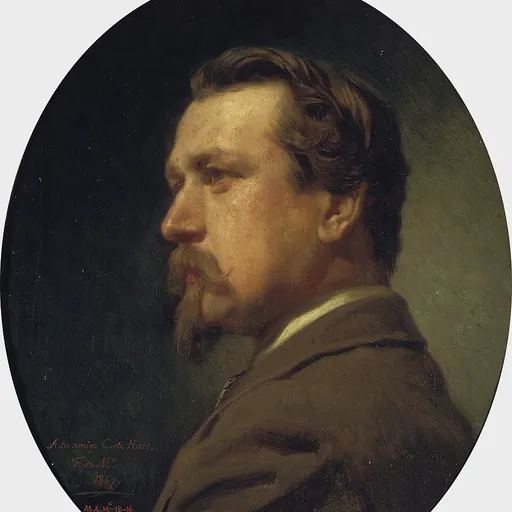
About Carlos de Haes
Lived 1826 – 1898 (aged 72). Carlos de Haes was a Spanish and Belgian painter, university teacher, graphic artist, artist, printmaker and draftsperson.
Carlos Sebastián Pedro Hubert de Haes (January 25, 1829 – June 17, 1898) was a Spanish painter from Belgium. He was noted for the Realism in his landscapes, and was considered to be the "first contemporary Spanish artist able to capture something of a particularly Spanish 'essence' in his work".
In the 1850s, Haes was involved in the rise of the Realist school of landscape. Coincidentally his landscape and wildlife paintings of the Monasterio de Piedra occurred at the time of an academic opening for the Painting School of the Real Academia de Bellas Artes de San Fernando, the selection to be made by a landscape competition. In 1857 he became the first professor of landscape painting, the first in Spain to teach painting directly from nature. In 1860, he became an Academic at the Royal Academy. In 1876, he presented at the National Exhibition with La Canal de Mancorbo en los Picos de Europa ("The Canal of Mancorbo in the Picos de Europa") later acquired by the Spanish state to be part of the collection of the Museo del Prado, because of its significance as a realistic Spanish landscape painting.
Early years Haes was born in Brussels to a family of bankers. In 1850, Haes decided to continue his art training by studying with the great Flemish landscape masters. His encounter with Joseph Quinaux, who mentored Haes from 1850 through 1855, influenced his painting outdoors, and defined his artistic works as a whole. In Brussels, he came in contact with other notable European painters at the annual exhibition of the Brussels Salon. He traveled throughout Holland, France, and Germany. It was coincidental that Haes' landscape and wildlife paintings of the Monasterio de Piedra occurred at the time of an academic opening for the Painting School of the Real Academia de Bellas Artes de San Fernando, the selection to be made by a landscape competition. He received the academic appointment in 1857, becoming professor of landscape painting, and becoming the first in Spain to teach painting directly from nature. Among his students were Jaime Morera, Aureliano de Beruete, and Darío de Regoyos. Haes took his students with him to paint in the countryside; under his teaching the "painters proliferated and took advantage of the new railway system to explore the furthest corners of the nation's topography." He influenced the Spanish novelist, Azorín, who perfected his writing technique by repeatedly viewing Haes' works at the museum. In 1860, he became an Academic at the Royal Academy, Though it did not win a prize, it was acquired by the Spanish state to be part of the collection of the Museo del Prado, because of its significance as a realistic Spanish landscape painting. working from outdoor preparatory sketches which were completed within a workshop. In terms of technique, his strokes have Impressionists connotations, though he lacks the treatment of light and color, and moves away from the spontaneity and immediacy of this art movement. Towards the end of his career, he developed a looser and more direct style associated with the Barbizon school. The best of his extensive work (four thousand pictures and notes) can be seen in the Carmen Thyssen Museum in Málaga, the Lleida Museum, and the Museo del Prado, which received 183 works of Haes which were donated by the Museum of Modern Art. His work has been documented by the likes of Rubén Darío.
Don’t just read it —
keep it.
Full-length biographies made to live with: read them, listen on the way to work, watch them tonight.
- E-book
- Audio
- Video
Instant download · yours to keep · every purchase keeps this site free
Important facts
more
Carlos Sebastian Pedro Humberto de Haes, Carolus Sebastianus Petrus Hubertus Haes, Carlos Sebastián Pedro Humberto DeHaes, Carlos DeHaesPeople in Carlos de Haes's life
Named in this biography and alive at the same time


Related people
Same field, nearest in time

Contemporaries
People whose lives overlapped Carlos de Haes's




Frequently asked questions
Who was Carlos de Haes?
Spanish painter from Belgium (1826-1898)
When was Carlos de Haes born?
Carlos de Haes was born on 27 January 1826 in Brussels.
When did Carlos de Haes die?
Carlos de Haes died on 17 June 1898 in Madrid.
What was Carlos de Haes's occupation?
Carlos de Haes was a painter, university teacher, graphic artist, artist, printmaker and draftsperson.
What nationality was Carlos de Haes?
Carlos de Haes was Spanish and Belgian.
Sources & further reading
Cite this page
APA: Biography.guide. (2026). Carlos de Haes. https://biography.guide/carlos-de-haes/
MLA: "Carlos de Haes." Biography.guide, https://biography.guide/carlos-de-haes/.
Chicago: "Carlos de Haes." Biography.guide. https://biography.guide/carlos-de-haes/.
Data last updated: 2026-09-24 · Spot an error? Report a correction.
Portrait: Wikimedia Commons · author & licence
Page generated 2026-09-27 05:08 UTC