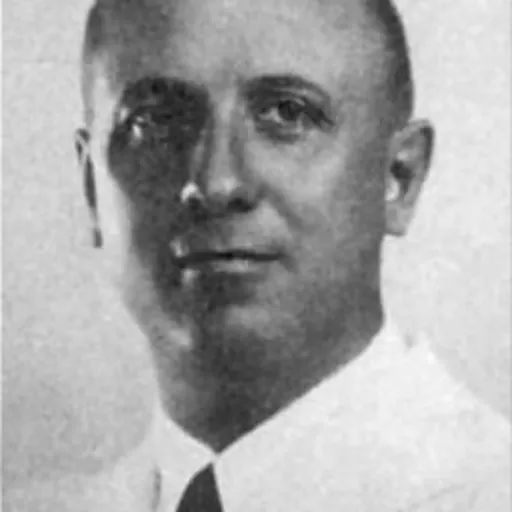
About Carlo Tiengo
Lived 1892 – 1945 (aged 53). Carlo Tiengo was an Italian politician.
Carlo Tiengo (1 April 1892 – 11 May 1945) was an Italian Fascist politician and civil servant, Minister of Corporations of the Kingdom of Italy from February to April 1943 and member of the Chamber of Fasces and Corporations. He also served as prefect in several Italian cities, including Trieste, Milan and Turin.
Biography
He was born in Adria in 1892, the son of Giovanni Battista Tiengo and schoolteacher Velia Gusella. In his youth he was one of the founders of the Green Cross of Adria and graduated in Law at the University of Padua, where he became part of an irredentist group called "San Giusto Battalion". He took part in the First World War with the rank of captain, earning a Silver Medal of Military Valor for the capture of an enemy outpost on Monte Asolone (Monte Grappa massif) in January 1918. Of republican ideas, he frequented the socialist-republican circles in Adria for some time, together with Giovanni Marinelli, but after attending a rally held by Benito Mussolini while finding himself by chance in Milan, he joined the Italian Fasces of Combat in April 1921. He then led the "action squads" in Polesine and took part in the March on Rome at the head of the "Polesana" Legion. For a short time, from January to March 1925, he was a member of the federal secretariat of the National Fascist Party of Rovigo, and following the establishment of the Voluntary Militia for National Security, he joined it, reaching the rank of console generale (brigadier general).
On 16 December 1926 Tiengo was appointed second class prefect, after which he was made prefect of Sondrio from 16 December 1926 to 16 September 1927, and later of Piacenza from 16 September 1927 to 16 December 1930. In January 1931 he was called to lead the prefecture of Gorizia, being promoted to first class prefect on 16 October 1932, and from 16 January 1933 to 31 July 1936 he served as prefect of Trieste. During his tenure in Gorizia he clashed with the elderly Slovenian archbishop of Gorizia Francesco Borgia Sedej, and later with the bishop of Trieste, Luigi Fogar; both bishops had formed during the years of the Habsburg empire and were therefore viewed with suspicion by the Fascist regime, especially because of their open opposition to the policy of Italianization. This led to negotiations between state and church that in October 1936 resulted in the resignation of Fogar, who was transferred to Rome, where he was appointed titular archbishop of the Archdiocese of Patras and assigned to the basilica of San Giovanni in Laterano. Tiengo, in the meantime, was transferred to the prefecture of Bologna on 1 August 1936, but only held the post for two weeks before being appointed prefect of Turin, replacing the previous prefect who had come into conflict with the federal secretary of the local section of the Fascist Party, Piero Gazzotti. Tiengo held until 1 February 1941.
In February 1941 he was appointed prefect of Milan, replacing Giovanni Battista Marziali; he held this post until 7 February 1943. In the same period he was also a member of the Chamber of Fasces and Corporations; after holding various positions at the top of the administration of the state and the ranks of the regime, in February 1943 he was appointed Minister of Corporations, thus becoming a member of the Grand Council of Fascism. He resigned for health reasons after two months, after which he was placed at the disposal of the Ministry of Finance, with the post of Commissioner for Paper and Cellulose and then of President of the National Institute for Consumption Tax Management. He retired for health reasons in August 1943.
Don’t just read it —
keep it.
Full-length biographies made to live with: read them, listen on the way to work, watch them tonight.
- E-book
- Audio
- Video
Instant download · yours to keep · every purchase keeps this site free
Important facts
People in Carlo Tiengo's life
Named in this biography and alive at the same time


Related people
Same field, nearest in time






Contemporaries
People whose lives overlapped Carlo Tiengo's






Frequently asked questions
Who was Carlo Tiengo?
Italian politician (1892–1945)
When was Carlo Tiengo born?
Carlo Tiengo was born on 1 April 1892 in Adria.
When did Carlo Tiengo die?
Carlo Tiengo died on 11 May 1945 in Paullo.
What was Carlo Tiengo's occupation?
Carlo Tiengo was a politician.
What nationality was Carlo Tiengo?
Carlo Tiengo was Italian.
Sources & further reading
Cite this page
APA: Biography.guide. (2026). Carlo Tiengo. https://biography.guide/carlo-tiengo/
MLA: "Carlo Tiengo." Biography.guide, https://biography.guide/carlo-tiengo/.
Chicago: "Carlo Tiengo." Biography.guide. https://biography.guide/carlo-tiengo/.
Data last updated: 2026-09-23 · Spot an error? Report a correction.
Portrait: Wikimedia Commons · author & licence
Page generated 2026-09-27 05:07 UTC