About Carl Borromäus Andreas Ruthart
Lived 1630 – 1703 (aged 72–73). Carl Borromäus Andreas Ruthart was a German painter, monk, engraver, christian minister, artist and printmaker.
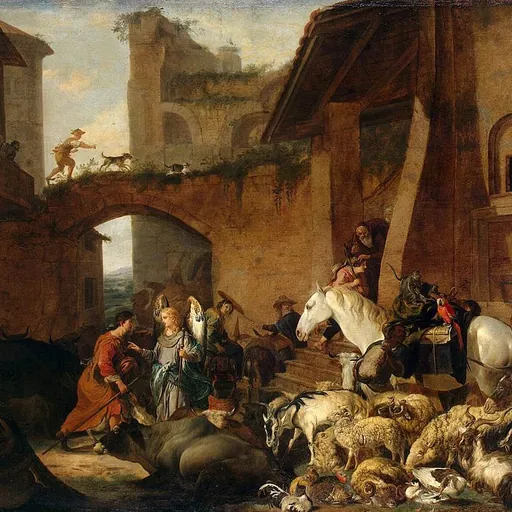
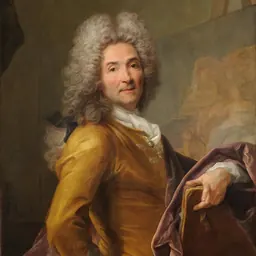
Carl Borromäus Andreas Ruthart (1630 – c. 1703; also known as Carl Ruther and Karl Ruthard; in Italian as Carlo Borromeo Rutardo) was a German painter who spent most of his career in Italy. During the last years of his life, he was referred to as Frà Andrea. He considered himself to be a follower of Peter Paul Rubens.
Biography He was born in Danzig. Around 1650, he was an apprentice of Daniel Schultz. From 1663 to 1664, he was a Guild Master in Antwerp. In the late 1660s, he passed through Regensburg on his way to Vienna, where he stayed for two years. Initially, he was an animal painter and specialized in depicting predators; especially the large cats, with harsh background scenes. Such paintings were very popular in Germany at the time. He also collaborated with Wilhelm Schubert van Ehrenberg, adding animals to his landscapes.
After moving to Italy, around 1672, Ruthart turned to painting sacred subjects, beginning with decorations for the choir at the Church of Sant'Eusebio in Rome.
He eventually settled in L'Aquila, impressed by the rite of the Celestinian Forgiveness, which was instituted by Pope Celestine V in the 13th century. So much so, that he became a Celestine monk and took the name Frà Andrea. He would spend the rest of his life in the convent at the Basilica of Santa Maria di Collemaggio.
While there, he painted four large canvases depicting the life of Pope Celestine, all of which, in keeping with his earlier specialty, included animals. This time however, they are shown being tamed. He did a similar series on Saint Bernardino of Siena which is preserved at the Museo Nazionale d'Abruzzo.
He also did four portrait paintings for the Palazzo del Municipio in Chieti depicting Pope Celestine, Braccio da Montone, Saint Benedict and Charles of Anjou. A painting by Ehrenburg, Ulysses in Circe's Palace, which includes animals by Ruthart, is at the Getty Center in Los Angeles. Ruthart died in L'Aquila c. 1703.
Don’t just read it —
keep it.
Full-length biographies made to live with: read them, listen on the way to work, watch them tonight.
- E-book
- Audio
- Video
Instant download · yours to keep · every purchase keeps this site free
Important facts
more
Carl Ruthart, karl ruthart, C. Roethaert, Roethaert, k. b. a. ruthart, Ruttaert, c. b. a. ruthart, karl b. andreas ruthart, Routard, Carl Ruthards, Charles Ruthart, Roctard, Carl Ruthard, a. ruthart, Carel Roetaard, karl andreas ruthart, Ruthardt, Roetaert, Rotart, Ruthart, Roetard, Rotaert, k. ruthart, RoatPeople in Carl Borromäus Andreas Ruthart's life
Named in this biography and alive at the same time



Related people
Same field, nearest in time


Contemporaries
People whose lives overlapped Carl Borromäus Andreas Ruthart's





Frequently asked questions
Who was Carl Borromäus Andreas Ruthart?
German painter (1630-1703)
When was Carl Borromäus Andreas Ruthart born?
Carl Borromäus Andreas Ruthart was born in 1630 in Gdańsk.
When did Carl Borromäus Andreas Ruthart die?
Carl Borromäus Andreas Ruthart died in 1703 in L'Aquila.
What was Carl Borromäus Andreas Ruthart's occupation?
Carl Borromäus Andreas Ruthart was a painter, monk, engraver, christian minister, artist and printmaker.
What nationality was Carl Borromäus Andreas Ruthart?
Carl Borromäus Andreas Ruthart was German.
Sources & further reading
· Wikipedia: Carl Borromäus Andreas Ruthart
· DBpedia: Carl Borromäus Andreas Ruthart
Cite this page
APA: Biography.guide. (2026). Carl Borromäus Andreas Ruthart. https://biography.guide/carl-borromaus-andreas-ruthart/
MLA: "Carl Borromäus Andreas Ruthart." Biography.guide, https://biography.guide/carl-borromaus-andreas-ruthart/.
Chicago: "Carl Borromäus Andreas Ruthart." Biography.guide. https://biography.guide/carl-borromaus-andreas-ruthart/.
Data last updated: 2026-09-22 · Spot an error? Report a correction.
Portrait: Wikimedia Commons · author & licence
Page generated 2026-09-27 05:03 UTC