
About Wilhelm Schubert van Ehrenberg
Lived 1630 – 1676 (aged 45–46). Wilhelm Schubert van Ehrenberg was a painter.
Wilhelm Schubert van Ehrenberg or Willem Schubart van Ehrenberg (also: Wilhem Schubert von Ehrenberg or Wilhem Schubert van Ehrenberg (Antwerp, 1630 or 1637– Antwerp, c. 1676) was a Flemish painter mainly active in Antwerp who specialized in architectural paintings including of real and imaginary church interiors, Renaissance palaces and picture galleries.
Life Most likely born in Antwerp where his baptism is recorded on 12 May 1630 (despite an unnamed source stating he was born in Germany), he entered the Antwerp Guild of Saint Luke in 1662. He resided in Antwerp for most of his life. His interiors of St. Peter's Basilica and other Roman subjects, are, however, based on engravings by contemporary artists, some of which are datable to the period between 1656 and 1667. An Italian sejourn may therefore not have occurred and is unlikely in view of his documented presence in Antwerp. He did visit France and resided in Reims in the period from March to May 1673 as he declared in a notarial statement made in Antwerp 16 months later together with Remacle Serin that they had met and socialised with the Flemish painter Anthoni Schoonjans in Reims. emphasize the Baroque architecture of the space depicted, but are more artificial than his Dutch Golden Age contemporaries such as Pieter Jansz Saenredam or Emanuel de Witte.
Of particular interest are a set of paintings representing the Seven Wonders of the World such as the Mausoleum of Halicarnassus and The Temple of Diana at Ephesus (both in the Musée Henri Dupuis Saint-Omer) and the two paintings of ruined tombstones (both in Oxford College Anon II, University of Oxford).
Gallery paintings
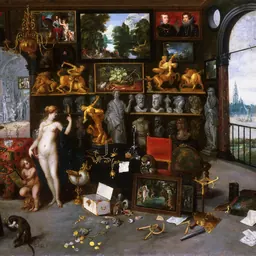
Wilhelm Schubert van Ehrenberg worked also in the genre of the 'gallery paintings'. The 'gallery paintings' genre is native to Antwerp where Frans Francken the Younger and Jan Brueghel the Elder were the first artists to create paintings of art and curiosity collections in the 1620s. Gallery paintings depict large rooms in which many paintings and other precious items are displayed in elegant surroundings. The earliest works in this genre depicted art objects together with other items such as scientific instruments or peculiar natural specimens. The genre became immediately quite popular and was followed by other artists such as Jan Brueghel the Younger, Cornelis de Baellieur, Hans Jordaens, David Teniers the Younger, Gillis van Tilborch and Hieronymus Janssens. The art galleries depicted were either real galleries or imaginary galleries, sometimes with allegorical figures.
An example of van Ehrenberg's work in this genre is the Interior of an art collector's cabinet with many visitors (Musée Girodet, Montargis). This is a collaboration with Gaspar de Witte and Hieronymus Janssens. The composition depicts an imaginary art gallery with many visitors who are appreciating and discussing some of the artworks in the gallery. This gallery painting represents a later development in the genre initiated by David Teniers the Younger, which excludes non-art objects from the gallery. The figures in the gallery painting are portrayed as forming part of an elite who possess privileged knowledge of art. The genre of gallery paintings had by that time become a medium to accentuate the notion that the powers of discernment associated with connoisseurship are socially superior to or more desirable than other forms of knowing. Other such collaborations between multiple Antwerp painters on picture gallery paintings are recorded. Another example is Jacob de Formentrou's Cabinet of pictures (also known as Art lovers in a painting cabinet), part of the collection of the Royal Collection. Such paintings can be read as a reference to connoisseurship, and in particular the connoisseur's activity of evaluating the authorship of paintings based on stylistic characteristics. It can also be regarded as a carefully crafted advertisement of the present talent and past legacy of the Antwerp school of painting.
Don’t just read it —
keep it.
Full-length biographies made to live with: read them, listen on the way to work, watch them tonight.
- E-book
- Audio
- Video
Instant download · yours to keep · every purchase keeps this site free
Important facts
more
Wilhelm Schubert van Aerdenberg, Wilhelm van Eerenberch, Wilhelm van Herdenberg, Erinbourgh, Wilhelm Schubart von Ehrenberg, Wilhelm Schubert van Herdenberg, Harenberg, Willem van Ehrenberg, Van Ehrenberg, Guilleaume van Aerdenbergh, Van Erhenberg, Willem Schubert Van Ehrenberg, Schubert van Ehrenberg, Wilhelm van Aerdenberg, EarenbergPeople in Wilhelm Schubert van Ehrenberg's life
Named in this biography and alive at the same time







Related people
Same field, nearest in time

Contemporaries
People whose lives overlapped Wilhelm Schubert van Ehrenberg's




Frequently asked questions
Who was Wilhelm Schubert van Ehrenberg?
Flemish painter (1630–1676)
When was Wilhelm Schubert van Ehrenberg born?
Wilhelm Schubert van Ehrenberg was born on 12 May 1630 in Antwerp.
When did Wilhelm Schubert van Ehrenberg die?
Wilhelm Schubert van Ehrenberg died in 1676 in Antwerp.
What was Wilhelm Schubert van Ehrenberg's occupation?
Wilhelm Schubert van Ehrenberg was a painter.
What nationality was Wilhelm Schubert van Ehrenberg?
Wilhelm Schubert van Ehrenberg's recorded nationality: Habsburg Netherlands.
Sources & further reading
· Wikipedia: Wilhelm Schubert van Ehrenberg
· DBpedia: Wilhelm Schubert van Ehrenberg
Cite this page
APA: Biography.guide. (2026). Wilhelm Schubert van Ehrenberg. https://biography.guide/wilhelm-schubert-van-ehrenberg/
MLA: "Wilhelm Schubert van Ehrenberg." Biography.guide, https://biography.guide/wilhelm-schubert-van-ehrenberg/.
Chicago: "Wilhelm Schubert van Ehrenberg." Biography.guide. https://biography.guide/wilhelm-schubert-van-ehrenberg/.
Data last updated: 2026-09-20 · Spot an error? Report a correction.
Page generated 2026-09-27 05:33 UTC