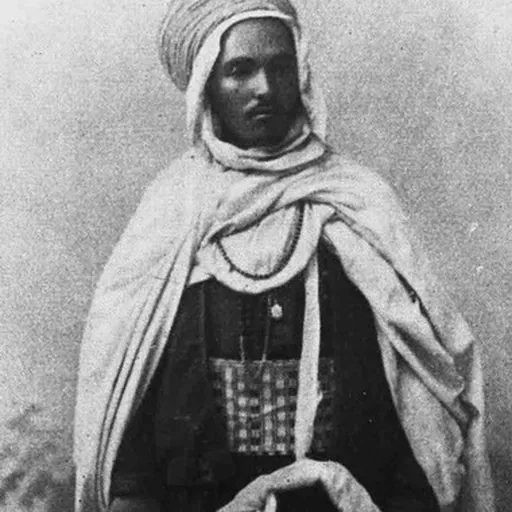
About Bou Hmara
Lived 1860 – 1909 (aged 48–49). Bou Hmara was a politician.
Jīlālī ibn Idrīs al-Yūsufī al-Zarhūnī (; c. 1860 – 1909), commonly known as El Rogui, El Roghi or Bou Hmara, was a pretender to the throne of Morocco in the period 1902–1909, during the reign of Abdelaziz and Abd al-Hafid.
Name His given name was Jilali ibn Idris al-Yusufi al-Zarhuni deriving from his birthplace being the village Ouled Youssef in the Zerhoun area near Fes. It is alternatively written as Djilali ben Driss Zerhouni el Youssefi. Alternatively, his name is given as Omar ez-Zarhouni.
He was known as El Rogui ( ar-Ruqī) meaning "the pretender".
He was also known by his opponents by the nickname Bou Hmara ( Bū Ḥmāra)—also spelled Bu Himara, Bou Hamara or Bouhmara — which is the colloquial form of Abū Ḥimāra. According to the historian Edmund Burke III, his name refers to the Moroccan army custom of parading recaptured deserters on the back of a donkey backwards to the amusement of soldiers. Riffians referred to him as Bu Tghyutsh for a similar reason.
Early life Jilali ibn Idris al-Yusufi al-Zarhuni was born in 1865 and was a Jebli peasant or tribesman from an Arab clan known as the Awlad Yusuf which settled near Zerhoun. and studied religion alongside . He trained in Hassan I's student engineer corps (tulba muhandis) studying as a student engineer (talib al-muhandis) in the 1880s. He became a minor makhzen official He was imprisoned in 1894 by the regent Ba Ahmed for forgery.
While ensconced in Taza, he was able to repel all attempts by the Sultan's army to invade his domain. However, by 1909, he had enlarged his area of control, and could not retain the loyalty of all the many different tribes it encompassed. In addition, he had alienated some of these tribes by selling mining concessions to Spanish interests.
By then the Sultan was Moulay Abdelhafid, a more vigorous ruler than Abdelaziz. Abdelhafid first attempted to discredit Bou Hmara by taking the real Moulay Mohammed, who was up until now imprisoned by the Sultan Abdelaziz, to a public mosque; but this caused a near riot and was not repeated. Fearing that Bou Hmara was expanding towards Fes, Abdelhafid sent another army against him, armed with cannon manned by French artillery instructors. During the resulting battle, the cannon were used to shell a religious shrine where Bou Hmara had taken refuge, and he was captured. Bou Hmara was paraded through Fez in a wooden cage and then tortured. He was put in a pit with lions by Abd al-Hafid of Morocco. He died on 12 or 15 September 1909.
Bou Hmara's men were either decapitated on the spot, or taken hostage. It is said that 400 prisoners began the march to Fes but only 160 arrived, the remainder having been ransomed. Once at Fes, one-fifth of the captives were punished at a public mutilation, a hand and opposing foot being cut off (hirabah), and the others imprisoned.
Legacy and reception Bou Hmara as a figure fascinated colonial writers more than his revolt. Because of his sudden rise, personality, ability as a military leader and defiance against the central government, he became a folk hero. The circumstances of his death also exacerbated his legend which persisted in the imagination of Moroccans long after his defeat.
He had a reputation for magic and prestidigitation. He surrounded himself with "a halo of miracles, prophecies and dreams" and is said to have done a number of miracles like his face changing colour three times a day. He attributed this to the claim that he was actually Mawlay Mohammed, the rightful heir to and eldest son of Hassan I.
His campaign exacerbated the makhzen 's financial problems at the time by undermining the sultan's legitimacy and necessitating military expeditions against him.
Don’t just read it —
keep it.
Full-length biographies made to live with: read them, listen on the way to work, watch them tonight.
- E-book
- Audio
- Video
Instant download · yours to keep · every purchase keeps this site free
Important facts
People in Bou Hmara's life
Named in this biography and alive at the same time

Related people
Same field, nearest in time




Contemporaries
People whose lives overlapped Bou Hmara's



Frequently asked questions
Who was Bou Hmara?
Pretender to the throne of Morocco (1860-1909)
When was Bou Hmara born?
Bou Hmara was born in 1860 in Oulad Youssef.
When did Bou Hmara die?
Bou Hmara died on 2 September 1909 in Fez.
What was Bou Hmara's occupation?
Bou Hmara was a politician.
What nationality was Bou Hmara?
Bou Hmara's recorded nationality: Alawi Sultanate.
Sources & further reading
Cite this page
APA: Biography.guide. (2026). Bou Hmara. https://biography.guide/bou-hmara/
MLA: "Bou Hmara." Biography.guide, https://biography.guide/bou-hmara/.
Chicago: "Bou Hmara." Biography.guide. https://biography.guide/bou-hmara/.
Data last updated: 2026-09-24 · Spot an error? Report a correction.
Portrait: Wikimedia Commons · author & licence
Page generated 2026-09-27 05:08 UTC