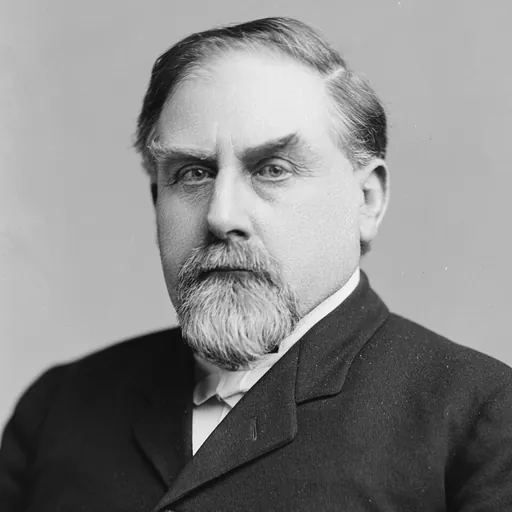
About Binger Hermann
Lived 1843 – 1926 (aged 83). Binger Hermann was an American politician and lawyer.
Binger Hermann (February 19, 1843 – April 15, 1926) was an American attorney and politician in Oregon. A native of Maryland, he immigrated to the Oregon Territory with his parents as part of the Baltimore Colony. Hermann served in both houses of the Oregon Legislative Assembly and as a Republican in the United States Congress.
Hermann served as the Commissioner of the General Land Office for a period of about five years. His written directives known as the Binger Hermann Policy, caused mineral claimants of several lode mining claims (Ex: Lucky Strike Gold Mining Co.) to suffer from what is referred to as "cadastral mayhem" Many locators looking for a cure had to wait until August 8, 1904, when Paragraph 147 of the Mining Circular was revised under the authority of the Act of April 28, 1904.
In 1904, Herman was also caught up in the Oregon land fraud scandal and brought to trial for alleged land fraud. The jury failed to agree and Hermann was never retried. Hermann was posthumously exonerated by the administration of Franklin D. Roosevelt.
Early life
Hermann was born the eldest of eleven children in Lonaconing, Maryland, in 1843 to immigrant parents: Henry Hermann, a German-born physician, and Elizabeth Hopkins, an English immigrant. He graduated from the Independent Academy (later called Irving College) in Manchester, Maryland.
Baltimore Colony
In the late 1850s, a group of Baltimore citizens, including Hermann's father, began to make plans to start a new life in the Oregon Territory. Hermann studied law and was admitted to the Oregon State Bar in 1866. meanwhile Democrats picked up 78 seats in the U.S. House in that election. In 1893, after Oregon was granted another congressional district based on the 1890 census, Hermann continued to serve in Congress, representing Oregon's 1st congressional district.
Hermann did not seek reelection in 1896, and was appointed by President McKinley as Commissioner of the United States General Land Office in Washington, D.C. He soon clashed with Secretary of the Interior Ethan A. Hitchcock over land matters. When Hermann's successor in Congress, Thomas H. Tongue, died in 1903, Hermann resigned his post and returned to run for Tongue's seat.
Mr. C.C. Goodale The U.S. Surveyor General for Colorado in his zeal to comply with the Commissioner's "directive" created mayhem. The new policy was that a prior official survey, in conflict with the mining claim being surveyed, must be shown on the plat in its patented position rather than where the monuments on the ground marked it to be. The policy was not well documented. A brief note on page 117 of James Underhill's book Mineral Land Surveying, 1906:
General Land Office Departmental Letter "N" indexed 2980, dated May 20, 1899, signed by Binger Hermann, Commissioner: The surveys referred to are the Portia, Silver Pine and Edison lodes, Sur. No. 12577, approved August 13, 1898; and the Hood Lode, Sur. No. 540, original survey approved July 24, 1875, amended survey approved March 16, 1881. Note: The Departmental Letter "N" takes the Colorado Surveyor General to task that he does NOT have the authority to "amend an approved survey upon alleged errors therein, reported by another deputy surveyor…" The GLO Commissioner required a careful examination of the two surveys and report, "in full as to what would be the result of an amendment of Sur. No. 12577 so as to locate the Hood, Sur. No.540 as approved… A sketch showing the plat of Sur. No. 12577 as it now exists, and what it would be if it were made to show Sur. No. 540 as patented, would probably best illustrate the possible errors herein suggested."
The 12577 amended Mineral survey is the first survey to suffer from the Cadastral mayhem instilled within the Binger Hermann policy, that being the sanctity of patent descriptions over original, undisturbed monuments or their perpetuations.
Excerpt of United States General Land Office Departmental Letter "N" indexed 3125, dated June 17, 1899. This letter responds to the report submitted by the Colorado Surveyor General (dated June 5, 1899) required in Departmental Letter "N" (indexed 2980). Note: This is the infamous June 17, 1899 GLO Departmental Letter "N" that is the basis of the five+ year policy referred to as the Binger Hermann policy.
Excerpt taken from the annual report prepared by Edward H. Anderson, Utah Surveyor General dated, June 30, 1901: "The Department of Interior holds that courses and distances once incorporated into a patent must be recognized in all subsequent conflicting & adjacent surveys, notwithstanding actual conditions on the ground to the contrary. This means a perpetuation of the error, if any exist, in the former patented survey, and the deputy who makes the latter survey is compelled to falsify his returns to conform to such error. The courts hold that the monuments and markings on the ground govern." Mr. Anderson included the same paragraph in his 1902 and 1903 reports to the GLO Commissioner. Mr. Anderson's statements are a stark reminder that the Binger Hermann policy is Cadastral vandalism of the official field notes, approved plat and patent.
Theoretical exclusions in mineral patents is only one of the two possibilities when patent description positions are held over monumented positions for prior official surveys. The other, which might be more insidious is when there is a true conflict, but the patent fails to exclude the conflict because the conflicting claims patent description position does not conflict. — Certified Federal Surveyors Program (CFedS). Co-administered by the Department of the Interior's Bureau of Land Management and the National Society of Professional Surveyors (NSPS)
Final years
Hermann returned to Roseburg, where he resumed his law practice and engaged in literary pursuits until his death. He was 83 years old at the time of his death.
In June 1943 the Oregon Shipbuilding Company launched its 210th Liberty ship, the Binger Hermann, named after the former Oregon congressman.
Works The Louisiana Purchase and Our Title West of the Rocky Mountains, with A Review of Annexation by the United States. Washington, DC: US Government Printing Office, 1898. "Early History of Southern Oregon," Quarterly of the Oregon Historical Society, vol. 17, no. 1 (March 1918), pp. 52–68. —Address to Oregon Historical Society, October 28, 1917. The Baltimore Colony and Pioneer Recollections. Coos Bay, OR: Baltimore Colony Centennial Committee, 1959.
Don’t just read it —
keep it.
Full-length biographies made to live with: read them, listen on the way to work, watch them tonight.
- E-book
- Audio
- Video
Instant download · yours to keep · every purchase keeps this site free
Important facts
Related people
Same field, nearest in time





Contemporaries
People whose lives overlapped Binger Hermann's

Frequently asked questions
Who was Binger Hermann?
American politician (1843–1926)
When was Binger Hermann born?
Binger Hermann was born on 19 February 1843 in Lonaconing.
When did Binger Hermann die?
Binger Hermann died on 15 April 1926 in Roseburg.
What was Binger Hermann's occupation?
Binger Hermann was a politician and lawyer.
What nationality was Binger Hermann?
Binger Hermann was American.
Sources & further reading
Cite this page
APA: Biography.guide. (2026). Binger Hermann. https://biography.guide/binger-hermann/
MLA: "Binger Hermann." Biography.guide, https://biography.guide/binger-hermann/.
Chicago: "Binger Hermann." Biography.guide. https://biography.guide/binger-hermann/.
Data last updated: 2026-09-22 · Spot an error? Report a correction.
Portrait: Wikimedia Commons · author & licence
Page generated 2026-09-27 05:02 UTC