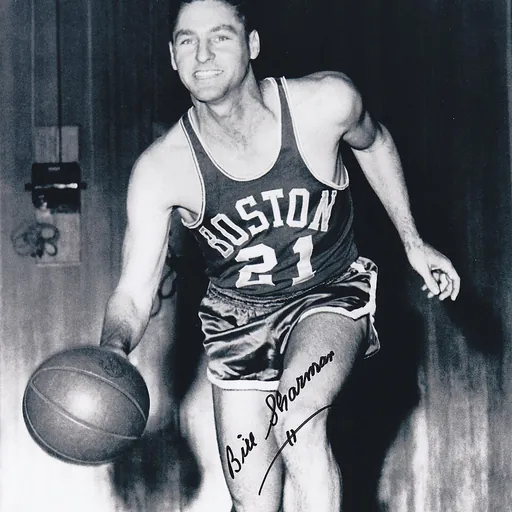
Bill Sharman
American basketball player and coach
About Bill Sharman
Lived 1926 – 2013 (aged 87). Bill Sharman was an American basketball player, coach and basketball coach.
William Walton Sharman (May 25, 1926 – October 25, 2013), also known as "Battling Bill", was an American professional basketball player and coach. Sharman is a two-time Naismith Memorial Basketball Hall of Fame inductee, having been inducted in 1976 as a player, and in 2004 as a coach. Only John Wooden, Lenny Wilkens, Tommy Heinsohn and Bill Russell share this double honor.
Sharman is mostly known for his time with the Boston Celtics in the 1950s as a player in the National Basketball Association (NBA), partnering with fellow Hall of Fame guard Bob Cousy in what was then considered the greatest backcourt duo of all time. As a coach, Sharman won titles in the American Basketball League (ABL), American Basketball Association (ABA), and NBA, and is credited with introducing the now-ubiquitous morning shootaround. He was named Coach of the Year in both the ABA and NBA.
Sharman was the first North American sports figure to win a championship as a player, coach, and executive. He was a 15-time NBA champion (having won four titles as a player with the Celtics, one as head coach of the Los Angeles Lakers, and ten during his time as a Lakers' general manager, president, and special consultant); and a 17-time champion in professional basketball overall counting his ABL and ABA titles. Sharman coached the 1971–72 Los Angeles Lakers to an NBA record 33-game win streak; a then-record regular season 69–13 win–loss mark; and the first Lakers championship in Los Angeles.
Sharman was an All-American basketball player at the University of Southern California (USC). He played under Naismith Hall of Fame head coach Sam Barry. Sharman was selected twice as the Most Valuable Player in the Pacific Coast Conference. Two of his teammates at USC were future Hall of Fame coaches Alex Hannum and Tex Winter.
Early life Sharman was born on May 25, 1926, in Abilene, Texas. The family moved to California when he was a child, and he grew up in Lomita, California.
He was a 15-letter athlete at PHS, excelling in basketball and baseball, competing in track, and winning the state amateur tennis title. He graduated in 1944, and was named California's Outstanding Athlete. He gave credit to PHS for contributing to his later success in life.
Sharman served during World War II from 1944 to 1946 in the US Navy. His 13.7 points per game average over his USC career was a then school record. As a senior, he was selected team captain and the team's most valuable player. Sharman was twice selected All-Pacific Coast Conference (PCC) and twice was named the PCC's Most Valuable Player. It was contemporaneously reported in 1950 that the International News Service and Colliers Magazine named Sharman a first-team All-American, the Associated Press and United Press named him a second-team All-American, and Look magazine named him a third-team All-American. The Sporting News also named him a first-team All-American.
Sharman played forward for USC under Hall of Fame head coach Sam Barry. Sharman was Hannum's teammate from 1946 to 1948 at USC. They both played with Winter during the 1946–47 USC season.
Professional baseball career In 1950, the Brooklyn Dodgers baseball organization offered Sharman a contract with a $12,000 signing bonus, at a time when professional baseball was more prestigious than professional basketball. He was called up to the Dodgers late in the 1951 season but did not appear in a game. He was part of a September 27 game in which the entire Brooklyn bench was cleared from the dugout for arguing with the home plate umpire over a ruling at the plate. This has led to the legend that Sharman holds the distinction of being the only player in baseball history to have ever been ejected from a major league game without ever appearing in one. However, although Sharman was among the Dodger bench players that had to go to the clubhouse, none of them were actually barred from playing in the game. In fact, in the top of the ninth, one of the other dismissed players, Wayne Terwilliger, was used as a pinch-hitter in the game.
Sharman continued to play baseball until breaking his basketball shooting hand while sliding into home plate, after which he decided to focus solely on basketball. The team offered Sharman $5,000, the most ever paid to a rookie. After refusing the initial offer, and telling the Capitols he wanted to play baseball, the team increased the offer to $8,000 and Sharman joined the Capitols. The team failed financially 35 games into the 1950–51 season. Before the team folded, Sharman played in 31 games, averaging 12.2 points and 3.5 rebounds per game with an .889 free thrown percentage.
Earl Lloyd, the African American player who broke the NBA's color barrier was a Capitols' teammate. Lloyd did not have a car, and Sharman would drive over to Lloyd's home in segregated Washington, D.C. to pick Lloyd up, so Lloyd would not have to take long bus rides. Lloyd said of Sharman, "'Bill was a decent guy when it wasn't fashionable...." After that, the reporting varies considerably as to the specific nature of the transactions (as to it being a trade involving cash and players; a series of cash transactions; whether the Celtics or Pistons paid Waterloo). All of the reporting does agree that the Celtics obtaining Sharman, Brannum, and Harris turned out heavily lopsided in Boston's favor; with Celtics' owner Walter A. Brown later saying that receiving any one of the three Pistons' players alone for Share would have been a favorable deal for the Celtics. The Celtics were in the playoffs every season Sharman was with the team (1951 to 1961). Sharman won four NBA championships with the Celtics.
Sharman was one of the first NBA guards to shoot better than .400 from the field, with a .450 percentage in 1953–54. He led the NBA in free throw percentage a record seven times (including a record five consecutive seasons), Sharman's career free throw percentage was .883, Sharman still holds the record for consecutive free throws in the playoffs with 56.
Sharman was named to the All-NBA First Team four consecutive seasons (1955 through 1959), and was an All-NBA Second Team member in 1952–53, 1954–55, and 1959–60. Sharman still holds the NBA All-Star Game record for field goals attempted in a quarter with 12.
The pairing of Sharman and fellow Hall of Fame Celtics guard Bob Cousy, combining a pure shooter with a playmaker, formed the first modern backcourt.
At the end of the 1960–61 NBA season, Sharman ended his NBA playing career after 11 seasons.
Sharman appeared in 19 games as a player for the Jets, but the franchise folded operations in late January 1962 during that league's only full season of play. Sharman remained in the ABL when he was hired to coach the Cleveland Pipers during the second half of the season by Pipers' team owner and president George Steinbrenner. The Pipers went on to win the ABL's only full-season championship title. Sharman had a 24–15 record with the Jets and 24–18 record with the Pipers during the ABL's 1961–62 season. The ABL folded altogether on December 31, 1962, before completing its second season. Sharman had left the ABL before the start of its second season.
After the Los Angeles Jets dissolved in 1962, Sharman brought a lawsuit to enforce his employment contract with the Jets, culminating in the case Sharman v. Longo (1967) 249 Cal.App.2d 948.
Los Angeles State College In July 1962, Sharman was hired as head coach and athletic director at Los Angeles State College (now California State, Los Angeles). The team had a losing record in its two previous seasons before hiring Sharman. He coached there for two seasons (1962 to 1964).
San Francisco Warriors (1966 to 1968) In March 1966, Sharman was hired as head coach of the NBA's San Francisco Warriors. They won the 1967 Western Division playoff semifinals and finals, and made it to the 1967 NBA Finals.
In his second and final season with the Warriors (1967–68), the team finished third in the Western Division, and lost in the 1968 Western Division finals to the Lakers. Sharman resigned as the Warriors coach after the end of the season, on April 26, stating he wanted to be more than a coach with the Warriors. Three days later he joined the Los Angeles Stars of the rival American Basketball Association as head coach.
Los Angeles / Utah Stars (1968–1971)
Sharman became the Stars' coach for the 1968–69 season. The Stars had offered him a long term contract with an increase in salary and an opportunity to purchase an ownership interest in the team. The championship team's star player was the 1971 ABA playoff MVP and future Hall of Fame center Zelmo Beaty. The Stars defeated the Kentucky Colonels, and their future hall of fame center Dan Issel, four games to three for the ABA championship.
In late May/early June 1971, the Los Angeles Lakers offered Sharman their head coaching job, and Sharman informed the Stars he was leaving. Sharman said that his lawyers advised Sharman that his contract with the Stars might not be valid because after the Stars moved to Utah he was told the terms giving him a potential ownership right and receiving a pension plan might not be honored. The Stars filed a $5 million lawsuit against Sharman, and obtained a temporary restraining order that Sharman could only coach the Stars.
The court held a hearing a week later, dismissed the temporary restraining order, and ruled that the Stars could not enjoin Sharman from coaching another team. The Stars maintained that they would still pursue legal action if he joined the Lakers. After Sharman took the Lakers' head coaching job, in 1971 Stars' owner Bill Daniels did pursue breach of contract litigation against Sharman personally, and a tort claim against the Lakers' ownership for inducing Sharman's alleged breach of contract, in a Utah federal district court. In early 1975, the federal district court judge ruled that Sharman had breached his contract. Sharman gave his personal opinion at the time, "'I've seen some home court decisions in basketball but the court's decision is a gross miscarriage of justice'". The matter then went to the jury which found that Sharman personally had to pay Daniels $250,000 in damages, and that the Lakers had induced Sharman's breach and had to pay Daniels $175,000. Sharman and the Lakers appealed, and in February 1977 the United States Court of Appeals for the Tenth Circuit reversed the $425,000 in judgments against them.
Los Angeles Lakers (1971 to 1976) As the Lakers' coach in the 1971–72 season, Sharman guided the Wilt Chamberlain and Jerry West-led Los Angeles Lakers to an NBA record 33 game win streak, a then-record 69–13 win–loss mark, the first Lakers championship in Los Angeles, and the first for the Lakers' franchise in more than a decade. The Lakers had been to the NBA finals seven times since moving from Minneapolis, losing each time. The Lakers' record fell to 47–35, and they were eliminated in the first round of the 1974 NBA playoffs. West retired before the 1974–75 season, in which the Lakers went 30–52. The Lakers traded for Kareem Abdul-Jabbar before the 1975–76 season. Abdul-Jabbar was the NBA's Most Valuable Player that season, but the team was 40–42 and did not make the playoffs.
This was Sharman's last season as the Lakers' coach. In five years as the Lakers' coach he had a 246–164 (.600) regular season record, and a 22–15 (.595) playoff record. In the 1971–72 season, Sharman had suffered a vocal cord injury while coaching that did not fully heal and got progressively worse over time. His voice degenerated to the degree he was no longer able to function as a coach by the end of the 1975–76 season. Including his ABL championship with the Pipers, Sharman is the only coach to win championships in three different professional basketball leagues. As the Lakers general manager Sharman built the 1980 and 1982 NBA championship teams, known as the "Showtime Lakers". Magic Johnson (1979, No. 1 overall), and James Worthy (1982, No. 1 overall); as well as all-star guard Norm Nixon (1977, No. 22 overall). Sharman signed future Hall of Fame forward Jamal Wilkes in July 1977, after Wilkes played out his option with the Golden State Warriors. In early 1980, Sharman had traded Don Ford and the Lakers 1980 No. 1 draft pick (No. 22 overall used to draft Chad Kinch) to the Cleveland Cavaliers for Butch Lee and the Cavaliers No. 1 draft pick in 1982, which was used to draft Worthy.
Sharman was still subject to problems with his voice that limited his functioning as general manager. In 1982, new Lakers' owner Jerry Buss made Sharman the Lakers' president, and West the Lakers' new general manager. As team president, Sharman oversaw the Lakers' 1985, 1987, and 1988 NBA championship teams. His former USC teammate Tex Winter played an integral role in four of those Lakers' championships as an assistant coach and consultant.
Legacy and honors
Sharman was enshrined in the Naismith Basketball Hall of Fame in 1976 as a player and again in 2004 as a coach. He is one of only five people to be enshrined in both categories, the others being John Wooden, Lenny Wilkens, and his former teammates Tom Heinsohn and Bill Russell. He was introduced at his 2004 Hall of Fame ceremony by Wooden, Bob Cousy, and Jerry West.
Sharman was a 15-time NBA champion (having won four titles as a player with the Celtics, one as head coach of the Los Angeles Lakers, and ten as a Lakers' executive and special consultant), and a 17-time champion in basketball overall counting his ABL and ABA titles. On October 29, 1996, Sharman was named one of the NBA's 50 Greatest Players. In October 2021, Sharman was again honored as one of the league's greatest players of all time by being named to the NBA 75th Anniversary Team.
Sharman died one day before his induction into the inaugural class of the Porterville High School Athletic Hall of Fame.
Personal life and death Sharman's marriage to his first wife, Illeana, lasted over 20 years and resulted in four children before their divorce in 1968. He was married to his second wife, Dorothy, from 1969 until her death from cancer in 1975. Sharman married Joyce McLay in 1981, with whom he remained married until his death.
Sharman was the author/co-author of two books, Sharman on Basketball Shooting, published by Prentice Hall in 1966; and The Wooden-Sharman Method: A Guide to Winning Basketball with John Wooden and Bob Selzer, published in 1975. He was a stand-in for the Tarzan character in a number of movies, and was a double for the actor Stewart Granger in the movie Green Fire (co-starring Grace Kelly). Sharman agreed to participate in a scene where Granger's character was being stalked by a tiger, only after being offered more money to play the scene that used an actual tiger. He recalled being in 40 to 50 movies, principally as an extra or in the background.
NBA career statistics
Regular season
Playoffs
Head coaching record
Don’t just read it —
keep it.
Full-length biographies made to live with: read them, listen on the way to work, watch them tonight.
- E-book
- Audio
- Video
Instant download · yours to keep · every purchase keeps this site free
Important facts
People in Bill Sharman's life
Named in this biography and alive at the same time






Related people
Same field, nearest in time

Contemporaries
People whose lives overlapped Bill Sharman's



Frequently asked questions
Who was Bill Sharman?
American basketball player and coach (1926–2013)
When was Bill Sharman born?
Bill Sharman was born on 25 May 1926 in Abilene.
When did Bill Sharman die?
Bill Sharman died on 25 October 2013 in Redondo Beach.
What was Bill Sharman's occupation?
Bill Sharman was a basketball player, coach and basketball coach.
What nationality was Bill Sharman?
Bill Sharman was American.
Sources & further reading
Cite this page
APA: Biography.guide. (2026). Bill Sharman. https://biography.guide/bill-sharman/
MLA: "Bill Sharman." Biography.guide, https://biography.guide/bill-sharman/.
Chicago: "Bill Sharman." Biography.guide. https://biography.guide/bill-sharman/.
Data last updated: 2026-09-23 · Spot an error? Report a correction.
Portrait: Wikimedia Commons · author & licence
Page generated 2026-09-27 05:05 UTC