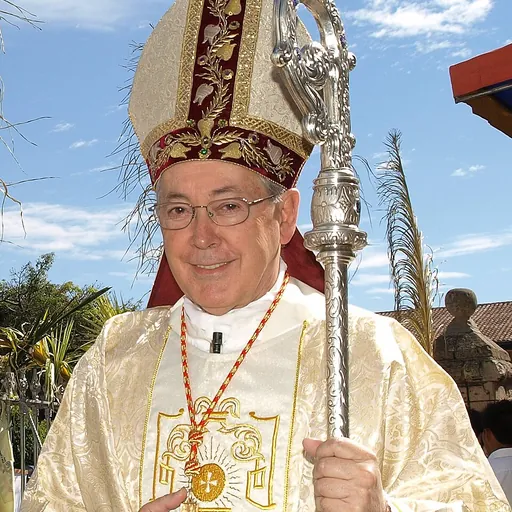
Juan Luis Cipriani Thorne
Catholic cardinal
About Juan Luis Cipriani Thorne
Born 1943. Juan Luis Cipriani Thorne is a Peruvian basketball player, catholic priest, catholic bishop and archbishop.
Juan Luis Cipriani Thorne (born 28 December 1943) is a Peruvian Catholic who served as Archbishop of Lima from 1999 to 2019. He has been a bishop since 1988 and was made a cardinal in 2001.
Biography
Early life and career Cipriani attended the Colegio Santa Maria Marianistas, a Catholic school, and as a young man he was a member of the Peruvian national basketball team for six years. He studied industrial engineering at the Universidad Nacional de Ingeniería in Lima, Peru, and worked as an engineer.
He later joined Opus Dei and was eventually ordained priest on 21 August 1977. He earned a doctorate in theology from the University of Navarra. He did pastoral work in Lima, taught at the Pontifical Faculty of Theology, and was regional vicar for Peru and Vice-Chancellor of the University of Piura.
Service in Ayacucho On 23 May 1988, Pope John Paul II appointed him titular Bishop of Turuzi and Auxiliary Bishop of Ayacucho and he received his episcopal consecration on 3 July from Cardinal Juan Landázuri Ricketts. He was named Apostolic Administrator of the Archdiocese upon the retirement of Archbishop Federico Richter Fernandez-Prada on 23 May 1991. He was named Archbishop of Ayacucho on 13 May 1995. He held an appointment in the Roman Curia as consultor of the Congregation for the Clergy from 1990 to 1999.
Ayacucho was the center of Peru's battle against the Shining Path, a violent revolutionary movement. Cipriani became an uncompromising voice for military suppression. In 1991, he said that "Most human rights organizations are just covering the tails of political movements, almost all of them Marxist and Maoist." In 1995, he backed legislation to shield the Peruvian military and police from prosecution for activities undertaken as part of the suppression of radical movements.
Cipriani was chancellor of the Pontifical Catholic University of Peru (PUCP) in 1997 when it barred a gay student organisation, Parenthesis Collective (Colectivo Paréntesis), from holding events. He had a pamphlet titled "Sexual Identity: Is It Possible to Choose?" prepared and distributed. It described homosexuality as a curable illness.
During the 1996–1997 Japanese embassy hostage crisis, he was named by President Fujimori to a trio of mediators to seek a peaceful resolution and the release of the hostages.
Service in Lima Pope John Paul II named him Archbishop of Lima in 1999. In January 2000 he was elected second vice-president of the Peruvian Bishop's Conference and head of its Commission for Education. He was the first priest incardinated into Opus Dei to be made a cardinal. On 15 May 2001, John Paul named him a member of two bodies of the Roman Curia, the Congregation for Divine Worship and the Discipline of the Sacraments and the Congregation for the Causes of Saints.
He was one of the cardinal electors who participated in the 2005 papal conclave that elected Pope Benedict XVI.
Cipriani regularly denounced efforts to recognize same-sex relationships. In 2005, Cipriani commented on the recent legalization of same-sex unions in Spain. He denounced the existence of a worldwide campaign and warned that by legalising same-sex unions, society is disfigured. He said: "In today's world, evil disguises itself as good, it is imposed on others, and woe to him who does not accept it!". He called on the faithful not to refer to relationships that "are not between a man and a woman" as marriage. He said: "Call it what you want but don't sell damaged goods, don't traffic in that dictatorship of moral relativism in which there is nothing good, only opinions and trends of thought." In 2013, he opposed legislation to create same-sex civil unions in Peru. He called it "an old strategy" that "starts by putting the shoe on the door with this law, and ends up asking for marriage between homosexuals". He said everyone was free to enter into contracts with one another, "but it is not necessary to start making a caricature of marriage and then destroy it".
In April 2008 he banned the practice of receiving Communion in the hand, requiring instead that the faithful receive on the tongue. He said that "the relaxed attitude of many priests" was to blame for a decline in reverence for the Eucharist among the faithful.
On 19 July 2011, he was named a member of the Pontifical Commission for Latin America by Pope Benedict XVI.
From 2007 to 2016, he fought with the Pontifical Catholic University of Peru, which resisted his attempts to assert control over its financial and academic affairs. Though he was supported by the Vatican under Pope Benedict for several years, the dispute was eventually resolved by the intervention of Pope Francis with an accord that sidelined Cipriani.
He was one of the cardinal electors who participated in the 2013 papal conclave that elected Pope Francis. He was mentioned at the time as a possible candidate for election to the papacy, though not among the most likely.
In a televised discussion about abortion on the program Diálogos de fe, he explained, "Statistics tell us that girls get abortions, but it is not because these girls were violated, but because, often, the woman puts herself on provoking display." The Archdiocese responded to widespread criticism of that statement by explaining that Cipriani was characterizing the immodest presentation of women on television.
Pope Francis accepted his resignation as Archbishop of Lima on 25 January 2019. Though nominated four times, he was never elected to head the Peruvian Bishops' Conference. He was also Grand Chancellor of the Pontifical Catholic University of Peru.
Misconduct Neglect of Sodalitium Christiane Vitae sex abuse reports
Cipriani was criticized for neglecting reports of sexual abuse which had been made against members of the Catholic church's Peru-based Sodalitium Christianae Vitae society. The sex abuse allegation was first made against Cipriani in August 2018. However, Cipriani denies any wrongdoing, saying:
"I want to clarify that the things described are completely false. I haven’t committed any crime, nor have I sexually abused anyone either in 1983 nor before nor after."
Human rights record
Peru's Truth Commission investigated human rights abuses committed by government forces during the 1980s and 1990s. It concluded that Cipriani had failed to defend human rights while auxiliary bishop and archbishop of Ayacucho. Cipriani rejected the report's findings which was partly accepted by the public. The Commission cited testimony by victims of the political violence in Ayacucho, the birthplace of the PCP-Shining Path. Its Final Report identified Cipriani as the only religious leader that did not support the work of Peru's Human Rights Coordinator, "whose activities he repeatedly pronounced himself in opposition to".
The Commission wrote:
Regarding the Peruvian Coordinator of Human Rights, an umbrella organizations of secular and church groups devoted to protecting human rights in Peru, Cipriani said:
In March 1991, Ciprani said that "As long as we do not state clearly that human rights are not absolute untouchable values, but are permanently subject to the limits set by human duties, it is impossible to deal effectively with the evils we suffer, especially immorality In public functions and terrorism. Let's put it briefly: Most institutions called "human rights defense" are the backbones of political movements, almost always of the Marxist and Maoist type". In 1995 he explained why he endorsed an amnesty for state military officials accused of war crimes: "It is a political decision, to achieve internal peace, because it is necessary to forgive to achieve reconciliation.
Don’t just read it —
keep it.
Full-length biographies made to live with: read them, listen on the way to work, watch them tonight.
- E-book
- Audio
- Video
Instant download · yours to keep · every purchase keeps this site free
Important facts
People in Juan Luis Cipriani Thorne's life
Named in this biography and alive at the same time




Related people
Same field, nearest in time


Contemporaries
People whose lives overlapped Juan Luis Cipriani Thorne's


Frequently asked questions
Who is Juan Luis Cipriani Thorne?
Catholic cardinal
When was Juan Luis Cipriani Thorne born?
Juan Luis Cipriani Thorne was born on 28 December 1943 in Lima.
What is Juan Luis Cipriani Thorne's occupation?
Juan Luis Cipriani Thorne is a basketball player, catholic priest, catholic bishop and archbishop.
What nationality is Juan Luis Cipriani Thorne?
Juan Luis Cipriani Thorne is Peruvian.
Sources & further reading
· Wikipedia: Juan Luis Cipriani Thorne
· DBpedia: Juan Luis Cipriani Thorne
Cite this page
APA: Biography.guide. (2026). Juan Luis Cipriani Thorne. https://biography.guide/juan-luis-cipriani-thorne/
MLA: "Juan Luis Cipriani Thorne." Biography.guide, https://biography.guide/juan-luis-cipriani-thorne/.
Chicago: "Juan Luis Cipriani Thorne." Biography.guide. https://biography.guide/juan-luis-cipriani-thorne/.
Data last updated: 2026-09-22 · Spot an error? Report a correction.
Portrait: Wikimedia Commons · author & licence
Page generated 2026-09-27 05:02 UTC