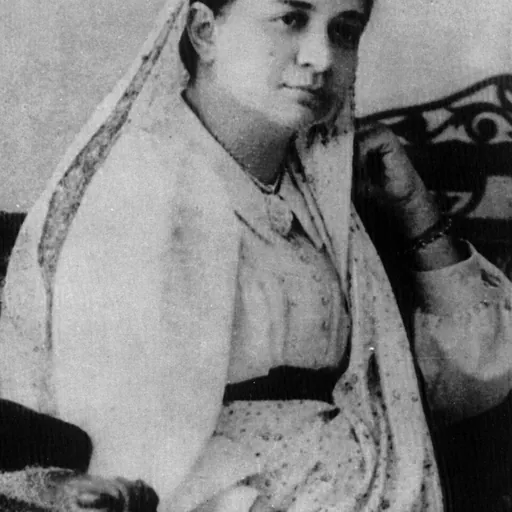
About Bhikaiji Cama
Lived 1861 – 1936 (aged 74). Bhikaiji Cama was an Indian public figure, women's rights activist and freedom fighter.
Design of the "Flag of Indian Independence" raised by Bhikhaiji Cama on 22 August 1907, at the International Socialist Conference in Stuttgart, Germany.Based on the Calcutta Flag, drawn by Hemchandra Kanungo and Sachindra Prasad Bose, the green, yellow and red fields represent Islam, Hinduism, and Buddhism respectively. The crescent moon and the sun again represent Islam and Hinduism, respectively. The eight lotuses in the upper register represent the eight provinces of British India. The words in the middle are in Devanagri script and read Vande Mataram "[We] Bow to thee Mother [India]", the slogan of the Indian National Congress.The design was adopted in 1914 as the emblem of the Berlin Committee (later known as the Indian Independence Committee). The original "Flag of Indian Independence" raised by Cama in Stuttgart is now on display at the Maratha and Kesari Library in Pune
Bhikhaiji Rustom Cama (24 September 1861 – 13 August 1936), also known as Madam Cama, was one of the prominent figures in the Indian independence movement. She unfurled one of the earliest versions of the flag of independent India on August 22, 1907, and she was the first person to hoist an Indian flag in a foreign nation, at the International Socialist Conference at Stuttgart.
Early life Bhikaiji Cama was born in Bombay (now Mumbai) in a large, affluent Parsi Zoroastrian family. Her parents, Sorabji Framji Patel and Jaijibai Sorabji Patel, were well known in the city, where her father Sorabji—a lawyer by training and a merchant by profession—was an influential member of the Parsi community.
Like many Parsi girls of the time, Bhikhaiji attended Alexandra Girls' English Institution. Bhikhaiji was by all accounts a diligent, disciplined child with a flair for languages.
On 3 August 1885 at Bombay, she married Rustomji Cama, who was the son of K. R. Cama, and from a loyalist family. Her husband was a wealthy, pro-British lawyer who aspired to enter politics. It was not a compatible or happy marriage,
Activism In October 1896, the Bombay Presidency was hit first by famine, and shortly thereafter by bubonic plague. Cama joined one of the many teams of nurses working out of Grant Medical College (which would subsequently become Haffkine's plague vaccine research centre), in an effort to provide care for the afflicted, and (later) to inoculate the healthy. Cama subsequently contracted the plague herself but survived. As she was severely weakened, she was sent to Britain for medical care in 1902.
Together with Naoroji and Singh Rewabhai Rana, Cama supported the founding of Varma's Indian Home Rule Society in February 1905. She refused. including Bande Mataram (founded in response to the Crown ban on the nationalist poem Vande Mataram) where she described the devastating effects of a famine that had struck the Indian subcontinent. In her appeal for human rights, equality and autonomy from Great Britain, she was the first person to unfurl what she called the "Flag of Indian Independence". It has been speculated that this moment may have been an inspiration to African American writers and intellectuals W. E. B. Du Bois in writing his 1928 novel Dark Princess. Cama's flag, a modification of the Calcutta Flag, was co-designed by Cama, and would later serve as one of the templates from which the current national flag of India was created.
After the second Socialist Congress at Stuttgart, Cama travelled to America to raise awareness of the Indian nationalist campaign and non-cooperation movement. Her activities in the United States included addressing members of the Minerva Club in New York. She returned to England in 1908.
Influenced by Christabel Pankhurst and the suffragette movement, Cama was vehement in her support for gender equality and she often stressed on the role of Indian women in building the nation.
Exile and death
With the outbreak of World War I in 1914, France and Britain became allies, and all the members of Paris India Society except Cama and Singh Rewabhai Rana left the country (Cama had been advised by fellow-socialist Jean Longuet to go to Spain with M.P. Tirumal Acharya). She and Rana were briefly arrested in October 1914 when they tried to agitate among Punjab Regiment troops that had just arrived in Marseilles on their way to the front. They were required to leave Marseilles, and Cama then moved to Rana's wife's house in Arcachon , near Bordeaux. Cama continued to maintain active contacts with Indian, Irish, and Egyptian revolutionaries as well as with French Socialists and Russian leadership.
Several Indian cities have streets and places named after Cama, or Madame Cama as she is also known. On 26 January 1962, India's 11th Republic Day, the Indian Posts and Telegraphs Department issued a commemorative stamp in her honour.
In 1997, the Indian Coast Guard commissioned a Priyadarshini-class fast patrol vessel ICGS Bikhaiji Cama after Bikhaiji Cama.
A high-rise office complex in R.K. Puram area of Delhi was established, which accommodates major Government Offices and companies such as Punjab National Bank,EPFO, Jindal Group, SAIL, GAIL, EIL etc. is named as Bhikaji Cama Place in tribute to her.
Following Cama's 1907 Stuttgart address, the flag she raised there was smuggled into British India by Indulal Yagnik and is now on display at the Maratha and Kesari Library in Pune, Maharashtra. In 2004, politicians of the BJP, India's political party, attempted to identify a later design (from the 1920s) as the flag Cama raised in Stuttgart. The flag Cama raised – misrepresented as "original national Tricolour" – has an (Islamic) crescent and a (Hindu) sun, which the later design does not have.
Don’t just read it —
keep it.
Full-length biographies made to live with: read them, listen on the way to work, watch them tonight.
- E-book
- Audio
- Video
Instant download · yours to keep · every purchase keeps this site free
Important facts
People in Bhikaiji Cama's life
Named in this biography and alive at the same time


Related people
Same field, nearest in time


Contemporaries
People whose lives overlapped Bhikaiji Cama's


Frequently asked questions
Who was Bhikaiji Cama?
Indian activist (1861-1936)
When was Bhikaiji Cama born?
Bhikaiji Cama was born on 24 September 1861 in Mumbai.
When did Bhikaiji Cama die?
Bhikaiji Cama died on 13 August 1936 in Mumbai.
What was Bhikaiji Cama's occupation?
Bhikaiji Cama was a public figure, women's rights activist and freedom fighter.
What nationality was Bhikaiji Cama?
Bhikaiji Cama was Indian.
Sources & further reading
Cite this page
APA: Biography.guide. (2026). Bhikaiji Cama. https://biography.guide/bhikaiji-cama/
MLA: "Bhikaiji Cama." Biography.guide, https://biography.guide/bhikaiji-cama/.
Chicago: "Bhikaiji Cama." Biography.guide. https://biography.guide/bhikaiji-cama/.
Data last updated: 2026-09-23 · Spot an error? Report a correction.
Portrait: Wikimedia Commons · author & licence
Page generated 2026-09-27 05:06 UTC