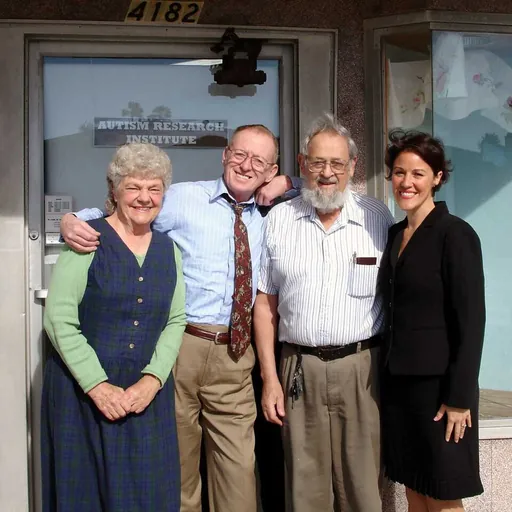
About Bernard Rimland
Lived 1928 – 2006 (aged 78). Bernard Rimland was an American psychologist, writer and medical author, known for Autism, Autism epidemic and Biomedical intervention for autism.
Bernard Rimland (November 15, 1928 – November 21, 2006) was an American research psychologist, alternative medicine promoter, writer, and lecturer, who was influential in dispelling the once-prevalent belief that autism was caused by emotionally cold or distant parenting. Rimland's first book, Infantile Autism—inspired by his experience parenting an autistic son—was instrumental in changing attitudes about the disorder. Rimland founded and directed two advocacy groups: the Autism Society of America (ASA) and the Autism Research Institute (ARI). He also promoted several unproven or discredited theories about the causes and treatment of autism. This included falsely claiming a link between vaccines and autism, falsely promoting facilitated communication as a legitimate form of augmentative and alternative communication, and falsely promoting chelation therapy and secretin as effective autism treatments. He also supported the ethically controversial practice of using aversives (including electric shocks) on autistic children.
Education Rimland completed his undergraduate studies and earned a master's degree in psychology at San Diego State University. a widely held belief popularized by Bruno Bettelheim. Infantile Autism challenged the medical establishment's perceptions of autism.
In 1967, Rimland left the ASA to establish the Autism Research Institute (ARI), a San Diego–based non-profit organization dedicated to researching and collecting data on autism and related disorders. He kept a database of research and case histories, as well as conducted and sponsored research in an attempt identify the cause of autism and offer effective treatment solutions. He published an ARI newsletter, which reached an international audience. published by ARI, which covers biomedical and educational advances in autism research.
Rimland served as technical advisor on autism for the 1988 movie Rain Man. Rimland suggested giving Raymond Babbitt, the movie's main character portrayed by Dustin Hoffman, Hoffman interviewed Rimland's son, Mark, in preparing for the role. The makers of the movie made a donation of $75,000, intended to go to ARI. However, the check was made out to ASA in error. Rimland sued to get the money returned, but lost in court because he failed to file the lawsuit in time.
In 1995, Rimland established Defeat Autism Now! (DAN!), an initiative overseen by ARI that claimed to promote effective biomedical autism treatments. However, DAN! primarily focused on the promotion of unproven or discredited alternative autism treatments and prophylactics, including chelation therapy, gluten-free, casein-free diets, vitamin therapy, hyperbaric oxygen therapy, and vaccine avoidance.
Rimland eventually returned to ASA leadership, last serving as an honorary member of the organization's board of directors in 2006 (the year he died).
Stance on key issues Rimland was outspoken on what he believed to be the major causes for autism: environmental pollutants, antibiotics, and vaccinations.
Vaccinations, thiomersal, and chelation therapy Rimland considered vaccinations to be a "prime suspect" in the onset of autism. He maintained that, while not proven, there was a direct link between thiomersal (a harmless mercury-based preservative used in some vaccines He also supported anti-vaccine activist Andrew Wakefield's now-discredited suggestion that the MMR vaccine was linked to autism. Rimland contended that the vaccination triggered autism by placing a burden on the immune systems of children between birth and age 2.
Rimland further alleged a link between the increase in autism diagnoses in the 1980s and the introduction of the MMR vaccine, He also rejected the idea that a diagnosis of autism at or around 18 months, the same time the vaccinations were administered, was coincidental. In 2010, The Lancet formally retracted the paper outright due to ethical misconduct and fraud on Wakefield's part.
Rimland also alleged autistic traits were symptoms of heavy-metal poisoning caused by exposure to thiomersal and other forms of mercury. Based on this belief, he advocated for the use of chelation therapy—which removes heavy metals from the body —to treat autism. In 2005, he told NBC News that chelation therapy was "by far the most effective treatment available" for autism. and that the thiomersal used as a preservative in some vaccines is not harmful. Chelation therapy is unproven as an autism treatment and has sometimes resulted in kidney damage, death, or other serious complications when improperly administered.
Diet therapy and secretin Rimland supported research that focused on "natural, non-toxic ways" to address symptoms of autism. He believed that vitamins (specifically B-6 and magnesium) and minerals could help change body chemistry and bring about behavioral changes.
Rimland advocated the use of secretin, a "naturally occurring intestinal hormone, saying it was "possibly the most important discovery in the history of autism. He claimed that children treated with the hormone showed "sudden and dramatic improvement". However, researchers in North Carolina and the University of Chicago in separate studies showed that the children receiving treatments with secretin showed "no more improvement" than those receiving a placebo. This treatment was not recommended by the National Institute of Child Health and Human Development.
Facilitated communication Rimland was an early supporter of facilitated communication (FC) (now discredited), though he disputed founder Douglas Biklen's claims that autism was "fundamentally a motor problem". At first, Rimland claimed the technique was effective for "a small number of people", but far fewer than the 100% success rate claimed by some proponents. He advocated "properly conducted research" to determine whether correct answers could be obtained if the facilitator did not know the answers.
As FC generated false claims of abuse (about 25 by his count in 1993), mostly against parents, Rimland's view of FC's usefulness changed to one of caution. "In almost every instance of this sort, when charges have come to court and been investigated, courts have decided that they were untrue." In 1995, Rimland reported that peer-reviewed studies (40+) with more than 400 people with autism as subjects had "failed to document FC in all but a handful of cases."
Applied behavior analysis Rimland was a proponent of applied behavior analysis (ABA), a controversial operant-conditioning system popularized as an autism treatment by psychologist Ole Ivar Lovaas. Lovaas' methods initially included the use of aversive stimuli to modify behavior, including slaps and electric shocks, as well as the withholding of food. In 1964, Rimland began treating his own son using operant conditioning after meeting with Lovaas and observing his methods. At least once, he misrepresented the views of his colleagues to make it seem as though they supported aversives when they did not so as to further his viewpoint. After Rimland quoted Anne Donnellan and another anti-aversive behaviorist as being in support of the practice, Donnellan issued the following response: "We never have made or written such a statement. Dr. Rimland has been warned publicly and privately that to continue to use our names and our professional reputations to support positions that he espouses and we oppose exposes him to charges of unethical, illegal, as well as ridiculous conduct."
Criticism of evidence base and other proponents Despite Rimland's support of ABA, he criticized those who characterized it as the only scientifically validated autism treatment, including the New York State Department of Health and the behaviorist nonprofit Association for Science in Autism Treatment (ASAT). In a 1999 column published by ARI's Autism Research Review International, Rimland claimed ABA's evidence base was weak in comparison to that of the vitamin B6 and magnesium treatments he had promoted. He also criticized Lovaas' "centerpiece" 1987 ABA study for not being double-blinded and its results not being replicated to date.
Personal life Rimland was born on November 15, 1928, in Cleveland, Ohio. He and his family moved to San Diego, California, in 1940.
In 1951, Rimland married Gloria Belle Alf. They had three children. Mark, born in 1956, exhibited challenging behaviors which Rimland self-diagnosed through research as autism. This condition, relatively unknown at the time, was confirmed by a pediatrician.
Death At the age of 78, Rimland died of prostate cancer on November 21, 2006, at a care facility in El Cajon, California.
Books 1964 Infantile Autism: The Syndrome and Its Implication for a Neural Theory of Behavior - written after his son, Mark, was diagnosed as autism. 1976 Modern Therapies (with Virginia Binder, A. Binder) 1998 Biological Treatments for Autism and PDD (with William Shaw, Lisa Lewis, Bruce Semon) 2001 Tired - so Tired!: And the "Yeast Connection" (with William Crook, Cynthia Crook) 2003 Vaccines, Autism and Childhood Disorders: Crucial Data That Could Save Your Child's Life (with Neil Z. Miller) 2003 Treating Autism: Parent Stories of Hope and Success (with Stephen M. Edelson, Ph.D.) 2006 Recovering Autistic Children (originally published as Treating Autism) Second Edition (with Stephen M. Edelson, Ph.D.)
Don’t just read it —
keep it.
Full-length biographies made to live with: read them, listen on the way to work, watch them tonight.
- E-book
- Audio
- Video
Instant download · yours to keep · every purchase keeps this site free
Important facts
People in Bernard Rimland's life
Named in this biography and alive at the same time







Related people
Same field, nearest in time


Contemporaries
People whose lives overlapped Bernard Rimland's

Frequently asked questions
Who was Bernard Rimland?
American psychologist (1928–2006)
When was Bernard Rimland born?
Bernard Rimland was born on 15 November 1928 in Cleveland.
When did Bernard Rimland die?
Bernard Rimland died on 21 November 2006 in San Diego.
What was Bernard Rimland's occupation?
Bernard Rimland was a psychologist, writer and medical author.
What was Bernard Rimland known for?
Bernard Rimland was known for Autism, Autism epidemic, Biomedical intervention for autism and Thiomersal controversy.
What nationality was Bernard Rimland?
Bernard Rimland was American.
Sources & further reading
Cite this page
APA: Biography.guide. (2026). Bernard Rimland. https://biography.guide/bernard-rimland/
MLA: "Bernard Rimland." Biography.guide, https://biography.guide/bernard-rimland/.
Chicago: "Bernard Rimland." Biography.guide. https://biography.guide/bernard-rimland/.
Data last updated: 2026-09-21 · Spot an error? Report a correction.
Portrait: Wikimedia Commons · author & licence
Page generated 2026-09-27 04:58 UTC