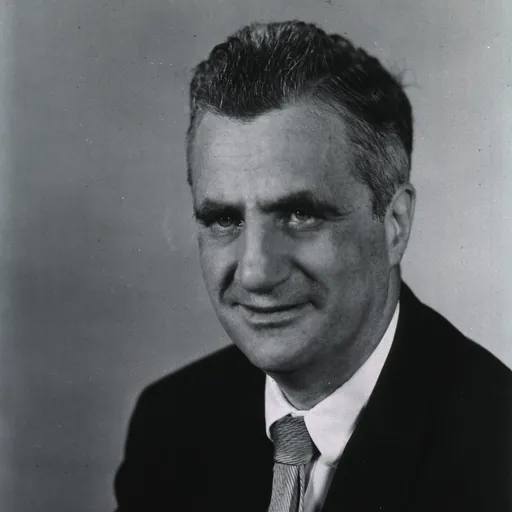
About Bernard Brodie
Lived 1907 – 1989 (aged 81). Bernard Brodie was a British and American biochemist, pharmacologist, university teacher and chemist.
Bernard Beryl Brodie (7 August 1907 – 28 February 1989) was a founding scientist in the area of biochemical and neurochemical pharmacology whose work in the 1940s and 1950s had great impact. He was a major figure in the fields of drug metabolism and drug therapy, studying how the absorption and interactions of drugs in the body. Brodie helped to found and lead the Laboratory of Chemical Pharmacology at the National Heart Institute in Bethesda, Maryland, one of the National Institutes of Health. He was a member of the United States National Academy of Sciences. He continued to a teach pharmacology at Pennsylvania State University and acted as a consultant to Hoffmann-LaRoche laboratories in Nutley, New Jersey.
Brodie also did research on anesthetic and hypnotic drugs. He correlated the distribution and clinical characteristics of thiopental, explaining Its rapid onset of action and its short duration as an anesthetic. He also pioneered a drug therapy for gout. His work also helps to minimize toxic effects and increase drug effectiveness through appropriate selection of dosages. He proposed an approach to the treatment of schizophrenia, studying the transmission of nerve impulses in the brain.
The biography, Apprentice to Genius by Robert Kanigel, describes Brodie's scientific career and the impact he had on a group of scientists who have gone on to make prize-winning breakthroughs in biomedical science.
Awards Brodie was elected to the National Academy of Sciences in 1966 and held memberships in the American Chemical Society, the American Heart Association, the International Union of Basic and Clinical Pharmacology and others.
In 1967, Brodie received the Albert Lasker Award for Basic Medical Research for more than 30 years of work resulting in "extraordinary contributions to biochemical pharmacology." the National Medal of Science, presented by President Lyndon B. Johnson (1968), and the Golden Plate Award from the American Academy of Achievement (1970).
He was the author or co-author of more than 350 scientific publications. The neuroscience department of the University of Cagliari was named in his honour by a former student, Gian Luigi Gessa.
Brodie died in 1989 in Charlottesville, Virginia at the age of 81.
Family Bernard Brodie was a brother of polio researcher Maurice Brodie.
Don’t just read it —
keep it.
Full-length biographies made to live with: read them, listen on the way to work, watch them tonight.
- E-book
- Audio
- Video
Instant download · yours to keep · every purchase keeps this site free
Important facts
People in Bernard Brodie's life
Named in this biography and alive at the same time



Related people
Same field, nearest in time




Contemporaries
People whose lives overlapped Bernard Brodie's


Frequently asked questions
Who was Bernard Brodie?
American biochemist (1907–1989)
When was Bernard Brodie born?
Bernard Brodie was born on 7 August 1907 in Liverpool.
When did Bernard Brodie die?
Bernard Brodie died on 28 February 1989 in Charlottesville.
What was Bernard Brodie's occupation?
Bernard Brodie was a biochemist, pharmacologist, university teacher and chemist.
What nationality was Bernard Brodie?
Bernard Brodie was British and American.
Sources & further reading
· DBpedia: Bernard Beryl Brodie
Cite this page
APA: Biography.guide. (2026). Bernard Brodie. https://biography.guide/bernard-brodie/
MLA: "Bernard Brodie." Biography.guide, https://biography.guide/bernard-brodie/.
Chicago: "Bernard Brodie." Biography.guide. https://biography.guide/bernard-brodie/.
Data last updated: 2026-09-20 · Spot an error? Report a correction.
Portrait: Wikimedia Commons · author & licence
Page generated 2026-09-27 04:57 UTC