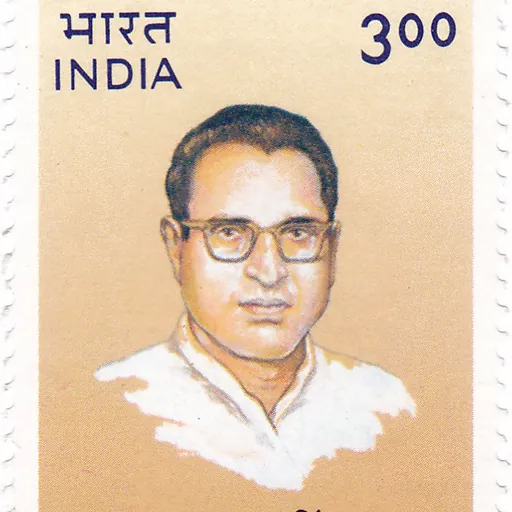
About Basawon Singh
Lived 1909 – 1989 (aged 79–80). Basawon Singh was an Indian politician, trade unionist and revolutionary.
Basawon Singh or Basawan Singh, also known as Basawon Sinha (23 March 1909 7 April 1989), was an Indian independence activist and a campaigner for the rights of the underprivileged, and industrial and agricultural workers.
He spent a total of 18 and a half years in prisons in British India as a consequence of his support for independence and he was committed to democratic socialism.
Along with Yogendra Shukla, he was a founder member of the Congress Socialist Party, a socialist caucus within the Indian National Congress, in Bihar. Among his revolutionary colleagues and friends he was called Lambad because of being very tall.
Early life Basawon Singh was born in Jamalpur (Subhai), Hajipur, Bihar on 23 March 1909 in a poor family. An only son, he lost his father at the age of Eight. He had come from a small farmer's family Background. At the age of ten he ran off to Hajipur to see and hear Mahatma Gandhi. A brilliant student, he secured scholarships in both primary and middle schools. Thereafter, he joined Dighi High School. He used to teach older boys for food and lodging. His mother sold a bamboo every month for two rupees to meet his other school expenses.
While at Bhagalpur, Singh undertook a fast unto death as a protest against what he thought were the prevailing inhuman conditions in jail. On the 12th day of the fast he was moved to Gaya Central Jail and kept in solitary confinement. Soon he was shifted to the jail's hospital. All efforts of forced feeding him failed, Sir Ganesh Dutt, the then minister of Bihar, asked Singh's mother, Daulat Kuer, to attend to urge him to give up his fast. When she attended, on the 50th day of the fast, she blessed him.
People waited daily at the jail gate to receive Singh's body should he die. All political prisoners in the jail were also on fast for the last few days in solidarity with him but on the 58th day he broke his fast after being informed by Gandhi that his demands had been met. He was released from jail in June 1936 because of his poor health but the city act was imposed on him to restrict his movement. He violated the restrictions and was again arrested.
Dalmianagar and 30 Days' Fast Unto Death Before independence Basawon Singh worked in the trade union movement with unabated zeal for the cause of democratic socialism, because trade unionism was one of the major factors for social change and social justice. Early in October 1938, he was arrested in Dalmianagar under Section 107 of C.P.C. with 6 other leaders for his regular meetings and organising an intensive strike of about 2400 men. In the course of the trade union movement, this prominent socialist leader often resorted to the Gandhian method of fasting to protest against the injustice meted out to workers. On 12 January 1949 he was arrested in Dalmianagar under the Bihar Maintenance of Public Order Act and he was released at the end of March. Afterwards he undertook hunger strike for 30 days in Dalmianagar for the cause of workers. was also an Indian politician and diplomat. She was twice elected to the Rajya Sabha from 1990 to 2000, and later served as Ambassador to Suriname and Barbados. She also became the first woman Union Minister of State (MoS) for external affairs in the cabinet of I. K. Gujral.
Travels abroad Basawon Singh had broad knowledge and was known for his scholarship among the Indian Independence Movement activists. He represented the country on various occasions. For the first time he paid a visit to Rangoon in 1950. In 1951, he was a delegate to the First Asian Socialist Conference held at Rangoon. In 1954, he went to China and he led the Indian Delegation to participate in the May Day Celebration. In 1956, he represented the Hind Mazdoor Sabha in the annual conference of the Japan Trade Union at Domei. In the same year, he went to the Soviet Union and led the Indian delegation to participate in the May Day celebration. He visited the United States in 1984 on the invitation of the American Federation of Labour Congress of Industrial Workers Organization.
Don’t just read it —
keep it.
Full-length biographies made to live with: read them, listen on the way to work, watch them tonight.
- E-book
- Audio
- Video
Instant download · yours to keep · every purchase keeps this site free
Important facts
People in Basawon Singh's life
Named in this biography and alive at the same time



Related people
Same field, nearest in time






Contemporaries
People whose lives overlapped Basawon Singh's



Frequently asked questions
Who was Basawon Singh?
Indian politician
When was Basawon Singh born?
Basawon Singh was born in 1909 in Hajipur.
When did Basawon Singh die?
Basawon Singh died in 1989.
What was Basawon Singh's occupation?
Basawon Singh was a politician, trade unionist and revolutionary.
What nationality was Basawon Singh?
Basawon Singh was Indian.
Sources & further reading
Cite this page
APA: Biography.guide. (2026). Basawon Singh. https://biography.guide/basawon-singh/
MLA: "Basawon Singh." Biography.guide, https://biography.guide/basawon-singh/.
Chicago: "Basawon Singh." Biography.guide. https://biography.guide/basawon-singh/.
Data last updated: 2026-09-21 · Spot an error? Report a correction.
Portrait: Wikimedia Commons · author & licence
Page generated 2026-09-27 04:59 UTC