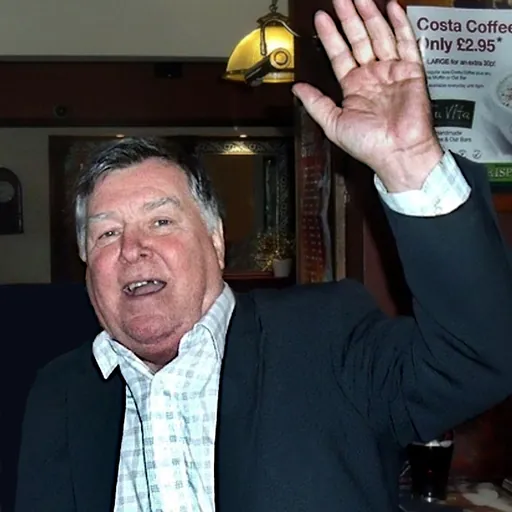
About Barry John
Lived 1945 – 2024 (aged 79). Barry John was a British rugby union player.
1968 British Lions, the 1969 Triple Crown and Wales tour John was selected for the British Lions in their tour of South Africa in 1968, but played in just four games before an injury forced him to return home. He played in three matches against district teams, Western Province, South Western Districts and , all wins for the tourists. He was then selected for the First Test, played at Johannesburg, against the South Africa national team. John's first Test for the British Lions lasted for only fifteen minutes, when after running for the line he was tackled by Jan Ellis, and John broke his collarbone on landing on the hard ground.
John played infrequently for Cardiff during the 1968/69 season, making just 14 appearances. Despite this he was available for all matches in the 1969 Five Nations Championship, again playing in each match paired with Edwards. The Welsh selectors had dropped five players from the previous Championship, and notable debutants in the team to face Scotland at Murrayfield on 1 February 1969 were J. P. R. Williams and Mervyn Davies. John scored his first international try in the encounter after charging down a kick and dummying his way over.
When Ireland came to Cardiff Arms Park in March the team was on a seven-match unbeaten run, and were looking at taking the Grand Slam after defeating England, France and Scotland. It therefore came as a surprise at the ease with which the Welsh pack dominated. Wales won 24–11, with Dai Morris the stand-out Welsh player, though John also had one of his best matches, keeping pressure on the Irish with long touch kicks and scoring with a dropped goal.
Before the end of the season, John took part in his one and only seven-a-side tournament for Cardiff when he participated in the 1969 Snelling Sevens tournament. Cardiff progressed to the final, where they succeeded in beating John's former club Llanelli. As well as the title, John won the "Bill Everson – Player of the Tournament" award.
With the end of the 1968/69 season, the Welsh Rugby Union sent a team to tour New Zealand and Australia. At half-back, Wales sent John, Edwards, Phil Bennett and Chico Hopkins, but in all three Tests, two against the New Zealand "All Blacks" and one against Australia, Welsh coach Clive Rowlands kept faith with John and Edwards. The Welsh team were completely overwhelmed by the All Blacks, losing both Tests, 0–19 and 12–33. A change of tactics by Rowlands, by switching Gerald Davies to the right wing, gave Wales a victory over Australia, and a six-try victory over Fiji (in which John was replaced by Bennett), helped the team gain a warm reception on their return to Britain.
South Africa, the 1970 Championship and the 1971 Grand Slam On 13 December 1969, Cardiff played host to the sixth touring South Africa team. The tour is remembered for the anti-apartheid protests that followed the team, and before the match 1,500 protesters had marched through the Welsh capital. John was unavailable for the encounter having fractured a rib while playing for the Barbarians against an Oxford University Past and Present team eleven days earlier. His place was taken by Beverley Davies and Cardiff lost 17–3. The game was played in atrocious muddy conditions, and a last minute try from Edwards snatched a 6–6 draw. Both John and Edwards had a substandard game that day, but they combined well in the last move of the game to avoid defeat. A week later on 31 January, John and Edwards faced the South Africans again, this time as part of the Barbarians. The South Africans produced their best play of the tour to come from behind to win 21–12.
There was little rest for the two Cardiff half-backs when on 7 February 1970, they were called back into the Wales team for the first match of the 1970 Five Nations Championship, a home encounter at Cardiff Arms Park against Scotland. Despite Scotland being 9–0 ahead at one point, Wales took the initiative and scored four tries without reply, winning 18–9. The England game was John and Edwards' 15th Wales international together, in an away match which recorded the largest haul of tries for the Welsh team in England since 1908. John scored one of the tries along with a dropped goal. Due to an injury to Edwards, John finished the game alongside Chico Hopkins. With only Ireland standing in front of a Welsh Triple Crown win, hopes were high, but Ireland, made John and Edwards look ordinary in a 14–0 defeat. John was unavailable for the final game of the tournament to France, his place taken by Phil Bennett. Wales beat France and shared the Championship with the French.
The 1971 Five Nations Championship was a new dawn for Welsh rugby. The new National Stadium was completed, and the team now into their Second Golden era were both experienced and talented. John and Edwards played in all four games, starting with an easy win over England. Wales won 22–6, with John scoring six points from two dropped goals. The second game of the Championship, played against Scotland, was a close encounter, won by Wales 19–18 thanks to a late Gerald Davies try converted by John Taylor. Barry John scored eight of Wales' points, with a try, penalty goal and a conversion; missing only his trademark drop goal to complete a full house of scores. John surpassed his Scotland tally in the next match, a home game against Ireland, scoring 11 points with a dropped goal, conversion and two penalty goals. Seen as one of Wales' more accomplished victories, the 23–0 win gave the team a Triple Crown title, and set up a Grand Slam encounter with France. Despite the low score, the 9–5 win over France at Stade Colombes on 27 March was a match of the highest quality. Edwards and John scored all the points in the encounter, Edwards with a try, John a try and a penalty goal. This was Wales' first Grand Slam since 1952 and the 1971 squad is seen as the greatest ever to be fielded by Wales.
1971 British Lions In 1971, on their tour of New Zealand, John was again selected for the British Lions. With the painful memories of the woeful 1969 Wales Tour to New Zealand, John was determined to succeed with the Lions. Under the management of Doug Smith and the coaching of Carwyn James (also from Cefneithin), John rose to great individual heights with his match-winning performances.
Before the second Test John played in two more tour matches; wins over Southland and New Zealand Universities, in which he scored 32 points. In between the second and third Tests, John played in three of the four regional matches, scoring 37 points including two tries in the game against Wairarapa. The final Test ended in a 14–14 draw, giving the series to the tourists. John scored eight of the Lions points, having scored in every match, Test and regional, he had played in. He scored 30 of the Lions 48 points over the four Tests, scored a record 191 points across the tour (6 tries, 31 conversions, 8 dropped goals and 27 penalties) and cemented his reputation as one of the game's greatest players. Despite this, John had a good Championship, scoring 35 points in the three games against England, Scotland and France. The opener, away to England, was won 12–3, with John scoring two penalty goals and converting a J. P. R. Williams try. This was followed by a win over Scotland, in which John played well, John's final international was at home to France. He successfully converted four penalty goals in a 20–6 victory to Wales, and in scoring his final penalty surpassed the Wales international points-scoring record of Jack Bancroft set nearly 60 years earlier. The Welsh Rugby Union's refusal to allow travel to Ireland stole the team's possibility of a consecutive Grand Slam title.
In 1972, at the age of only 27, with 25 Wales caps and 5 British Lions caps, Barry John retired from the game. John cited the media attention and the unfair expectations of his country as reasons, believing he was "living in a goldfish bowl".
His 25 caps for Wales resulted in 90 points scored, 5 tries, 9 conversions, 13 penalties and 8 dropped goals. His British Lions career added a further 30 international points, with a single try, 3 conversions, 5 penalties and 2 dropped goals. For Cardiff he played 5 seasons, playing 93 matches, during which he scored 24 tries and 30 dropped goals. His dropped goal total for Cardiff was the club's second highest total, drawn with Wilf Wooller but short of Percy Bush's tally of 35.
Critical reception As the authors of the official history of the Welsh Rugby Union, David Smith and Gareth Williams wrote of John: The clue to an understanding of his achieved style lies in what he could make others do to themselves. The kicking, whether spinning trajectories that rolled away or precise chips or scudding grubbers, was a long-range control, but his running, deft, poised, a fragile illusion that one wrong instant could crack, yet rarely did, was the art of the fly-half at its most testing. He was the dragonfly on the anvil of destruction. John ran in another dimension of time and space. His opponents ran into the glass walls which covered his escape routes from their bewildered clutches. He left mouths, and back rows, agape.
Gareth Edwards, in his 1978 autobiography, when describing John, wrote: He had this marvellous easiness in the mind, reducing problems to their simplest form, backing his own talent all the time. One success on the field bred another and soon he gave off a cool superiority which spread to others in the side. Physically he was perfectly made for the job, good and strong from the hips down and firm but slender from the waist to the shoulders.
J. P. R. Williams regarded John as "Without doubt, the greatest player I played with."
Gerald Davies, who played with John for Wales and the British Lions, in his 1971 autobiography described Edwards as "fiery and impulsive", but John was "fairer, aloof and apart. Whilst the hustle and bustle went on around him he could divorce himself from it all; he kept his emotions in check and a careful rein on the surrounding action. The game would go according to his will and no-one else's ..."
Rodney Webb, who represented England between 1967 and 1972, is quoted as saying "Barry John's punting was phenomenal. He could drop the ball on a sixpence and he could do it every time". Webb, who developed the modern rugby ball, believes that John cannot be compared to modern kickers because "the modern ball is coated in a laminate, has dimpled surfaces, unobtrusive lacing and multi panels. In the seventies the balls soaked up water, swerved all over the place and were placed in the mud and slime when kicking for goal". He was one of the inaugural inductees of the International Rugby Hall of Fame in 1997 and in 1999 was inducted into the Welsh Sports Hall of Fame. In 2015 he was inducted into the World Rugby Hall of Fame.
Amateurism As an amateur rugby union player, John was not paid to play rugby at club or international level. To receive money for playing would have been recognised as an act of professionalism and would have resulted in action from one of the governing unions, normally suspension or a ban. To prevent players switching to professional rugby league, players were given boot money by their clubs or sponsors, named after the early practice of placing money in the players' boots. In his 2011 book Appy, businessman and football manager Meirion Appleton said that in the 1970s he made illegal payments to both John and Gareth Edwards. Appleton said that before an international match he gave both players envelopes containing money from sportswear manufacturer Adidas. John was never charged with taking illegal payments during his career.
Personal life John was born at Low-land, a smallholding at Cefneithin in Carmarthenshire, Wales. He was the second child of William and Vimy John; his brother Delville was three years his senior. John had a further four siblings, Alan, Clive, Madora and Diane. The family went to live at Foelgastell, staying with an uncle and aunt, shortly after John's birth but returned to Cefneithin when John was two.
At the age of 18, he left grammar school and was awarded a place at Trinity College, Carmarthen, with ambitions of becoming a teacher. He studied physical education, junior science and horticulture. He left Trinity in the summer of 1967, and took up a post as a physical education teacher at Monkton House School in Cardiff, a private school for boys between the ages of eight and sixteen. John moved to Cardiff and shared a house with several other rugby players, including former Llanelli team mate Gerald Davies. John quit his position at Monkton House when he toured South Africa in 1968 and never taught again. On his return from Africa, John moved back to his family home at Cefneithin. He spent six weeks unemployed and during this period he considered turning to professional rugby league, almost signing for St Helens.
Following an interview with David Coleman for the BBC programme, Sportsnight, in which his jobless situation was discussed, John was offered a job working for Forward Trust, a finance company in Cardiff. When John quit playing rugby in 1972, he also left his job as a finance representative, signing a contract to write a weekly column and cover important matches for the Daily Express. He was also signed to take part in sport programmes presented by HTV, the Wales and West of England commercial television company. John and Jan had four children; they later separated.
In 2001, John ran a Chinese restaurant near Cardiff's Millennium Stadium.
In 2009, he decided to sell his rugby memorabilia, including his Wales caps, stating that he felt no nostalgia towards the items, and the honour of playing for Wales was all that mattered. A family statement read: "Barry John died peacefully today at the University Hospital of Wales surrounded by his loving wife and four children. He was a loving Dadcu [grandfather] to 11 grandchildren and a much-loved brother."
Don’t just read it —
keep it.
Full-length biographies made to live with: read them, listen on the way to work, watch them tonight.
- E-book
- Audio
- Video
Instant download · yours to keep · every purchase keeps this site free
Important facts
People in Barry John's life
Named in this biography and alive at the same time







Related people
Same field, nearest in time



Contemporaries
People whose lives overlapped Barry John's



Frequently asked questions
Who was Barry John?
Welsh rugby union player (1945–2024)
When was Barry John born?
Barry John was born on 6 January 1945 in Cefneithin.
When did Barry John die?
Barry John died on 4 February 2024 in Cardiff, University Hospital of Wales.
What was Barry John's occupation?
Barry John was a rugby union player.
What nationality was Barry John?
Barry John was British.
Sources & further reading
Cite this page
APA: Biography.guide. (2026). Barry John. https://biography.guide/barry-john/
MLA: "Barry John." Biography.guide, https://biography.guide/barry-john/.
Chicago: "Barry John." Biography.guide. https://biography.guide/barry-john/.
Data last updated: 2026-09-21 · Spot an error? Report a correction.
Portrait: Wikimedia Commons · author & licence
Page generated 2026-09-27 04:59 UTC