About Balthasar van den Bossche
Lived 1681 – 1715 (aged 33–34). Balthasar van den Bossche was a painter.
Balthasar van den Bossche (1681–1715) was a Flemish painter who is mainly known for his wide range of genre subjects and occasional portraits.
Life Balthasar van den Bossche was born in Antwerp where he studied under the Flemish genre painter Gerard Thomas, an artist who specialized in paintings of studio and picture gallery interiors. Van den Bossche became a master of the Antwerp Guild in 1697. He then travelled to France and maintained a studio in Paris for some time.
He had returned to Antwerp by 1700 and worked for an art dealer. At the same time he continued to paint with notable success. He had important patrons such as the Duke of Marlborough who visited Antwerp after the Battle of Ramillies in 1706. The Duke of Marlborough was so impressed by van den Bossche’s works that he commissioned him to paint a portrait of the Duke including the scene of a battle. Van den Bossche painted the portrait in collaboration with Pieter van Bloemen, a well-known painter of animals, in particular horses.
In 1774 Sir Joshua Reynolds referred to van den Bossche when writing about the French painter Antoine Coypel (1661–1722): 'The modern affectation of grace in his works, as well as in those of Bosch (sic) and Watteau, may be said to be separated by a very thin partition from the more simple and pure grace of Correggio and Parmegiano'.
Work
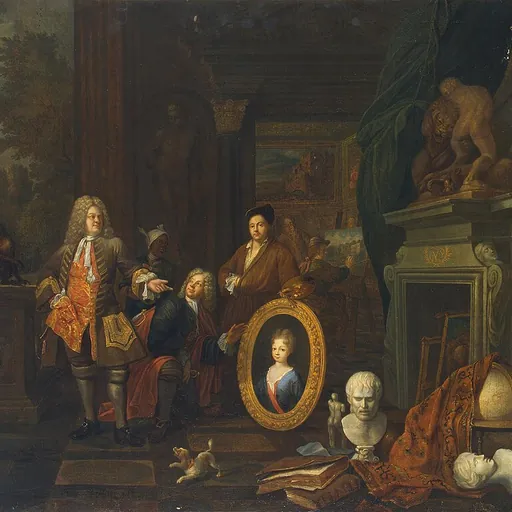
General While van den Bossche’s works include the occasional individual and group portrait, the bulk of his output explored the various genre subjects that had been introduced in Flemish and Dutch painting in the 17th century. The preferred subjects of his genre paintings were picture galleries and artist studios, which were also the preferred themes of his master Gerard Thomas. He also painted alchemists in their laboratories, guardroom scenes, conversation pieces, merry companies and doctor visits.
His teacher's style was evident in van den Bossche’s work. He shared the same preference for depicting luxurious bourgeois rooms and conversation pieces, that showcased his patrons' social superiority. These interiors were adorned with the symbols of genteel politeness, artistic discernment, fashion and wealth to highlight that his sitters possessed material wealth as well as social graces.
As was customary in Antwerp, van den Bossche collaborated with other specialist painters. His collaborations with Pieter van Bloemen (an animal specialist) and Jacob Balthasar Peeters (an architectural painter) are documented.
Artist studios and picture galleries
Van den Bossche gained a reputation with his representations of artist studio interiors and art collector galleries. He often painted pendant works with one of the pair of paintings representing an artist studio and the other the patron in his home with his collection.
The genre of the 'gallery paintings' is native to Antwerp where Frans Francken the Younger and Jan Brueghel the Elder were the first artists to create paintings of art and curiosity collections in the 1620s. Gallery paintings depict large rooms in which many paintings and other precious items are displayed in elegant surroundings usually with the owner present. The earliest works in this genre depicted art objects together with other items such as scientific instruments or peculiar natural specimens. The genre became immediately quite popular and was followed by other artists such as Jan Brueghel the Younger, Cornelis de Baellieur, Hans Jordaens, David Teniers the Younger, Gillis van Tilborch and Hieronymus Janssens. The art galleries depicted were either real galleries or imaginary galleries, sometimes with allegorical figures. The later development of the genre to which van den Bossche contributed depicted the figures in the gallery paintings in a manner which emphasised that they formed part of an elite with privileged knowledge of art. His gallery paintings thus were a medium to accentuate the notion that the powers of discernment associated with connoisseurship are socially superior to or more desirable than other forms of knowledge.
An example of van den Bossche's contribution to the genre is the composition A man examining a urine flask which shows a man examining a urine flask for the purpose of medical diagnosis. He is surrounded by alchemical and scholarly apparatus and books. A mother, daughter and child are consulting him. A possible interpretation of the scene is that they are trying to find out whether the daughter is pregnant. Another scene with a similar subject called The iatrochemist (Chemical Heritage Foundation) shows a man (the iatrochemist) holding up for inspection a urinal that was brought to him by a servant. The iatrochemist is consulting at the same time a manual. The room contains a number of alchemist tools but is clearly not intended as a realist representation of an alchemist's or physician’s work area. This is clear from the fact that many of the motifs in the scene are borrowed from Teniers or from other works of van den Bossche himself such as the globe and the Turkish carpet which he also used in some of his art studio scenes. The depictions of van den Bossche of the theme of the uroscopy do not appear to criticise the iatrochemist but rather show him as a person to whom the patients come in the confidence that he is a man of knowledge.
Guardroom scenes
Balthasar van den Bossche also painted a number of guardroom scenes. A guardroom scene typically depicts an interior with officers and soldiers engaged in merrymaking. Guardroom scenes often included mercenaries and prostitutes dividing booty, harassing captives or indulging in other forms of reprehensible activities.
Van den Bossche's guardroom scenes did not include the rowdy scenes more common in the 17th century but depicted more intimate settings of officers with their servants. An example of a guardroom scene by van den Bossche is the Guardroom scene (Sold at Dorotheum on 14 April 2005, Vienna, lot 116), which shows an Oriental looking officer who is instructing an African servant to add a saddle to a pile of weapons, a drum, parts of armour and a war standard in the foreground of the picture. The armour depicted in the picture was already out of date at the time it was painted since metal armours, breast plates and helmets fell out of use from the 1620s. It is possible that in line with the moralizing intent of the genre, the armour is a reference to the vanitas motif of the transience of power and fame.
Don’t just read it —
keep it.
Full-length biographies made to live with: read them, listen on the way to work, watch them tonight.
- E-book
- Audio
- Video
Instant download · yours to keep · every purchase keeps this site free
Important facts
more
II Bossche, V. der Bosch, Vanden Boos, b. van den bosche, B. van den Bossche, van Den II Bosch Balthasar, Van den Bossche, Vandenbosch, Vanemboss, Vanden Bossche, Vander-Bos, b. van der bossche, Van Bose, V. Boss, Vanderbosch, Bossche, Van der Bos, Vander Bos, Balthazar van den Bosch, Balthazar van den II Bossche, B. Van Den BoschPeople in Balthasar van den Bossche's life
Named in this biography and alive at the same time





Related people
Same field, nearest in time




Contemporaries
People whose lives overlapped Balthasar van den Bossche's



Frequently asked questions
Who was Balthasar van den Bossche?
Flemish painter (1681-1715)
When was Balthasar van den Bossche born?
Balthasar van den Bossche was born in 1681 in Antwerp.
When did Balthasar van den Bossche die?
Balthasar van den Bossche died in 1715 in Antwerp.
What was Balthasar van den Bossche's occupation?
Balthasar van den Bossche was a painter.
What nationality was Balthasar van den Bossche?
Balthasar van den Bossche's recorded nationality: Habsburg Netherlands.
Sources & further reading
· Wikipedia: Balthasar van den Bossche
· DBpedia: Balthasar van den Bossche
Cite this page
APA: Biography.guide. (2026). Balthasar van den Bossche. https://biography.guide/balthasar-van-den-bossche/
MLA: "Balthasar van den Bossche." Biography.guide, https://biography.guide/balthasar-van-den-bossche/.
Chicago: "Balthasar van den Bossche." Biography.guide. https://biography.guide/balthasar-van-den-bossche/.
Data last updated: 2026-09-22 · Spot an error? Report a correction.
Portrait: Wikimedia Commons · author & licence
Page generated 2026-09-27 05:00 UTC