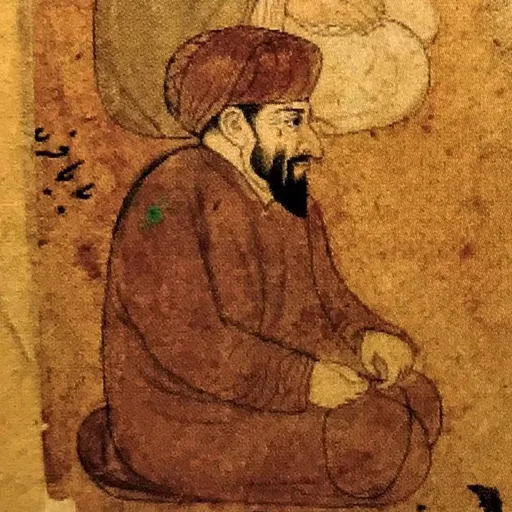
About Baba Farid
Lived 1175 – 1265 (aged 89–90). Baba Farid was a writer, poet and sufi.
Biography Bābā Farīd was born in 1188 (573 AH) in Kothewal, 10 km from Multan in the Punjab region, to Jamāl-ud-dīn Suleimān and Maryam Bībī (Qarsum Bībī), daughter of Wajīh-ud-dīn Khojendī. Another source claims he was born in 1173. His family had immigrated to the Indus Valley from Kabul in modern-day Afghanistan during the time of his grandfather. He received his early education at Multan, which had become a centre for Muslim education. There he met his teacher Khwaja Qutbuddin Bakhtiar Kaki, who was passing through Multan on his way from Baghdad to Delhi.
Once his education was over, he moved to Delhi, where he learned the Islamic doctrine from his master, Khwaja Qutbuddin Bakhtiar Kaki. He later moved to Hansi, Haryana. When Khwaja Bakhtiyār Kākī died in 1235, Farīd left Hansi and became his spiritual successor and instead of settling in Delhi, he returned to his native Punjab and settled in Ajodhan (present-day Pakpattan, Punjab, Pakistan). He was one of the founding fathers of the Chishti Sufi order.
Fariduddin Ganjshakar's shrine darbār is located in Pakpattan, Punjab, Pakistan.
Poetry
Baba Farid was the first major Punjabi poet.
It is uncertain if the verses attributed to Farid in the Sikh scripture refers to Fariduddin Ganjshakar. According to Bhardwaj (2016), the language of the verses more closely resembles a later stage of Punjabi, leading credence to the theory that these verses were originally authored by the 11th successor of Farid's spiritual lineage named Ibrahim Farid (also known as Farid Sani, "Farid the Second"), who died in Sirhind in 1552 and had disciples spread across Punjab and Delhi. According to this alternative view, Guru Nanak lived during the period of this Farid and perhaps procured the verses which were originally authored by Ibrahim Farid during a meeting between the two. Another theory is that the verses found in the Guru Granth Sahib attributed to Farid are ultimately originally traceable to Fariduddin Ganjshakar but that successive generations of his spiritual lineage altered the language of the verses to keep them understandable to the common population owing to linguistic evolution and change across generations. and the Auqaf Department, which administers the shrine. The shrine is open all day and night for visitors. The shrine has its own huge electricity generator that is used whenever there is power cut or loadshedding, so the shrine remains bright all night, all year round. When their matters are solved they bring charity food for visitors and the poor, and drop money in big money boxes that are kept for this purpose. This money is collected by the Auqaf Department of the Government of Pakistan that looks after the shrine.
On 25 October 2010, a bomb exploded outside the gates of the shrine, killing six people.
Baba Farid's Serai in Jerusalem In Jerusalem, there is a place called Al-Hindi Serai or Indian hospice (Indian lodge or shrine), where it is claimed Baba Farid lived for many years in the early 13th century, almost 800 years ago. Baba Farid walked into Jerusalem around the year 1200, little more than a decade after the armies of Saladin had forced the Crusaders out of Jerusalem. The place is now a pilgrim lodge for people of the Indian sub-continent. It is claimed that this building is currently cared for by the 94-year-old caretaker, Muhammad Munir Ansari, in 2014. "No one knows how long Baba Farid stayed in the city. But long after he had returned to the Punjab, where he eventually became head of the Chishti order, Indian Muslims passing through Jerusalem on their way to Mecca wanted to pray where he had prayed, to sleep where he had slept. Slowly, a shrine and pilgrim lodge, the Indian Hospice, formed around the memory of Baba Farid." The Shrine (mazar/mazār) is vast and spacious, located in the city of Pakpattan, otherwise Pākpattan Sharīf, located in central Punjab province in Pakistan. A chilla is found near Baghanwala village of Pind Dadan Khan, District Jhelum. A chilla is also found on the top of hill of Donphin nose hill of Visakhapatnam port of Visakhapatnam city in which it is believed that Hazarat Baba Fareed spent some time here, and there is a vast banyan tree in the premises which used to shed sugar in Baba's honour
Death anniversary and Urs Every year, the saint's death anniversary or Urs is celebrated for six days in the first Islamic month of Muharram, in Pakpattan, Pakistan. During the opening of the Gate of Paradise, extensive security arrangements are made to protect people from stampedes. In 2001, 27 people were crushed to death and 100 were injured in a stampede.
Legacy
As mentioned under Biography above, Baba Farid is considered one of the founding fathers of the Chishti Sufi order. His teacher, Khwaja Bakhtiar Kaki was a disciple of Moinuddin Chishti and Baba Farid's most famous disciple is Nizamuddin Chishti of Delhi, making him an important link in the chain of Chishti masters in South Asia and a very influential spiritual master in South Asia. [See also Honor in Sikhism below.]
One of Farīd's most important contributions to Punjabi literature was his development of the language for literary purposes. Whereas Sanskrit, Arabic, Turkish and Persian had historically been considered the languages of the learned and the elite, and used in monastic centres, Punjabi was generally considered a less refined folk language. Although earlier poets had written in a primitive Punjabi, before Farīd there was little in Punjabi literature apart from traditional and anonymous ballads. By using Punjabi as the language of poetry, Farīd laid the basis for a vernacular Punjabi literature that would be developed later. The English translation of Farid's devotional poetry by Rana Nayar was conferred with Sahitya Akademi Golden Jubilee award in 2007.
The city of Faridkot bears his name. According to legend, Farīd stopped by the city, then named Mokhalpūr, and sat in seclusion for forty days near the fort of King Mokhal. The king was said to be so impressed by his presence that he named the city after Baba Farid, which today is known as Tilla Baba Farid. The festival Bābā Sheikh Farād Āgman Purb Melā' is celebrated in September each year from (21–23 Sep, for 3 days), commemorating his arrival in the city. Ajodhan In Bangladesh, one of the largest districts of the country Faridpur District was named after him. It is believed that he established his seat in this town.
Faridia Islamic University, a religious madrassa in Sahiwal, Punjab, Pakistan, is named after him, and in July 1998, the Punjab Government in India established the Baba Farid University of Health Sciences at Faridkot, the city which itself was named after him.
There are various explanations of why Baba Farid was given the title Shakar Ganj ('Treasure of Sugar'). One legend says his mother used to encourage the young Farīd to pray by placing sugar under his prayer mat. Once, when she forgot, the young Farīd found the sugar anyway, an experience that gave him more spiritual fervour and led to his being given the name. Guru Arjan Dev Ji, the 5th guru of Sikhism, included these hymns himself in the Adi Granth, the predecessor of the Guru Granth Sahib.
Langar Fariduddin Ganjshakar first introduced the institution of the Langar in the Punjab region. The institution greatly contributed to the social fabric of Punjabi society and allowed peoples of various faiths and backgrounds to attain free food and drink. The practice, introduced by Fariduddin Ganjshakar grew and is documented in the Jawahir al-Faridi compiled in 1623 CE. It was later, both the institution and term, adopted by Sikhs.
Commemorative postage stamp In 1989, on the 800th birth anniversary of Baba Farid, the Pakistan Post Office issued a commemorative postage stamp in his honor.
Places named after him Baba Farid University of Health Sciences, Punjab, India Faridpur, Bangladesh Faridkot, Punjab, India Sheikhsar, Rajasthan, India Sheikhchuliya, Rajasthan, India Faridabad, Haryana, India
Descendants Salim Chisti (1478 – 1572), a famous Sufi saint during the reign of Akbar, was a direct descendant of Baba Farid. Muhibbullah Allahabadi (1587–1648) was also his descendant. Islam Khan I and Mukarram Khan who served as governors of Bengal Subah were grand-sons of Salim Chishti. The noble Paigah family, which was influential in the former Hyderabad state, also traced its lineage from Baba Farid.
Don’t just read it —
keep it.
Full-length biographies made to live with: read them, listen on the way to work, watch them tonight.
- E-book
- Audio
- Video
Instant download · yours to keep · every purchase keeps this site free
Important facts
People in Baba Farid's life
Named in this biography and alive at the same time

Related people
Same field, nearest in time




Contemporaries
People whose lives overlapped Baba Farid's






Frequently asked questions
Who was Baba Farid?
12th-century Punjabi Sunni Muslim preacher and mystic
When was Baba Farid born?
Baba Farid was born in 1175 in Multan.
When did Baba Farid die?
Baba Farid died in 1265 in Pakpattan.
What was Baba Farid's occupation?
Baba Farid was a writer, poet and sufi.
Sources & further reading
Cite this page
APA: Biography.guide. (2026). Baba Farid. https://biography.guide/baba-farid/
MLA: "Baba Farid." Biography.guide, https://biography.guide/baba-farid/.
Chicago: "Baba Farid." Biography.guide. https://biography.guide/baba-farid/.
Data last updated: 2026-09-21 · Spot an error? Report a correction.
Portrait: Wikimedia Commons · author & licence
Page generated 2026-09-27 04:59 UTC