
Qutbuddin Bakhtiar Kaki
Indian Sufi
About Qutbuddin Bakhtiar Kaki
Lived 1173 – 1235 (aged 61–62). Qutbuddin Bakhtiar Kaki was a sufi.
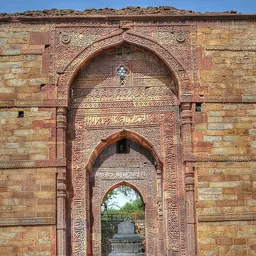
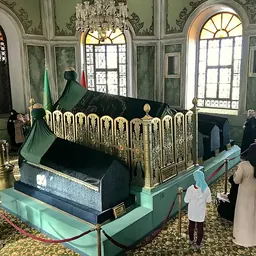
Quṭb al-Aqṭāb Khwāja Sayyid Muḥammad Bakhtiyār al-Ḥusaynī, Quṭb al-Dīn Bakhtiyār Kākī (born 1173 – died 1235) was a Sunni Muslim Sufi mystic, saint and scholar of the Chishti Order from Delhi, India. He was the disciple and the spiritual successor of Khawaja Sayyid Mu'in al-Din Chishti as head of the Chishti order. Before him the Chishti order in India was confined to Ajmer and Nagaur. He played a major role in establishing the order securely in Delhi. His Dargah is located adjacent to Zafar Mahal in Mehrauli, and is also the venue of his annual Urs festivities. The Urs was held in high regard by many rulers of Delhi like Iltutmish who built a nearby stepwell, Gandhak ki Baoli for him, Sher Shah Suri who built a grand gateway, Bahadur Shah I who built the Moti Masjid mosque nearby and Farrukhsiyar who added a marble screen and a mosque.
His most famous disciple and spiritual successor was Khawaja Sayyid Fariduddin Ganjshakar, who in turn became the spiritual master of Delhi's noted Sufi saint, Nizamuddin Auliya, who himself was the spiritual master of Amir Khusrau and Nasiruddin Chiragh Dehlavi.
Qutb al-Din Bakhtiyar Kaki had much influence on Sufism in India. As he continued and developed the traditional ideas of universal brotherhood and charity within the Chisti order, a new dimension of Islam started opening up in India which had hitherto not been present. He forms an important part of the Sufi movement which attracted many people to Islam in India in the thirteenth and fourteenth centuries. People of every religion like Hindus, Christians, Sikhs, etc. visiting his Dargah every week.
Early life Qutb al-Din Bakhtiyar Kaki was born in 569 A.H. (1173 C.E.) in the ancient city of Osh (alternatively Awsh or Ush) in the Fergana Valley (present Osh in southern Kyrgyz Republic (Kyrgyzstan), part of historic Transoxiana).
Khwaja Qutb al-Din's original name was Bakhtiyar and later on he was given the title Qutb al-Din. He was a Husayni Sayyid and his lineage is recorded as follows: He is Qutb al-Din Bakhtiyar bin Kamal al-Din Musa, bin Muhammad, bin Ahmad, bin Husam al-Din, bin Rashid al-Din, bin Radi al-Din, bin Hasan, bin Muhammad Ishaq, bin Muhammad, bin Ali, bin Ja'far, bin Ali al-Rida, bin Musa al-Kazim, bin Ja'far al-Sadiq, bin Muhammad al-Baqir, bin Ali Zayn al-Abidin, bin Husayn, bin Ali bin Abi Talib and Fatimah al-Zahra, the daughter of Prophet Muhammad. His mother, who herself was an educated lady, arranged for his education by Shaikh Abu Hafs. Thus, he was the first spiritual successor of Mu'in al-Din Chishti.
Later life
Move to Delhi
In obedience to the desire of his spiritual master, Mu'in al-Din Chishti, Khwaja Bakhtiyar moved to the city of Delhi during the reign of Iltutmish (r. 1211–1236) of the Delhi Sultanate. Many people started visiting him daily.
He continued and extended the musical tradition of the Chisti order by participating in sama or Mehfil-e-Sama. It is conjectured that this was with the view that, being in consonance with the role of music in some modes of Hindu worship, it could serve as a basis of contact with the local people and would facilitate mutual adjustments between the two communities. On the 14th of Rabi' al-Awwal 633 A.H. (27 November 1235 CE)
His influence over people Mahatma Gandhi visiting the Dargah during the Annual Urs, 1948. As a well-known saint, Khwaja Bakhtiyar Kaki exercised great sway over the people. He continued the policy of non-involvement with the government of the day. This was the traditional way of saints of the Chisti order in South Asia, as they felt that their linkage with rulers and the government would turn their mind towards worldly matters.
During the lifetime of the Khwaja he was held in great esteem by the Delhi Sultan, Iltutmish. It is contended that the Qutb Minar, the world's tallest brick minaret, partially built by Iltumish, was named so after him. He was also the favorite saint of the Lodi dynasty which ruled over Delhi from 1451 to 1526. His importance continues to this day and can be gauged by the following historical fact. When Mahatma Gandhi launched his last fast-unto-death in Delhi in 1948, asking that all communal violence be ended once and for all, he was pressed by leaders of all denominations to end the fast. One of the six conditions that Gandhi put forward to end the fast was that Hindus and Sikhs as an act of atonement should repair the shrine of Khwaja Bakhtiyar Kaki which had been damaged during the communal riots.
Phoolwalon-ki-sair festival
The darbaar shrine of Qutb al-Din Bakhtiyar Kaki has also been the venue of the annual Phoolwalon-ki-sair (a festival of flower-sellers) in autumn, which has now become an important inter-faith festival of Delhi.
The festival has its origins in 1812, when Queen Mumtaz Mahal, wife of the Mughal Emperor, Akbar II (r. 1806–1837) made a vow to offer a chadar and flower pankha at the Dargah and a pankha at the Yogmaya Temple, also at Mehrauli, if her son Mirza Jehangir, who, after inviting the wrath of Sir Archibald Seton, the then British Resident of the Red Fort, was exiled to Allahabad, returned safely. And as the legend goes, he did, and so began the tradition.
Royal grave enclosure
Incidentally, Akbar II is now buried nearby in a marble enclosure, along with other Mughals, Bahadur Shah I and Shah Alam II.
Works Divan-i Khwajah Qutb al-Din Bakhtiyar Kaki
Gallery
Don’t just read it —
keep it.
Full-length biographies made to live with: read them, listen on the way to work, watch them tonight.
- E-book
- Audio
- Video
Instant download · yours to keep · every purchase keeps this site free
Important facts
People in Qutbuddin Bakhtiar Kaki's life
Named in this biography and alive at the same time
Related people
Same field, nearest in time


Contemporaries
People whose lives overlapped Qutbuddin Bakhtiar Kaki's




Frequently asked questions
Who was Qutbuddin Bakhtiar Kaki?
Indian Sufi
When was Qutbuddin Bakhtiar Kaki born?
Qutbuddin Bakhtiar Kaki was born in 1173 in Osh, Osh Region.
When did Qutbuddin Bakhtiar Kaki die?
Qutbuddin Bakhtiar Kaki died on 27 November 1235 in Delhi.
What was Qutbuddin Bakhtiar Kaki's occupation?
Qutbuddin Bakhtiar Kaki was a sufi.
Sources & further reading
· Wikipedia: Qutbuddin Bakhtiar Kaki
· DBpedia: Qutbuddin Bakhtiar Kaki
Cite this page
APA: Biography.guide. (2026). Qutbuddin Bakhtiar Kaki. https://biography.guide/qutbuddin-bakhtiar-kaki/
MLA: "Qutbuddin Bakhtiar Kaki." Biography.guide, https://biography.guide/qutbuddin-bakhtiar-kaki/.
Chicago: "Qutbuddin Bakhtiar Kaki." Biography.guide. https://biography.guide/qutbuddin-bakhtiar-kaki/.
Data last updated: 2026-09-20 · Spot an error? Report a correction.
Page generated 2026-09-27 05:29 UTC