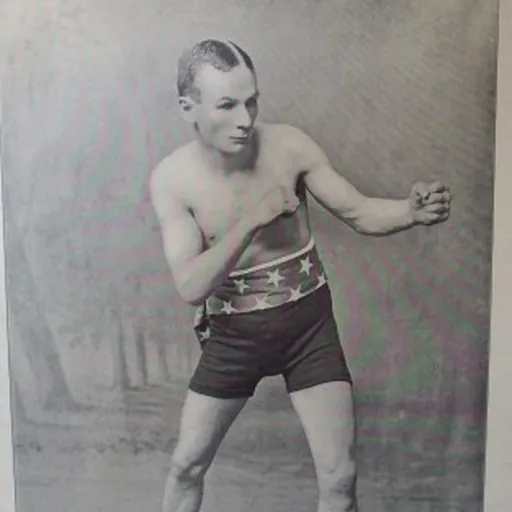
About Austin Rice
Lived 1872 – 1921 (aged 48). Austin Rice was an American boxer.
Austin Rice (December 25, 1872 – January 17, 1921) was a New London boxer who became a Featherweight Title contender on January 14, 1903, when he faced featherweight champion Young Corbett II in Hot Springs, Arkansas. Though he lost the fight, he went toe to toe with a world class competitor for eighteen rounds and would meet four more boxing champions, easily placing him among the World's top ten featherweight boxers for his era.
Though just missing a world title against Young Corbett II and George Dixon, Rice fought contenders Joe Bernstein, and Benny Yanger, as well as champions Harry Harris, Dave Sullivan, and Terry McGovern.
Early life Rice was born in Waterford, Connecticut, a suburb of New London, on December 25, 1872. He may have shared Tony Nelson as a boxing coach in his youth with fellow New London boxers Mosey King, an early New England Lightweight Champion and Abe Hollandersky, a welterweight, and 1913 Panamanian Heavyweight champion.
Rice got his start in boxing while drilling as a Waterford militiaman. He did some amateur bouts in New London while stationed there. One of his early boxing friends and sparring partners, Jim Gaffney, of New London, later became an important figure in the New London Police Department as well as a boxing manager. Another early opponent was Eddie Gallagher of New York. Martin and Joe Flaherty of New London worked as early managers for Rice.
Two months later, on February 27, 1902, Rice fought Jewish ex-Bantamweight World Champion Harry Harris to a six round draw at Chicago's Pyramid Athletic Club. That spring, Rice fought Benny Yanger, one of his most gifted opponents. Yanger, though never confirmed as a featherweight champion, beat boxing Hall of Famer Abe Attell by TKO in a close and historic nineteen round match on April 24, 1902, in St. Louis. Attell held the World Featherweight Title for an historic ten years between 1902 and 1912. Only one month after Yanger's remarkable win over featherweight champion Attell, Rice was selected to face Yanger in a six round match in Chicago on May 26, 1902, though he lost. The Topeka State Journal wrote that "George Siler gave the decision to Yanger, but not without protest from the majority of the sporting writers of the Chicago dailies." Another source noted that Rice may have won the battle with Yanger if there had been a few additional rounds.
Twice, Rice fought Billy Barrett, a competent New York featherweight in Stafford Springs and Middletown, Connecticut, on October 2 and May 1, 1901. Both bouts garnered considerable local press. They had met previously on November 26, 1899, in a close match in New York at catchweights of 128 pounds. Rice won the bout by a narrow margin. In August 1904, Rice consented to box a three round exhibition match at the opening of the New London Opera House with fellow New London boxer and long time Yale boxing coach Mosey King.
Rice was first scheduled for a 20 round exhibition with Young Corbett II, featherweight champion, in Waterford, Connecticut, on November 6, 1902. The match did not take place until January 14, 1903, in Arkansas, and the originally scheduled bout never took place. According to one article, police officers arrested Rice in Waterbury to prevent his fighting on November 6. Corbett II was apparently arrested in Hartford as well, on the grounds that boxing was illegal in Connecticut at the time. Fellow New London boxer Mosey King made the trip with Rice to Hot Springs, Arkansas, riding the trains day and night to meet featherweight champion Young Corbett II. The Featherweight Title Bout with Young Corbett II in Arkansas on January 14, which Rice lost in a 17 round TKO, was one of the most difficult of Rice's life, and he was in considerable distress by the end of the bout, More significantly, however, the Norwich Bulletin felt Rice unexpectedly dominated the first three rounds of the historic bout, and may have performed better if not for exhaustion from the long train ride he took to get to Hot Springs. This fight became the only sanctioned chance at the World Featherweight Title Rice would receive.
When not gaining income as a boxer, Rice worked at an iron mill near the end of his career. At times, he made extra income as a wrestler, as did many boxers of his era.
Rice died as a result of injuries from being run over by a wagon he was driving on January 17, 1921. He had been married and left one son, George.
Don’t just read it —
keep it.
Full-length biographies made to live with: read them, listen on the way to work, watch them tonight.
- E-book
- Audio
- Video
Instant download · yours to keep · every purchase keeps this site free
Important facts
People in Austin Rice's life
Named in this biography and alive at the same time




Related people
Same field, nearest in time


Contemporaries
People whose lives overlapped Austin Rice's


Frequently asked questions
Who was Austin Rice?
American boxer
When was Austin Rice born?
Austin Rice was born on 25 December 1872.
When did Austin Rice die?
Austin Rice died on 17 January 1921 in New London.
What was Austin Rice's occupation?
Austin Rice was a boxer.
What nationality was Austin Rice?
Austin Rice was American.
Sources & further reading
Cite this page
APA: Biography.guide. (2026). Austin Rice. https://biography.guide/austin-rice/
MLA: "Austin Rice." Biography.guide, https://biography.guide/austin-rice/.
Chicago: "Austin Rice." Biography.guide. https://biography.guide/austin-rice/.
Data last updated: 2026-09-22 · Spot an error? Report a correction.
Portrait: Wikimedia Commons · author & licence
Page generated 2026-09-27 05:04 UTC