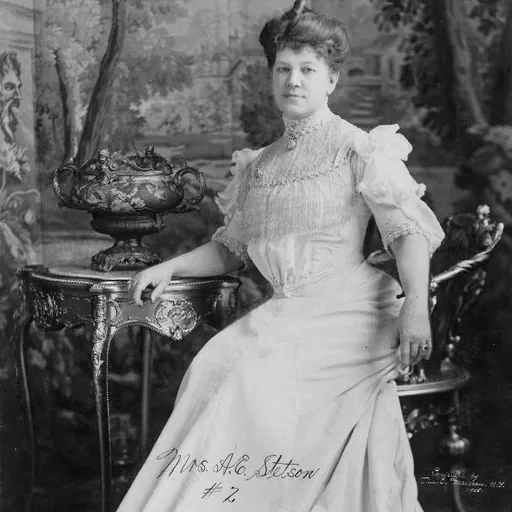
About Augusta Emma Stetson
Lived 1842 – 1928 (aged 85–86). Augusta Emma Stetson was an American poet, writer and theologian.
Augusta Emma Stetson (née Simmons) (October 12, 1842 – October 12, 1928) was an American religious leader. Known for her impressive oratory skills and magnetic personality, she attracted a large following in New York City. However, her increasingly radical theories, conflicts with other church members including a well-known rivalry with Laura Lathrop, and attempts to supplant Mary Baker Eddy as the leader of The First Church of Christ, Scientist, led to her eventually being excommunicated from the church on charges of insubordination and of false teaching. Afterwards she began preaching and publishing various works on her theories which she named the "Church Triumphant," and started a controversial radio station to advance her cause.
Early life and career Augusta Simmons was born in Waldoboro, Maine to Peabody and Salmoe Simmons, Eddy was apparently disappointed with Stetson's preaching style however, such as her going on stage in immodest dress, and was particularly "mortified" by her at least once "imitating a Negro playing on a banjo." Another student of Eddy's was Laura Lathrop, who had been sent there in October 1885 to help organize a church there, roughly a year before Stetson. Lathrop was, according to a journalist, "almost the antithesis of Mrs. Stetson in character and temperament" and that "Mrs. Lathrop attracts love, whereas Mrs. Stetson compels respect." Before Stetson arrived in New York, Lathrop had already established a Christian Science teaching institute, stirred up interest for the new religion in the city, and had even been praised for her healing work by Methodist bishop John Philip Newman. in February 1888; which was incorporated with 17 students with Stetson being named as preacher. Stetson began exerting her influence and control more and more over the New York Christian Scientist community, as well as in other parts of the United States, including as far west as Portland, Oregon.
Stetson clearly resented Lathrop. In 1891, she established the "New York City Christian Science Institute" to rival Lathrop's teaching institute, and formed a core group of support for herself within the fledgling church. Eddy increasingly chastised Stetson in letters, but was also grateful for the support Stetson had given her over the years. The $1,200,000 church edifice on 96th Street and Central Park West was dedicated free of debt in November 1903.
Excommunication and later years Because Stetson's church in New York was the largest and richest Christian Science church in the world at the time, many people within and without the movement saw her as Eddy's obvious successor as leader of the Christian Science church, a position Stetson clearly saw herself in as well, and to many it was only a question of whether she would be appointed or institute a coup. This was of concern to Eddy, who took opportunities to make it clear that she would not appoint Stetson as her successor. and "Christian Science: A Religion That Heals Through Spiritual Law". In a reversal from the previous antagonism with Second Church, The new First Church leadership announced that the Thanksgiving service that year would be combined with Second Church's. Stetson was, as one historian put it, an "incurable mythomaniac" and that "nothing she says, especially about herself, can be taken at face value", and she even went so far as to reassemble photostats of handwritten letters from Eddy to make herself look good. Stetson's former church in New York condemned her for the station, saying that she was in "no way connected with the Christian Science movement" and that the church opposed all "attacks on other religions or religionists." In 1927, Stetson predicted her own immortality, and in 1928, shortly before her death, she announced she was withdrawing from her radio station. Stetson died on October 12, 1928, in Rochester, New York.
Published works (partial list) Poems (1901; second edition, 1910) Reminiscences, Sermons, and Correspondence (1913) Vital Issues in Christian Science (1914)
Don’t just read it —
keep it.
Full-length biographies made to live with: read them, listen on the way to work, watch them tonight.
- E-book
- Audio
- Video
Instant download · yours to keep · every purchase keeps this site free
Important facts
People in Augusta Emma Stetson's life
Named in this biography and alive at the same time





Related people
Same field, nearest in time

Contemporaries
People whose lives overlapped Augusta Emma Stetson's

Frequently asked questions
Who was Augusta Emma Stetson?
American theologian (1842–1928)
When was Augusta Emma Stetson born?
Augusta Emma Stetson was born in 1842 in New York City.
When did Augusta Emma Stetson die?
Augusta Emma Stetson died in 1928.
What was Augusta Emma Stetson's occupation?
Augusta Emma Stetson was a poet, writer and theologian.
What nationality was Augusta Emma Stetson?
Augusta Emma Stetson was American.
Sources & further reading
· Wikipedia: Augusta Emma Stetson
· DBpedia: Augusta Emma Stetson
Cite this page
APA: Biography.guide. (2026). Augusta Emma Stetson. https://biography.guide/augusta-emma-stetson/
MLA: "Augusta Emma Stetson." Biography.guide, https://biography.guide/augusta-emma-stetson/.
Chicago: "Augusta Emma Stetson." Biography.guide. https://biography.guide/augusta-emma-stetson/.
Data last updated: 2026-09-21 · Spot an error? Report a correction.
Portrait: Wikimedia Commons · author & licence
Page generated 2026-09-27 04:59 UTC