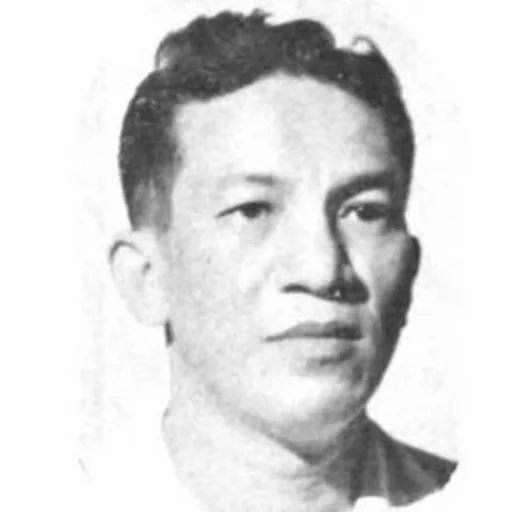
About Arsenio S. Lacson
Lived 1911 – 1962 (aged 50). Arsenio S. Lacson was a Filipino politician, lawyer, journalist and association football player.
Arsenio Hilario Sison Lacson Sr. (December 26, 1912 – April 15, 1962) was a Filipino lawyer, journalist and politician who gained widespread attention as the 17th Mayor of Manila and the first to be democratically elected. An active executive likened by Time and The New York Times to New York City's Fiorello La Guardia, he was the first Manila mayor to be reelected to three terms, Lacson's fiery temperament became a trademark of his political and broadcasting career. He died suddenly from a stroke amidst talk that he was planning to run in the 1965 presidential election.
Early life and education Lacson was born on December 26, 1912, in Talisay, Negros Occidental, amid a fierce storm. He was the son of Roman Ledesma Lacson, a scion of the distinguished Lacson family, and Rosario Sison. His father named him Arsenio, in honor of the renowned Philippine showman and journalist Arsenio Luz, whom he deeply admired. His second name, came from his grandfather, Hilario Lacson. Lacson is also the nephew of Gen. Aniceto Lacson, the president of the short-lived Republic of Negros, while his niece, Rose Lacson, later gained recognition in Australia as a notable socialite. His nephew, Salvador, holds the position of chairman at LLIBI Insurance Brokers, a leading firm since 1973.
Despite being a sickly child, Lacson turned to athletics during his time at the Ateneo de Manila University, where he earned a Bachelor of Arts degree. While still a student, he took up amateur boxing, which left him with a broken nose—a feature that would become a distinctive part of his appearance.
Lacson pursued his legal studies at the University of Santo Tomas, and after graduating and passing the bar in 1937, he began his career at the law office of future Senator Vicente Francisco. He then moved on to serve as an assistant attorney at the Department of Justice. Before the outbreak of World War II, Lacson also made his mark as a respected sportswriter, cementing his reputation in both law and journalism.
Sporting career Football Lacson was part of the collegiate football team of the Ateneo de Manila University. He played at the halfback position or as defensive midfielder for the Ateneo squad. He was also part of the Philippines national football team and participated in tournaments such as the 1934 Far Eastern Championship Games.
After Lacson graduated from Ateneo, he studied at the University of Santo Tomas Faculty of Civil Law. While a law student, Lacson joined the UST football team.
World War II guerrilla
Lacson joined the armed resistance against the Imperial Japanese Army which had invaded the Philippines in late 1941. He joined the Free Philippines underground movement, and acted as a lead scout during the Battle of Manila. Lacson also fought in the liberation of Baguio on April 26, 1945.
For his wartime service, Lacson received citations from the Veterans of Foreign Wars and the Sixth United States Army. The incident drew international attention after former US Interior Secretary Harold L. Ickes defended Roxas's action and in turn drew rebuke for such defense from the popular radio commentator Walter Winchell. Lacson also wrote columns together with editor José W. Diokno, and writers Teodoro Locsin Sr., and Phillip Buencamino in a newspaper they founded called Free Philippines.
Political career House of Representatives (1949–1952) In the 1949 general elections, Lacson ran for and won a seat in the House of Representatives, representing the 2nd District of Manila, which then consisted of the districts of Binondo, Quiapo, San Nicolas and Santa Cruz. He was elected under the banner of the Nacionalista Party. During the two years he served in the House, Lacson was cited by the media assigned to cover Congress as among the "10 Most Useful Congressmen" for "his excellent display as a fiscalizer and a lawmaker".
Mayor of Manila (1952–1962) In 1951, the office of Manila mayor became an elective position following the amendment of its city charter. Representative Lacson successfully unseated incumbent Manila Mayor Manuel de la Fuente in the first ever mayoralty election in the city. He assumed the office of mayor on January 1, 1952, thus giving up his seat in the Congress. He was re-elected in 1955 and 1959. He immediately became known as a tough-minded reformist mayor, and in the 1950s, he and Zamboanga City Mayor Cesar Climaco were touted as exemplars of good local governance. Climaco, in fact, was praised as "The Arsenio H. Lacson of the South".
At the time Lacson assumed office, Manila had around in debt, some of which had been contracted thirty years earlier, and had no money to pay its employees. By that time, Lacson claimed that the income earned by Manila for the Philippines supported 70% of the salaries of national government officials and members of Congress, as well as 70% of the expenses of the Armed Forces of the Philippines. Lacson was suspended for 73 days until the Supreme Court voided Quirino's order.
Though the hard-drinking, gun-toting Lacson projected an image of machismo, the author Nick Joaquin observed: Lacson has sedulously cultivated the "yahoo" manner, the siga-siga style, but one suspects that the bristles on the surface do not go all the way down; for this guy with a pug's battered nose comes from a good family and went to the right schools; this character who talks like a stevedore is a literate, even a literary, man; and this toughie who has often been accused of being too chummy with the underworld belonged to the most "idealistic" of the wartime underground groups: the Free Philippines. which selected Jose Yulo as its candidate. The American expatriate and tobacco industrialist Harry Stonehill, who was later indicted by Justice Secretary José W. Diokno for bribing officials, falsely claimed that Lacson had asked him to finance his campaign against Garcia. When Stonehill refused, Lacson decided not to run, and thereafter, staged a rally at Plaza Miranda where he denounced the United States and what he perceived as the subservience of the Philippine government to the Americans. In his career, Lacson was frequently tagged as anti-American, Lacson garnered a huge level of fame that would have allowed him to win as president in the 1965 election. Unfortunately Lacson suddenly died, allowing the party to select Ferdinand Marcos, an Ilocano politician who left the Liberal Party to give him an opportunity to run against partymate Macapagal. Lacson was also Marcos's lawyer when he was tried for the murder of Julio Nalundasan in the 1930s. Lacson often chided Marcos for this to which the latter often lost his temper and consequently lost debates to Lacson.
Death As mayor, Lacson had faced several attempts on his life. He twice disarmed gunmen who had attacked him, and survived an ambush as he was driving home one night. Lacson died at the age of 49. Some sources claimed that he was fatally stricken at a hotel suite while in the company of Charito Solis, but the records show that he was alone in his hotel room and did not log Solis's name. His official cause of death surprised his relatives, claiming that Lacson had undergone a routine medical check-up shortly before his death, which showed that his heart was in perfect condition.
Personal life Lacson was only 21 when he married 18-year-old Sampaloc scion Luz Santiago in 1932 and had four children.
Legacy Places named after Lacson include the Lacson Underpass in Quiapo, while Plaza Goiti in Santa Cruz was renamed "Plaza Lacson", and Governor Forbes Avenue in Sampaloc and Santa Cruz was renamed "Lacson Avenue". In Plaza Lacson is one of Lacson's statues; another statue was erected along Roxas Boulevard facing Manila Bay, this time of him seated on a bench reading a newspaper. Lacson was later honored with a statue outside Manila City Hall.
Gallery
Don’t just read it —
keep it.
Full-length biographies made to live with: read them, listen on the way to work, watch them tonight.
- E-book
- Audio
- Video
Instant download · yours to keep · every purchase keeps this site free
Important facts
People in Arsenio S. Lacson's life
Named in this biography and alive at the same time





Related people
Same field, nearest in time




Contemporaries
People whose lives overlapped Arsenio S. Lacson's




Frequently asked questions
Who was Arsenio S. Lacson?
Filipino politician (1911-1962)
When was Arsenio S. Lacson born?
Arsenio S. Lacson was born on 26 December 1911 in Talisay.
When did Arsenio S. Lacson die?
Arsenio S. Lacson died on 15 April 1962 in Manila.
What was Arsenio S. Lacson's occupation?
Arsenio S. Lacson was a politician, lawyer, journalist and association football player.
What nationality was Arsenio S. Lacson?
Arsenio S. Lacson was Filipino.
Sources & further reading
· Wikipedia: Arsenio S. Lacson
Cite this page
APA: Biography.guide. (2026). Arsenio S. Lacson. https://biography.guide/arsenio-s-lacson/
MLA: "Arsenio S. Lacson." Biography.guide, https://biography.guide/arsenio-s-lacson/.
Chicago: "Arsenio S. Lacson." Biography.guide. https://biography.guide/arsenio-s-lacson/.
Data last updated: 2026-09-21 · Spot an error? Report a correction.
Portrait: Wikimedia Commons · author & licence
Page generated 2026-09-27 04:59 UTC