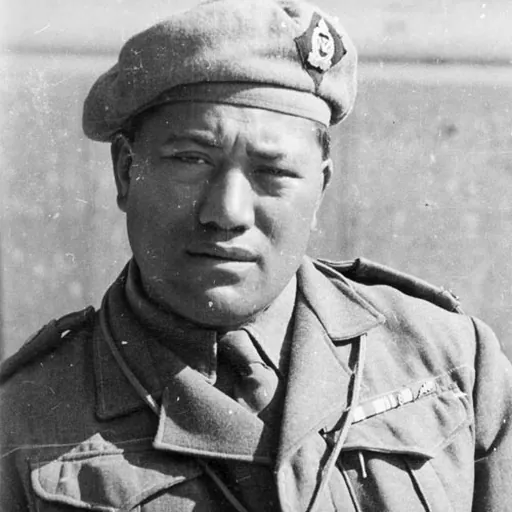
Arapeta Awatere
Ngati Porou and Ngati Hine; interpreter, military leader, Maori welfare officer, local politician, convicted murderer
About Arapeta Awatere
Lived 1910 – 1976 (aged 65). Arapeta Awatere was a New Zealand politician.
Arapeta Marukitepua Pitapitanuiārangi Awatere (25 April 1910 – 6 March 1976) was a scholar, decorated military leader, Māori welfare officer, writer, linguist, and local politician. He served in the Māori Battalion from 1940 to 1945, commanding C Company at the Battle of Tebaga Gap in 1943 and later leading the battalion in Italy. He was awarded the Military Cross and the Distinguished Service Order for bravery and leadership.
After the war he became a prominent civic figure, teaching and advocating for Māori language and culture. He also wrote poetry and translated literary works into Māori, with some of his early poems appearing in Te Ao Hou in 1959. Despite later health struggles, including the effects of a stroke and diabetes, Awatere remained active as a teacher and writer.
In 1969, following the murder of his mistress’s lover, he was imprisoned at Mount Eden Prison, where he continued to write and teach until his death in 1976.
Sir Peter Williams QC described him as “one of the great New Zealanders of all time.” Early life Born in Tūpāroa, on the East Coast of New Zealand, on 25 April 1910, Arapeta Marukitepua Pitapitanuiārangi Awatere was the son of Petuere Wī Hēkopa Awatere, a farmer, and his wife Hēni Hautao. Through his father, he was affiliated with the Te Whānau-a-Hinetāpora hapū (sub-tribe) of Ngāti Porou, and with the Ngāti Hine iwi via his mother. His early years were spent in Northland, at his mother's marae at Whangaruru, before he returned to the East Coast at the age of 6.
His paternal family supervised his education, ensuring that Awatere was immersed in Māori tradition and arts. He became highly skilled in Māori weaponry, particularly the taiaha (staff weapon). Educated at local schools, he proceeded to Te Aute College in Hawke’s Bay for his secondary schooling. As his parents had died by this time, he worked as a sailor during the holiday periods to pay his tuition. In 1933, he returned to the East Coast, settling at Gisborne.
Battle for Point 209
As commander of C Company, Awatere took part in the Battle of Tebaga Gap—specifically, the assault on Point 209, a decisive phase of the Tunisian campaign and the Allied attempt to breach the Mareth Line. Prior to the attack, the Tairāwhiti officers, including Awatere, Lieutenant Ngarimu, and Pine Taiapa, had written to Sir Āpirana Ngata expressing deep concern for the heavy losses among the men of C Company. The letter, dated 18 February 1943, arrived in New Zealand only after news reached Ngata of the deaths of Ngarimu and twenty-two others at Point 209.
Much of the modern understanding of the engagement derives from Monty Soutar’s Ngā Tama Toa: The Price of Citizenship (2008), which draws on oral testimony and battalion records. According to Soutar, as well as Awatere’s memoir Awatere: A Soldier’s Story (1974) and J. F. Cody’s official battalion history (1956), the attack began with C Company ordered to seize a forward ridge—later nicknamed Hikurangi—which was mistakenly identified as Point 209. Faulty intelligence left the Māori troops exposed on the lower slope while more heavily armed German Panzer Grenadiers held the true crest of Point 209 behind them.
Leading from the front, Awatere personally directed the advance under fire, signalling movements by whistle and hand. Ngarimu led 14 Platoon in a charge that destroyed two German machine-gun posts and captured the crest of Hikurangi. Through the night of 26–27 March, C Company repelled repeated counter-attacks at close quarters, using rifles, bayonets, grenades, and even stones when ammunition ran out. Ngarimu, twice wounded, refused evacuation and continued to lead; Awatere, also wounded, remained in command until relieved the following morning. Of the 98 men who advanced, 22 were killed and almost all the remainder wounded.
Their defence of Hikurangi enabled the New Zealand Division to break through the Tebaga Gap and open the way for the Eighth Army’s advance on the Mareth Line. Ngarimu was posthumously awarded the Victoria Cross—the first Māori recipient—while Awatere received the Military Cross and Colonel Charles Bennett the Distinguished Service Order.
Italy and Command Following the Tunisian campaign, the battalion joined the Italian Campaign in October 1943, fighting at Orsogna, Cassino, Florence, and Faenza. Awatere was appointed commanding officer of the 28th Battalion in July 1944, succeeding Lieutenant Colonel R. Young who had taken ill, serving in this capacity for two months until Young’s return to duty. Awatere reverted to second-in-command of the unit. On 18 November 1944 Young stood down as commander as he was returning to New Zealand on furlough; Awatere, now a lieutenant colonel, resumed command of the battalion. In recognition of his services during the campaign in Italy, he was awarded the Distinguished Service Order (DSO). According to another member of the battalion, Awatere gave a speech after being presented with the DSO, during which he stressed that his award belonged to all the battalion, not himself. Following the end of the war in Europe, Awatere relinquished command in June 1945 and returned to New Zealand.
Later life Arapeta Awatere in Auckland, c. 1960s. Courtesy of the Alexander Turnbull Library, Wellington, New Zealand. Licensed for non-commercial use with attribution.
After his return to New Zealand in August 1945, Awatere spent two years travelling with Eruera Stirling, visiting hundreds of marae to honour members of the 28th (Māori) Battalion who had been killed during the war. Following this commemorative tour, he undertook two rituals of purification that were intended to release him from the effects of warfare.
In the days leading up to 3 August 1969, he told friends and a church colleague, the Reverend Wī Huata, that he had experienced several rehu (premonitions) that Hākaraia was in danger. He sought Huata’s advice that evening, but the minister was unavailable, and Awatere later told him he had felt compelled to check on her welfare.
Writing in a review of Murray Edmond’s Time to Make a Song and Dance: Cultural revolt in Auckland in the 1960s, David Eggleton observed that the book encapsulates Awatere as “a complex, tragic figure”.
His poetry appeared in leading journals including Te Ao Hou Despite this, his work was often excluded from mid-century English-language anthologies because he wrote primarily in Māori.
Don’t just read it —
keep it.
Full-length biographies made to live with: read them, listen on the way to work, watch them tonight.
- E-book
- Audio
- Video
Instant download · yours to keep · every purchase keeps this site free
Important facts
People in Arapeta Awatere's life
Named in this biography and alive at the same time




Related people
Same field, nearest in time





Contemporaries
People whose lives overlapped Arapeta Awatere's





Frequently asked questions
Who was Arapeta Awatere?
Ngati Porou and Ngati Hine; interpreter, military leader, Maori welfare officer, local politician, convicted murderer (1910-1976)
When was Arapeta Awatere born?
Arapeta Awatere was born on 25 April 1910.
When did Arapeta Awatere die?
Arapeta Awatere died on 6 March 1976.
What was Arapeta Awatere's occupation?
Arapeta Awatere was a politician.
What nationality was Arapeta Awatere?
Arapeta Awatere was New Zealand.
Sources & further reading
Cite this page
APA: Biography.guide. (2026). Arapeta Awatere. https://biography.guide/arapeta-awatere/
MLA: "Arapeta Awatere." Biography.guide, https://biography.guide/arapeta-awatere/.
Chicago: "Arapeta Awatere." Biography.guide. https://biography.guide/arapeta-awatere/.
Data last updated: 2026-09-21 · Spot an error? Report a correction.
Portrait: Wikimedia Commons · author & licence
Page generated 2026-09-27 05:00 UTC