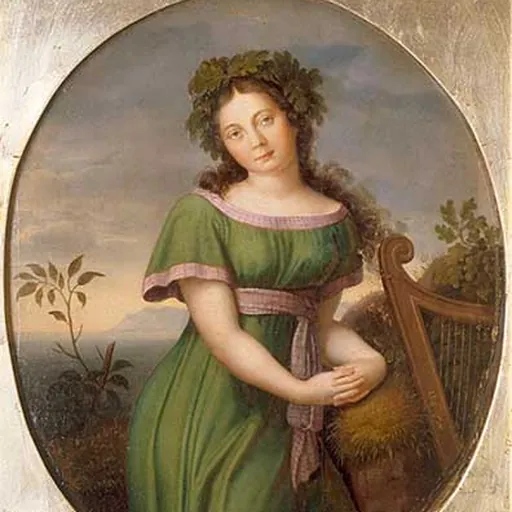
Anna Milder-Hauptmann
Soprano opera singer in Austria and Germany
About Anna Milder-Hauptmann
Lived 1785 – 1838 (aged 52). Anna Milder-Hauptmann was an Austrian actor, opera singer and singer.
Pauline Anna Milder-Hauptmann (13 December 1785 – 29 May 1838) was an operatic soprano. Her career spanned a remarkable period in Western classical music: early on, she sang for Joseph Haydn; she later premiered some songs by Franz Schubert; and toward the end of her career sang in the celebrated revival of J. S. Bach's Saint Matthew Passion under the direction of Felix Mendelssohn. Above all, Milder is remembered for having sung the demanding role of Leonore at the premieres of all three versions (1805, 1806, 1814) of Beethoven's opera Fidelio.
Biography Early life Milder was born in Constantinople where her father, Felix Milder from Salzburg, was employed by the Austrian ambassador Baron Herbert von Rathkeal as "Kabinets-Courier"; her mother was lady-in-waiting to the ambassador's wife. When Anna was five years old, the family left for Bucharest, where Felix worked as translator until they had to leave because of the Austro-Turkish War (1788–1791). Milder had astonished Neukomm at her audition by effortlessly singing the famous high-tessitura Queen of the Night aria by Mozart; under his instruction she developed fullness and beauty of sound in her mid and lower registers. Milder was engaged for 500 florins, and made her stage debut there as Juno in Süßmayr's opera Der Spiegel von Arkadien on 9 April 1803. Soon she won major roles and moved to the Theater am Kärntnertor, with a contract worth 2,000 florins. In 1805, she sang the title role in the first performance of Beethoven's Leonore, and again in the second and third versions in 1806 and 1814, when in the final revision its title was changed to Fidelio, as it is known today'. Luigi Cherubini wrote his German opera Faniska for her in 1806. He was so impressed by her performance in Martín's opera Una cosa rara and other works that he invited her to Paris, but she refused due to her impending marriage to Viennese jeweler Peter Hauptmann in 1810. Peter Hauptmann (1763–1858) maintained at this time his own house theater in the Trattnerhof. The marriage was not happy, they had a daughter in 1811 and later the couple lived separately. She contributed to the success of Joseph Weigl's Das Waisenhaus (1808) and, as Emmeline, Die Schweizer Familie (1809). Her performance in Gluck's Iphigénie en Tauride in 1812 was largely responsible for the Gluck revival in Vienna and Berlin. She sang in the first Vienna performance of Cherubini's Médée in 1812. In 1812 and 1813, she toured Breslau, Berlin, Karlsruhe, Stuttgart and Frankfurt. The Austrian currency fell sharply around 1814, and Milder-Hauptmann received offers for roles at the Berlin Court Opera. Accompanied by her sister Jeanette Antonie Bürde, an accomplished composer and pianist, she travelled to Berlin in May 1815 where she would stay for the next 14 years. Gaspare Spontini was music director at the Berlin Court Opera, and she sang the role of Statira in the first Berlin performance of his opera Olimpie in 1821 as well as in the premieres of his operas Nurmahal (as Namouna) in 1822 and Agnes von Hohenstaufen (as Irmengard) in 1827. Following a quarrel with Spontini, she left Berlin in 1829 and visited Russia, Sweden and Denmark. She then returned to Berlin, where she made her last public appearance in 1836. was written by Beethoven specifically for Anna Milder. Beethoven later twice made major revisions to his opera (1806, 1814) and on both occasions Milder returned to take the title role.
Milder had a substantial influence on the final 1814 form of the opera in demanding modifications to her extended scena in Act 1. Winton Dean writes, "Milder later told Anton Schindler that she had severe struggles with Beethoven over 'the unbeautiful, unsingable passages [the Act 1 scena], unsuited to her voice'." Later sopranos may be grateful to Milder for prevailing in this struggle, since the changes she insisted on made the aria easier to sing. But Dean also opines that Beethoven's changes were a major improvement in the music itself, making it "terser and more concentrated".
Milder was intended to sing Beethoven's concert aria "Ah, perfido!", Op. 65, at his massive Academy Concert on 22 December 1808 (when the Fifth and Sixth Symphonies, Fourth Piano Concerto and Choral Fantasia were heard for the first time under the composer's direction), but following a quarrel between Beethoven and Peter Hauptmann, Milder's soon-to-be husband, she refused and was replaced (disastrously) by a young singer named Josephine Killitschky.
Beethoven admired Milder very much and sought to create a new opera that would again feature her in a prominent role, even after she moved to Berlin in 1816 (where she was again very successful in the local production of Fidelio). This is known through a friendly letter from Beethoven to Milder sent in 1816. However, though many candidate libretti were considered by the composer during his remaining years, he never wrote another opera.
In later life Milder made five visits to Vienna in order to visit her daughter there.
Reputation and opinion Milder's voice was repeatedly praised for its strength and beauty. Joseph Haydn once said to the young Milder, after she had sung an aria for him, "My dear child, you have a voice like a house." Johann Friedrich Reichardt said Milder's voice was the most beautiful he had heard since Elisabeth Mara's. Goethe was deeply moved by Milder's performance when he heard her in 1823 in Marienbad; on the occasion of Milder's 25th stage anniversary on 9 April 1828, he sent her a dedicated copy of his play Iphigenia in Tauris. Generally, her performances of works by Rossini were disliked by critics.
Dedications Many composers dedicated works to Milder-Hauptmann, including Bernhard Klein, Neukomm, Carl Blum, Conradin Kreutzer, Joseph Wolfram, Carl Borromäus von Miltitz. Among the more notable works are:
Kreutzer wrote his monodrama Adele von Budoy (1821, in 1823 revived as Cordelia with Wilhelmine Schröder-Devrient) for Milder. Franz Schubert wrote the lied "Der Hirt auf dem Felsen", D. 965, for Milder-Hauptmann which she premiered in Riga on 10 February 1830 and later that year also sang in Berlin. Milder had previously premiered Schubert's song "Die Forelle" and he had in 1824 dedicated the lied "Suleika II", D. 717, to her; the role of Estrella in his opera Alfonso und Estrella was designed for her, but the opera was never performed during Schubert's lifetime. The Allgemeine musikalische Zeitung (XVI, 1814, col. 315) wrote: "Happy those for whom works are written!" .
Don’t just read it —
keep it.
Full-length biographies made to live with: read them, listen on the way to work, watch them tonight.
- E-book
- Audio
- Video
Instant download · yours to keep · every purchase keeps this site free
Important facts
People in Anna Milder-Hauptmann's life
Named in this biography and alive at the same time






Related people
Same field, nearest in time



Contemporaries
People whose lives overlapped Anna Milder-Hauptmann's



Frequently asked questions
Who was Anna Milder-Hauptmann?
Soprano opera singer in Austria and Germany (1785-1838)
When was Anna Milder-Hauptmann born?
Anna Milder-Hauptmann was born on 13 December 1785 in Constantinople.
When did Anna Milder-Hauptmann die?
Anna Milder-Hauptmann died on 29 May 1838 in Berlin.
What was Anna Milder-Hauptmann's occupation?
Anna Milder-Hauptmann was an actor, opera singer and singer.
What nationality was Anna Milder-Hauptmann?
Anna Milder-Hauptmann was Austrian.
Sources & further reading
· Wikipedia: Anna Milder-Hauptmann
· DBpedia: Anna Milder-Hauptmann
Cite this page
APA: Biography.guide. (2026). Anna Milder-Hauptmann. https://biography.guide/anna-milder-hauptmann/
MLA: "Anna Milder-Hauptmann." Biography.guide, https://biography.guide/anna-milder-hauptmann/.
Chicago: "Anna Milder-Hauptmann." Biography.guide. https://biography.guide/anna-milder-hauptmann/.
Data last updated: 2026-09-21 · Spot an error? Report a correction.
Portrait: Wikimedia Commons · author & licence
Page generated 2026-09-27 04:58 UTC