
About Amaro Rodríguez Felipe
Lived 1678 – 1747 (aged 69). Amaro Rodríguez Felipe was a Spanish privateer, merchant, moneylender and pirate.
Amaro Rodríguez-Felipe y Tejera Machado (3 May 16784 October 1747), also known as Amaro Pargo, was a Spanish privateer and merchant. He was one of the most well-known Spanish privateers during the Golden Age of Piracy. Pargo was noted for his commercial activities and for his frequent religious donations and aid to the poor. As a privateer, he targeted trade routes between Cádiz and the Caribbean, on several occasions attacking British and Dutch merchant ships, earning recognition in his time as a hero and coming to be regarded as "the Spanish equivalent of Francis Drake". He was declared a Caballero hidalgo in 1725 and obtained certification of nobility and royal arms in 1727.
Nickname For years there has been speculation as to the reason behind Rodríguez Felipe's nickname of Pargo. Traditionally, it has been believed that this pseudonym means that the raider was "fast", "elusive in battle" and "moving in the sea as the aforementioned fish", the red porgy (also called Pargo). More recent theories rooted in popular tradition have also attributed the nickname to the facial features of a corsair.
More recently, other theories have emerged; Professor Manuel de Paz at the University of La Laguna and librarian Daniel García Pulido view Rodríguez Felipe's nickname as not having to do with his face resembling a fish, but with the nickname of his family's clan.
He was baptized by the priest Manuel Hurtado Mendoza in the Iglesia de Los Remedios (Church of Our Lady of Los Remedios, today a cathedral in the city). His godfather was Amaro López. He was the son of Juan Rodríguez Felipe and Beatriz Tejera Machado. He had seven brothers.
Amaro lived with his family in the Plaza de San Cristóbal in La Laguna (also called "Plaza Tanque de Abajo"). The family had several possessions and houses, most of them located close to the political, economic, and religious center of the city, around the current Plaza del Adelantado (then called "Plaza de Abajo"). He advised the captain to feign surrender in order to start a battle from which they emerged victorious. In gratitude, the captain gave Amaro his first ship. With it he began his business activities, including participation in the Atlantic slave trade in Spanish America. For this, Amaro Pargo obtained a letter of marque from King Philip V of Spain. He also traded in other products such as various textiles and nuts. These products were brought from the Canary Islands to the Indies. Main commercial routes of the Spanish Empire with the Indies (in red). Amaro Pargo used the route that crossed the Atlantic and went to the Caribbean.
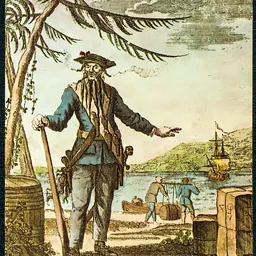
In 1712, Pargo captured the British-flagged merchant ship Saint Joseph, which operated out of Dublin and was commanded by Captain Alexander Westher. Pargo was later accused of not having acted with rigor at the time of exercising his rights as a privateer. This was because Pargo looted the ship's cargo and forced Westher to sail with Pargo's ship to the port of Santa Cruz de Tenerife on pain of sinking Saint Joseph if Westher refused to do so. Nevertheless, the capture of Saint Joseph was considered legitimate because Britain was at war with Spain. He was a character who in his day had the same reputation and popularity as that of Blackbeard and Francis Drake.
Access to the nobility On 25 January 1725 Amaro Pargo was declared Caballero hijodalgo. In addition, Pargo obtained the actual certification of Nobility and Arms also given in Madrid on 9January 1727 by Juan Antonio de Hoces Sarmiento, who was chronicler and king of arms of Felipe V of Spain.
The privateer attributed many of his exploits to the miraculous intervention of the nun, including an episode in which the nun reportedly saved his life in Cuba, without her body leaving the convent; that is, by the phenomenon of bilocation.
Those searching for romance have over the centuries wanted to see deeper meaning in the friendship between the privateer and the nun who was 25 years his elder. Balbina Rivero, author of Amaro Pargo, el pirata de Tenerife, suggests that interpretation in his book.
Death and inheritance Amaro died 4 October 1747 in his hometown. According to chronicles, his funeral was "very solemn" and the funeral procession transferring his body to his burial site made eight stops on the street, slowed down by the crowd that accompanied the procession.
According to historical records, Pargo was buried alongside his parents and a black servant. The tomb was found, however, to also contain six more people, as well as some incomplete remains of babies. It is believed that some of these people were nephews or great nephews of Amaro Pargo, while the babies were found to not be related to the privateer. They may have been buried together with Pargo due to a custom all over Spain and the Canary Islands to bury unbaptized children next to an adult, in the belief that the adult would guide them to Heaven.
The exhumation was funded by the French video game company Ubisoft to promote the sixth installment of their Assassin's Creed video game series, Assassin's Creed IV: Black Flag, and Naughty Dog's popular gaming franchise Uncharted. as Barbuzano spent five years to investigating Pargo in historical archives of the Indies in Seville, where all documentation of travel between Spain and America was kept. Amaro Pargo was a main character in Alexander De Chastelaine's novel Black Sam, where the benevolent privateer Pargo offered Samuel Bellamy and his pirate crew refuge at his home shores on the Canary Islands.
Among the novels inspired by him are Amaro Pargo, el pirata de Tenerife by Balbina Rivero, and El Sarcófago de las Tres Llaves by Pompeyo Reina, and the Argentine writer Ernesto Frers makes reference to Amaro Pargo in his work Más allá del legado pirata.
Film and television Mural painting representing Pargo located in San Cristóbal de La Laguna, Tenerife. In 1989, Televisión Española en Canarias broadcast a television series called La historia en persona. This series consisted of thirteen episodes, one of which was dedicated to the figure of Amaro Pargo.
In 2023, the American television series Expedition Unknown dedicated a chapter to the figure of Amaro Pargo with the title "Riches of Spain's Pirate King".
Music and theater The musical group Rincón de La Mareta dedicated a song to Pargo in 2016. In it, composed by Raquel Álvarez, the story of Amaro Pargo, his fortune and his passage through Cuba is narrated.
In the theatrical play La Conquista más pirata of Timaginas Teatro, Amaro Pargo shares the limelight with Rear Admiral Horacio Nelson, the Catholic Monarchs and Alonso Fernández de Lugo.
In the year 2022, in the month of May, coinciding with Amaro's birth anniversary, an album dedicated entirely to his figure called El Corsario de Aguere is released, under the direction and musical production of Raquel Álvarez.
Others In 2017, the Ruta Gastronómica de Amaro Pargo was presented in the city of La Laguna, a gastronomic route set in 18th-century cuisine and inspired by the figure of Pargo.
The City Council of San Cristóbal de La Laguna launched in 2021 an interactive video game entitled El tesoro de Amaro Pargo, which allows you to discover the main historical-artistic values of this city, declared a World Heritage Site by UNESCO in 1999.
Don’t just read it —
keep it.
Full-length biographies made to live with: read them, listen on the way to work, watch them tonight.
- E-book
- Audio
- Video
Instant download · yours to keep · every purchase keeps this site free
Important facts
People in Amaro Rodríguez Felipe's life
Named in this biography and alive at the same time


Related people
Same field, nearest in time


Contemporaries
People whose lives overlapped Amaro Rodríguez Felipe's




Frequently asked questions
Who was Amaro Rodríguez Felipe?
Spanish corsair (1678–1747)
When was Amaro Rodríguez Felipe born?
Amaro Rodríguez Felipe was born on 3 May 1678 in San Cristóbal de La Laguna.
When did Amaro Rodríguez Felipe die?
Amaro Rodríguez Felipe died on 4 October 1747 in San Cristóbal de La Laguna.
What was Amaro Rodríguez Felipe's occupation?
Amaro Rodríguez Felipe was a privateer, merchant, moneylender and pirate.
What nationality was Amaro Rodríguez Felipe?
Amaro Rodríguez Felipe was Spanish.
Sources & further reading
· Wikipedia: Amaro Rodríguez Felipe
Cite this page
APA: Biography.guide. (2026). Amaro Rodríguez Felipe. https://biography.guide/amaro-rodriguez-felipe/
MLA: "Amaro Rodríguez Felipe." Biography.guide, https://biography.guide/amaro-rodriguez-felipe/.
Chicago: "Amaro Rodríguez Felipe." Biography.guide. https://biography.guide/amaro-rodriguez-felipe/.
Data last updated: 2026-09-20 · Spot an error? Report a correction.
Page generated 2026-09-27 05:24 UTC