
Blackbeard
English pirate
About Blackbeard
Lived 1680 – 1718 (aged 37–38). Blackbeard was a British pirate.
Edward Teach (or Thatch; ), better known as Blackbeard, was an English pirate who operated around the West Indies and the eastern coast of Britain's North American colonies. He remains one of history's most well-known pirates.
Little is known about Blackbeard's early life, but he may have been a sailor on privateering ships during Queen Anne's War before he settled on the Bahamian island of New Providence, a base for Captain Benjamin Hornigold, whose crew Teach joined around 1716. Hornigold placed him in command of a sloop that he had captured, and the two engaged in numerous acts of piracy. Their numbers were boosted by the addition to their fleet of two more ships, one of which was commanded by Stede Bonnet, but Hornigold retired from piracy toward the end of 1717, taking two vessels with him.
Teach captured a French slave ship known as , renamed her , equipped her with 40 guns, and crewed her with over 300 men. His nickname derived from his thick black beard and menacing appearance. He was reported to have tied lit fuses (slow matches) under his hat to frighten his enemies. He formed an alliance of pirates and blockaded the port of Charles Town, South Carolina, ransoming its inhabitants. He then ran Queen Anne's Revenge aground on a sandbar near Beaufort, North Carolina. He parted company with Stede Bonnet and settled in Bath, North Carolina, historically known as Bath Town, where he accepted a royal pardon. However, he was soon back at sea, where he attracted the attention of Alexander Spotswood, the governor of Virginia. Spotswood arranged for a party of soldiers and sailors to capture him. On , following the battle at Ocracoke Inlet, Teach and several of his crew were killed by a small force of sailors led by Lieutenant Robert Maynard. His flagship Queen Anne's Revenge was discovered by divers in November 1996 in Beaufort Inlet off the coast of North Carolina.
Teach was a shrewd and calculating leader who spurned the use of violence, relying instead on his fearsome image to elicit the response that he desired from those whom he robbed. He was romanticised after his death and became the inspiration for an archetypal pirate in works of fiction across many genres.
Early life Little is known about Blackbeard's early life. It is commonly believed that at the time of his death he was between 35 and 40 years old and thus born around 1680. In contemporary records his name is most often given as Blackbeard, Edward Thatch or Edward Teach. The latter is most often used because it is the form used in the dispatches of North America's only newspaper at the time, The Boston News-Letter, but primary sources written by people who had actually met the pirate all refer to him as "Thatch" or variations thereof. Several spellings of his surname exist: Thatch, Thach, Thache, Thack, Tack, Thatche, and Theach. One source claims that his surname was Drummond, but the lack of any supporting documentation makes this unlikely. Pirates habitually used fictitious surnames while engaged in piracy so as not to tarnish the family name, which makes it unlikely that Teach's real name will ever be known.
The 17th-century rise of Britain's American colonies and the rapid 18th-century expansion of the Atlantic slave trade had made Bristol an important international seaport, and Teach was most likely raised in what was then the second-largest city in England. He could almost certainly read and write. He communicated with merchants and, upon his death, had in his possession a letter addressed to him by the Chief Justice and Secretary of the Province of Carolina, Tobias Knight. Author Robert Lee speculated that Teach may therefore have been born into a respectable, wealthy family. He may have arrived in the Caribbean in the last years of the 17th century, on a merchant vessel (possibly a slave ship). The 18th-century author Charles Johnson claimed that Teach was for some time a sailor operating from Jamaica on privateer ships during the War of the Spanish Succession, and that "he had often distinguished himself for his uncommon boldness and personal courage." It is unknown at what point during the war Teach joined the fighting, as with the record of most of his life before he became a pirate.
Life as a pirate New Providence
With its history of colonialism, trade and piracy, the West Indies was the setting for many 17th- and 18th-century maritime incidents. The privateer-turned-pirate Henry Jennings and his followers decided, early in the 18th century, to use the uninhabited island of New Providence as a base for their operations since it was within easy reach of the Florida Strait and its busy shipping lanes, which were filled with European vessels crossing the Atlantic. New Providence's harbour could easily accommodate hundreds of ships but was too shallow for the Royal Navy's larger vessels. The author George Woodbury described New Providence as "no city of homes. It was a place of temporary sojourn and refreshment for a literally floating population," continuing, "The only permanent residents were the piratical camp followers, the traders, and the hangers-on. All others were transient." In New Providence, pirates found a welcome respite from the law.
Teach was one of those who came to enjoy the island's benefits. Probably shortly after the signing of the Treaty of Utrecht, he moved there from Jamaica, and, along with most privateers once involved in the war, became involved in piracy. Possibly about 1716, he joined the crew of Captain Benjamin Hornigold, a renowned pirate who operated from New Providence's safe waters. In 1716, Hornigold placed Teach in charge of a sloop he had taken as a prize. In early 1717, Hornigold and Teach, each captaining a sloop, set out for the mainland. They captured a boat carrying 120 barrels of flour out of Havana, and shortly thereafter took 100 barrels of wine from a sloop out of Bermuda. A few days later they stopped a vessel sailing from Madeira to Charles Town, South Carolina. Teach and his quartermaster, William Howard, may at this time have struggled to control their crews. By then they had probably developed a taste for Madeira wine, and on 29 September near Cape Charles, all they took from the Betty of Virginia was her cargo of Madeira before they scuttled her with the remaining cargo.
It was during this cruise with Hornigold that the earliest known report of Teach was made, in which he is recorded as a pirate in his own right, in command of a large crew. In a report made by a Captain Mathew Munthe on an anti-piracy patrol for North Carolina, "Thatch" was described as operating "a sloop 6 and about 70 men." In September, Teach and Hornigold encountered Stede Bonnet, a landowner and military officer from a wealthy family who had turned to piracy earlier that year. Bonnet's crew of about 70 were reportedly dissatisfied with his command, so with Bonnet's permission, Teach took control of his ship, Revenge. The pirates' flotilla now consisted of three ships: Teach on Revenge, Teach's old sloop, and Hornigold's Ranger. By October, another vessel had been captured and added to the small fleet. The sloops Robert of Philadelphia and Good Intent of Dublin were stopped on 22 October 1717 and their cargo holds emptied.
As a former British privateer, Hornigold attacked only his old enemies, but for his crew, the sight of British vessels filled with valuable cargo passing by unharmed became too much, and at some point toward the end of 1717 he was demoted. Whether Teach had any involvement in this decision is unknown, but Hornigold quickly retired from piracy. He took Ranger and one of the sloops, leaving Teach with Revenge and the remaining sloop. The two never met again and, as did many other occupants of New Providence, Hornigold accepted the King's pardon.
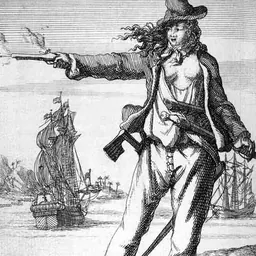
Blackbeard multiple image total_width=300 image1=Blackbeard the Pirate.jpg alt1= image2=General History of the Pyrates - Blackbeard the Pirate (1725).jpg alt2= footer=Blackbeard, as pictured within Charles Johnson's A General History of the Pyrates. The first image is a 1724 depiction by Benjamin Cole, The ship was , a large French Guineaman registered in Saint-Malo and carrying a cargo of slaves. This ship had originally been the English merchantman Concord, captured in 1711 by a French squadron, and then changed hands several times by 1717. Teach and his crews sailed the vessel south along Saint Vincent and the Grenadines to Bequia, where they disembarked her crew and captive cargo, and converted the ship for their own use. The crew of were given the smaller of Teach's two sloops, which they renamed ("Bad Meeting"), and sailed for Martinique. Teach may have recruited some of their slaves, but the remainder were left on the island and were later recaptured by the returning crew of .
Teach immediately renamed as Queen Anne's Revenge and equipped her with 40 guns. By this time Teach had placed his lieutenant Richards in command of Bonnet's Revenge. In late November the same year, near Saint Vincent, he attacked the Great Allen. After a lengthy engagement, he forced the large and well-armed merchant ship to surrender. He ordered her to move closer to the shore, disembarked her crew and emptied her cargo holds, and then burned and sank the vessel. The incident was chronicled in the Boston News-Letter, which called Teach the commander of a "French ship of 32 Guns, a Briganteen of 10 guns and a Sloop of 12 guns." It is not known when or where Teach collected the ten-gun briganteen, but by that time he may have been in command of at least 150 men split among three vessels.
On 5 December 1717 Teach stopped the merchant sloop Margaret off the coast of Crab Island, near Anguilla. Her captain, Henry Bostock, and crew, remained Teach's prisoners for about eight hours, and were forced to watch as their sloop was ransacked. Bostock, who had been held aboard Queen Anne's Revenge, was returned unharmed to Margaret and was allowed to leave with his crew. He returned to his base of operations on Saint Christopher Island and reported the matter to Governor Walter Hamilton, who requested that he sign an affidavit about the encounter. Bostock's deposition details Teach's command of two vessels: a sloop and a large French guineaman, Dutch-built, with 36 cannons and a crew of 300 men. The captain believed that the larger ship carried valuable gold dust, silver plate, and "a very fine cup" supposedly taken from the commander of Great Allen. Teach's crew had apparently informed Bostock that they had destroyed several other vessels, and that they intended to sail to Hispaniola and lie in wait for an expected Spanish armada, supposedly laden with money to pay the garrisons. Bostock also claimed that Teach had questioned him about the movements of local ships, but also that he had seemed unsurprised when Bostock told him of an expected royal pardon from London for all pirates.
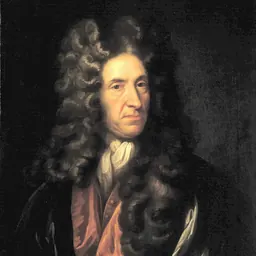
A General Historie, though, is generally considered to be a reliable source. Johnson may have been an assumed alias. As Johnson's accounts have been corroborated in personal and official dispatches, Lee (1974) considers that whoever he was, he had some access to official correspondence. Konstam speculates further, suggesting that Johnson may have been the English playwright Charles Johnson, the British publisher Charles Rivington, or the writer Daniel Defoe.
Various superstitious tales exist of Teach's ghost. Unexplained lights at sea are often referred to as "Teach's light", and some recitals claim that the notorious pirate now roams the afterlife searching for his head, for fear that his friends, and the Devil, will not recognise him. A North Carolinian tale holds that Teach's skull was used as the basis for a silver drinking chalice; a local judge even claimed to have drunk from it one night in the 1930s.
The name of Blackbeard has been attached to many local attractions, such as Charleston's Blackbeard's Cove. His name and persona have also featured heavily in literature. He is the main subject of Matilda Douglas's fictional 1835 work Blackbeard: A page from the colonial history of Philadelphia.
Film renditions of his life include Blackbeard the Pirate (1952) starring West Country native Robert Newton whose exaggerated West Country accent is credited with popularising the stereotypical "pirate voice", Blackbeard's Ghost (1968), Blackbeard: Terror at Sea (2005) and the 2006 Hallmark Channel miniseries Blackbeard. Parallels have also been drawn between Johnson's Blackbeard and the character of Captain Jack Sparrow in the 2003 adventure film Pirates of the Caribbean: The Curse of the Black Pearl. Blackbeard is also portrayed as a central character in three TV series: by John Malkovich in Crossbones (2014), by Ray Stevenson in seasons three and four of Black Sails (2016–2017), and by Taika Waititi in Our Flag Means Death (2022).
In 2013 and 2015, the state government of North Carolina uploaded Nautilus Productions videos of the wreck of the Queen Anne's Revenge to its website without permission. As a result, Nautilus Productions, the company documenting the recovery since 1998, filed suit in federal court over copyright violations and the passage of "Blackbeard's Law" by the North Carolina General Assembly. Before posting the videos the General Assembly passed "Blackbeard's Law", N.C. Gen Stat §121-25(b), which stated, "All photographs, video recordings, or other documentary materials of a derelict vessel or shipwreck or its contents, relics, artifacts, or historic materials in the custody of any agency of North Carolina government or its subdivisions shall be a public record pursuant to Chapter 132 of the General Statutes." On 5 November 2019, the U.S. Supreme Court heard oral arguments in Allen v. Cooper. The Supreme Court subsequently ruled in the state's favor, and struck down the Copyright Remedy Clarification Act, which Congress passed in 1989 to attempt to curb such infringements of copyright by states.
As a result of the ruling Nautilus filed a motion for reconsideration in the United States District Court for the Eastern District of North Carolina. On 18 August 2021 Judge Terrence Boyle granted the motion for reconsideration, which North Carolina promptly appealed to the United States Court of Appeals for the Fourth Circuit. The 4th Circuit denied the state's request to appeal on 14 October 2022. Nautilus then filed their second amended complaint on 8 February 2023 alleging 5th and 14th Amendment violations of Nautilus' constitutional rights, additional copyright violations, and claiming that North Carolina's "Blackbeard's Law" represents a Bill of Attainder. Eight years after the passage of Blackbeard's Law, on 30 June 2023, North Carolina Gov. Roy Cooper signed a bill repealing the law.
Don’t just read it —
keep it.
Full-length biographies made to live with: read them, listen on the way to work, watch them tonight.
- E-book
- Audio
- Video
Instant download · yours to keep · every purchase keeps this site free
Important facts
People in Blackbeard's life
Named in this biography and alive at the same time






Related people
Same field, nearest in time


Contemporaries
People whose lives overlapped Blackbeard's


Frequently asked questions
Who was Blackbeard?
English pirate
When was Blackbeard born?
Blackbeard was born in 1680 in Bristol.
When did Blackbeard die?
Blackbeard died on 22 November 1718 in Ocracoke.
What was Blackbeard's occupation?
Blackbeard was a pirate.
What nationality was Blackbeard?
Blackbeard was British.
Sources & further reading
Cite this page
APA: Biography.guide. (2026). Blackbeard. https://biography.guide/blackbeard/
MLA: "Blackbeard." Biography.guide, https://biography.guide/blackbeard/.
Chicago: "Blackbeard." Biography.guide. https://biography.guide/blackbeard/.
Data last updated: 2026-09-26 · Spot an error? Report a correction.
Page generated 2026-09-27 05:13 UTC