
About Aluízio Alves
Lived 1921 – 2006 (aged 84). Aluízio Alves was a Brazilian politician.
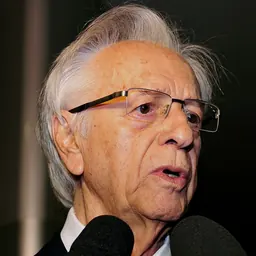
Aluízio Alves (11 August 1921 – 6 May 2006) was a Brazilian journalist, lawyer, and politician. He was the governor of the state of Rio Grande do Norte, from 1961 to 1966, later being arrested by the Brazilian military dictatorship through Institutional Act Number Five (AI-5) in 1969. He was a member of the politically prominent Alves family, which has competed with the Maia family for dominance in the political scene for decades. His son is former federal deputy and minister Henrique Eduardo Alves. His other brothers Agnelo and Garibaldi, and their sons, including Carlos Eduardo and Garibaldi Filho, were and are major politicians in their own right.
Early life and education Alves was born on 11 August 1921 in Angicos. He was the son of Manuel Alves Filho and Maria Fernandes Alves. He was a lawyer who graduated with a degree in Juridical and Social Sciences from the School of Law of Maceió and a specialization in Social Services, returned to his journalistic activities after graduation.
He first worked as an employee at A Razão and A República, both based in Natal. He moved to Rio de Janeiro in 1949 and became editor in chief to Tribuna da Imprensa, owned by Carlos Lacerda.
Career
Alves' political trajectory came in response to his professional activities and his debut on the political scene received the blessings of José Augusto Medeiros and Dinarte Mariz, chief leader of the state's UDN branch. Alves was elected to be a federal deputy in 1945 and participated in the Constituent National Assembly to promulgate the new post-Vargas Constitution on 18 September 1946.
The figurehead of Mariz' elevation to state government in 1955, he broke with his alliance in face of an episode where the recently elected governor ignored a series of actions by the government that were brought together by Alves in an extensive agreement. Angered, he withdrew politically from his mentor, became a member of the PSD, and was elected governor in 1960, beating deputy Djalma Marinho to the distaste of Mariz.
His political advertising during this election season, including the "Cruzada da esperança" campaign, is considered to be an early pioneering project in the state's political campaigns. His governance marked a period where populism was a driving force in the politics of Rio Grande do Norte. During his governorship, he implemented programs to bring access to electricity across the state through the São Francisco Hydroelectric Company (Chesf), expand literacy rates in the state, made major reforms to the state social welfare system, and with creating the Cidade da Esperança, the first subsidized housing project in Latin America.
A setback came on 7 February 1969, as he was removed from office by the military dictatorship through AI-5 due to accusations of corruption which were documented in a case that had been dismissed in February 1973.
An executive with the Union of Brazilian Businesses, Alves expanded his activities beyond the area of communications, and after the reintroduction of a multiparty system in Brazil in the waning days of the dictatorship, he became a member of the Peoples' Party. He soon became a member of the PMDB. He ran for governor of Rio Grande do Norte in 1982, but lost to José Agripino Maia of the PDS.
A strong supporter of Tancredo Neves' candidacy for president, he was nominated to be the Administrative Minister by the president-elect, later being confirmed for the position by his successor José Sarney, a post to which he served from 15 March 1985 to 15 February 1989. During his time as minister, the National School of Public Administration (ENAP) was created.
In 1990, he was once again elected to become federal deputy, a position in which he would soon briefly resign from during the Itamar Franco administration to become his Minister of Regional Integration from 8 April 1994 to 1 January 1995. As the minister in this office, he took over the transposition project with the São Francisco River.
Personal life Aluízio Alves married Ivone Lyra in 1944, with whom they had two children: twins Ana Catarina Alves and Henrique Eduardo Alves, both federal deputies and the latter also being a former Chamber of Deputies president and minister; and Henrique José Alves.
Death & legacy Alves died in Natal in 2006 due to cerebral ischemia. He is buried at Cemitério Morada da Paz.
The full name of Greater Natal International Airport is in part named after Alves.
Don’t just read it —
keep it.
Full-length biographies made to live with: read them, listen on the way to work, watch them tonight.
- E-book
- Audio
- Video
Instant download · yours to keep · every purchase keeps this site free
Important facts
People in Aluízio Alves's life
Named in this biography and alive at the same time






Related people
Same field, nearest in time




Contemporaries
People whose lives overlapped Aluízio Alves's



Frequently asked questions
Who was Aluízio Alves?
Brazilian journalist, lawyer and politician
When was Aluízio Alves born?
Aluízio Alves was born on 11 August 1921 in Angicos.
When did Aluízio Alves die?
Aluízio Alves died on 6 May 2006 in Natal.
What was Aluízio Alves's occupation?
Aluízio Alves was a politician.
What nationality was Aluízio Alves?
Aluízio Alves was Brazilian.
Sources & further reading
Cite this page
APA: Biography.guide. (2026). Aluízio Alves. https://biography.guide/aluizio-alves/
MLA: "Aluízio Alves." Biography.guide, https://biography.guide/aluizio-alves/.
Chicago: "Aluízio Alves." Biography.guide. https://biography.guide/aluizio-alves/.
Data last updated: 2026-09-25 · Spot an error? Report a correction.
Page generated 2026-09-27 05:12 UTC