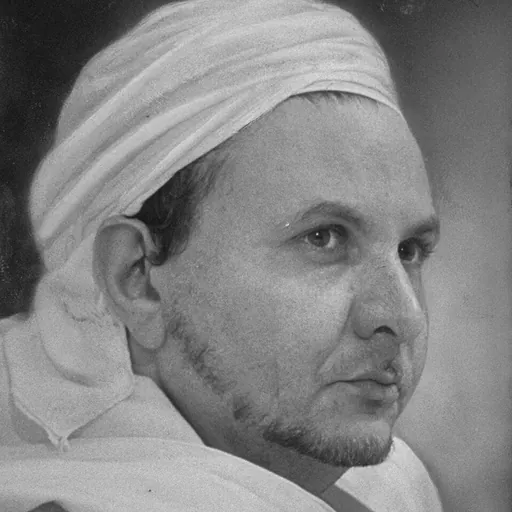
About Allal al-Fassi
Lived 1910 – 1974 (aged 64). Allal al-Fassi was a Moroccan politician, poet, literary scholar, revolutionary, writer and scholar.
Muhammad Allal al-Fassi (; 10 January 1910 – 13 May 1974) was a Moroccan nationalist leader, politician, writer, poet, Pan-Arabist and Islamic scholar who was one of the early leaders of the Moroccan nationalist movement. He later became the president for life of the Istiqlal Party after independence representing it until his death in 1974. He served briefly as Minister of Islamic Affairs from 1961 to 1963.
Born into the prominent scholarly , he became involved in the Moroccan nationalist movement at a young age during his years as a student at al-Qarawiyyin. In response to the Berber Dahir, he helped to arouse protest and began to coordinate with other nationalists leading to the formation of nationalist parties like the . After riots broke out in 1937, al-Fassi was exiled to Gabon for 10 years. During his exile, the Istiqlal Party was formed and he was given the honorary role of zaʿīm.
After returning from him exile, he went into self-exile to Cairo. Whilst in Cairo, he collaborated with other nationalist leaders from the Maghreb. He supported militant nationalists like the Moroccan Army of Liberation after Mohammed V's exile and after independence became the leader of the Istiqlal which at that point had expanded massively becoming divided between a right and left wing later culminating into a split within the party. He was also involved as the head of the codification commission for the Mudawana. As Minister of Islamic Affairs, al-Fassi promoted the institution of a new constitution but he eventually resigned after the controversial Baháʼí Affair. After his resignation, al-Fassi became a prominent opposition leader against Hassan II's government. He died of a heart attack on a trip to Romanian leader Nicolae Ceaușescu.
He was a "neo-Salafist" who advocated for the synthesis of nationalism and reformist Salafism. As an advocate for an Arab-Islamic identity for Morocco, he wanted a Morocco that imposed Arabisation and ruled by Sharia. He developed the idea of Greater Morocco which later came to influence the official policy of the Moroccan government. He was also a prolific writer who wrote over forty books and articles.
He has been described as the "father of Moroccan nationalism".
Early life and education Muhammad Allal al-Fassi was born in Fes on 10 January 1910 Andalusian family This family claimed descent from Uqba ibn Nafi. His father, Abd al-Wahid al-Fassi, was a judge and grand mufti who served as doctor of divinity at Qarawiyyin. Allal al-Fassi's mother came from a prominent mercantile family known as the Ma'safirine family and had memorized the Quran by seven. Before attending Qarawiyyin, he was a student in the Nasiriyyah Free School. he studied at the University of al-Qarawiyyin where he received a purely Arab education.
Career
Early nationalist activity According to al-Fassi, he became politically conscious in 1925 when the French authorities attempted to appropriate water from the Oued Fes to divert it to French companies.
In 1926, he set up a nationalist newsletter called Umm al-Banin. In 1927, along with other students at Qarawiyyin, al-Fassi founded the Students' Union which sought the purification of Islam and aimed to alter the teaching methods of the university. It joined with the Supporters of Truth, a student group in Rabat led by Ahmed Balafrej, in 1929 to form the Moroccan League. By 1930, al-Fassi began to lecture at mosques, Quranic schools and the Qarawiyyin on the theme of the Prophet and the Rashidun caliphs. or 1932. He was also barred from entering Morocco in August 1933 after visiting France.
Beginnings of mass nationalist protest In 1930, the Berber Dahir was passed, officially codifying customary law in Berber tribal areas rather than Sharia law. According to the historian Susan Gilson Miller, The Berber Dahir proved to be a "foundational event in the unfolding story of Moroccan nationalism". In response to this dahir, Allal al-Fassi began coordinating with other nationalists, including Ahmed Balafrej, and organised public protest against the dahir. In al-Fassi's view, the dahir was "barbaric" and an "attempt at the annihilation of native people" by suppressing Arab and Islamic culture while replacing it with pre-Islamic Berber customs. As a result of the Dahir, he also met prominent Lebanese Pan-Arabist Shakib Arslan. Arslan maintained ties with a number of prominent nationalists, including Balafrej and Ouazzani, and played a significant role in helping Moroccan nationalists develop a shared sense of struggle with the rest of the Arab and Muslim world. The Berber Dahir also led to the formation of the first political party in Morocco, the (CAM) in May 1934 which al-Fassi co-founded and served as its president. It had between 200 to 300 members. Al-Fassi described him as "a great monarch" and stated that the Sultan had promised to recover the rights lost by Moroccans.
The CAM published the Plan of Reforms in 1934 in both Arabic and French. Al-Fassi was one of its ten signatories and, together with , presented a copy to the Resident-General. The demands of the reform plan included the abolition of the Berber Dahir, the unification of legal system under Maliki law, the expansion of educational opportunities to Moroccans, the establishment of municipal councils, the appointment of Moroccans to positions of authority, and the recognition of Arabic as an official language. According to the Treaty of Fes, the purpose of the protectorate was to "establish a stable regime founded on internal order and general security that will permit the introduction of reforms and will assure the economic development of the country" while also simultaneously preserving the theoretical sovereignty of the sultan. Commenting on the reform plan, al-Fassi says:
The plan was rejected by the French administration and by 1937, the nationalist movement started to split with the CAM also outlawed by the French protectorate in October 1937. The CAM split into the which al-Fassi co-led and the Popular Movement (later the Party of Democracy and Independence) which was led by al-Fassi's former ally Mohamed Hassan Ouazzani. Traditionally, the split has been explained ideologically for example by the orientalist Robin Bidwell and according to the political scientist Adria Lawrence, it has been often charactered as being between "traditionalists" and "Westernists". However, according to a number of scholars including Mohammed Zade and , the split was likely more to do with personality differences and disagreements over the structure of leadership. The French justified the exile by accusing al-Fassi of conspiring to overthrow the protectorate to crown himself king. This was unlikely as al-Fassi had not made demands for independence at this point nor was he opposed to the monarchy. It is more likely he was exiled because his opposition to the French caused political instability. Despite his exile, he continued to exert influence over the nationalist movement. The scholar Ian Shaw says "His years of exile had given him the mystique of political martyrdom". He was isolated during this exile only being allowed to speak to his father but that too was restricted. During al-Fassi's exile, starting from 1941, Charles de Gaulle entered into contact with him hoping to use al-Fassi in a coup against the Vichy government in Morocco to bring it to the Free French fold. However, out of suspicion that al-Fassi was in contact with a foreign power broke off this contact. The Istiqlal Party was founded in January 1944 by former members of the CAM. This party submitted their manifesto for independence although al-Fassi did not sign it. Allal al-Fassi was given the role of zaʿīm of the Istiqlal. According to the academic John Waterbury, this role was purely honorary. The formation of the Istiqlal was met with peaceful demonstrations in support of it in the major cities. However, the French responded to this harshly by arresting a number of nationalist leaders like Balafrej accusing them of collaborating with Nazi Germany. This in turn led to more violence.
To solve this crisis, the French appointed a new Resident-General, , who initiated a more liberal policy like freeing nationalist leaders and a number of other concessions. Their return was marked by large public banquets and parades in Fes and Rabat, and contributed to an increase in Istiqlal's membership. He soon became the official leader of Istiqlal and founded the newspaper Al-Alam.
Al-Fassi shortly left for Cairo to self-exile due to clashes with the king and the Istiqlal leadership as he felt that his role as leader was purely symbolic lacking any decision-making power. Another reason for why he left was the hardening of French policies in Morocco. Whilst in Cairo, he became a lecturer at Al-Azhar University. In 1952, al-Fassi went for a world tour to gain international support travelling to and lecturing in Europe, South America, North America and the Middle East. He also went to the UN to plea the case for Moroccan independence and put pressure on France. This period in Cairo was when he wrote his most important writings like The Independence Movements in Arab North Africa (1947) and (1951). His exile led to the rise of militant nationalism leading to the formation of clandestine armed groups like the Moroccan Army of Liberation (MLA). The MLA initially praised Allal al-Fassi as their nominal leader and al-Fassi was linked to the MLA through his cousin Abd al-Kabir al-Fassin one of its leaders. al-Fassi aimed to leverage his supposed influence over the MLA and the MLA initially celebrated al-Fassi as their nominal leader. Al-Fassi refused to enter into negotiations with France until Mohammed V was allowed to return in November.
On October 17, al-Fassi returned to Tetouan from Cairo and toured the Spanish zone. He received enthusiastic crowds from cities like Tetouan, Larache and Ksar el-Kebir. However, this publicity campaign had little relation with actual MLA military operations. Despite being accompanied with an MLA commander, al-Fassi never inquired into the morale or physical conditions of MLA troops. MLA and Istiqlal leaders met in March and after, Allal al-Fassi declared an end to the jihad. This prompted the MLA high command to issue its own declaration, stating that no one else was authorised to speak on its behalf or to mediate between it and the king. In March 1956, Morocco’s declaration of independence was signed, with Spain withdrawing from the northern zone the following month.
In July 1956, he put forward a map of Morocco in the Al-Alam which included all of Mauritania, parts of Western Algeria and a section of Northern Mali and all of the Spanish Sahara.
Between 1947 and 1956, the Istiqlal went through a period of significant expansion. In 1944, party membership was estimated at around three thousand later expanding to ten thousand in 1947 and after 1952, one hundred thousand. In the 50s, it reached two hundred and fifty thousand members and by the early months of Moroccan independence, it reached 1.6 million. After independence, al-Fassi was appointed secretary-general and later president for life of the Istiqlal. During the period after independence, the Istiqlal sought to create a homogenous i.e. all-Istiqlal government. However, this would have reduced the monarch to just a figurehead and the monarchy feared becoming secondary to the Istiqlal or ceremonial causing it to come into conflict with the Istiqlal. While the Istiqlal were loyal to the monarchy on the surface, they questioned Mohammed V's policies. They opposed the presence of American military bases, advocated popular elections and demanded limits on the power of the monarchy. The right wing, which constituted the majority, was economically liberal and politically conservative. Al-Fassi proposed giving the left wing several government posts but it was rejected by Bouabid as he insisted that Driss M'Hammedi should be minister of the interior due to his familiarity with the and ability to speak Berber. which would end Istiqlal's chances to establish a one-party system. This plan was successful as it led to al-Fassi retiring from the party and the radical Ben Barka being excluded from the government. This eventually led to the formation of a new party led by Ben Barka called the National Union of Popular Forces (UNFP).
After independence, in 1956, al-Fassi was appointed professor of Islamic law in the newly created University of Rabat. In October 1957, a codification committee was established to codify the Mudawana, the Moroccan family code. Allal al-Fassi was selected to become the head The purpose of the Mudawana, according to anthropologist Jamila Bargach, was to try to reclaim the "pure uncorrupted sources of Islamic teachings, to shed their un-Islamic interpretations, all of this in a more accessible, more 'modern' format" and it was influenced by the Salafiya movement. Despite his involvement in the Mudawana, his progressive views on women were not incorporated into it.
From June 1961 to January 1963, At this time, the Ministry only had a marginal role with the only purpose of overseeing the administration of waqf lands. In 1961, in Tangier, the League of Moroccan ’Ulema was established with Allal al-Fassi as head. He resigned as minister due to the international backlash from the Baháʼí affair, which was the arrest of 14 Baháʼí Faith adherents in Nador in 1962 who were accused of proselytisation. Al-Fassi was one of the main supporters for their prosecution and he even tried to go further than the king to show his commitment to the Islamic cause. He was elected to the Parliament in May 1963 Under Hassan II's rule, al-Fassi became part of the political opposition. Despite his constitutional monarchism, he opposed Hassan's growing authoritarianism.
In 1971 and 1972, Morocco went through two subsequent coups. Allal al-Fassi was present during the first coup and was among the injured. As a result of the first coup, Hassan II invited both the Istiqlal and the UNFP to join the cabinet where they entered into an alliance called the National Bloc. They began talks with the palace, but these talks shortly broke down when the king announced a new constitution without consulting the parties. The National Bloc subsequently boycotted the next constitutional referendum (which passed despite this) with Allal al-Fassi publicly turning down a renewed offer of participation in the government. on a visit to Romania where he was scheduled to meet with Nicolae Ceaușescu, communist leader of Romania.
Arabism Allal al-Fassi wanted an independent Morocco that was closely linked to Arab culture and the Middle East and he promoted a greater Arab identity. He and the Istiqlal influenced Moroccan cultural policy to define Moroccan national identity in terms of its Arab and Islamic roots He launched several public campaigns like, in 1970, a petition in favour of Arabisation which was signed by 500 intellectuals and Islamic scholars and published in the Istiqlal newspaper, Al-Alam. He supported the Arab League.
Salafism Allal al-Fassi was one of the most prominent Salafists in Morocco and he became influenced by Salafism during his time at al-Qarawiyyin. Allal al-Fassi has been associated with Islamic modernism.
Al-Fassi differed greatly from "purist Salafis" who shared more similarities to Wahhabists from Saudi Arabia and also disapproved of his conception of Salafism. Al-Fassi saw Salafism as a movement that meant Islamic revival and his definition of it was so broad that it could include any reformer since the 9th century as long as they affirmed tawhid, advocated for Islamic law, attempted to prevent the decline of the ummah or opposed despotism. This meant, for al-Fassi, that both Ibn Rushd and Muhammad ibn Abd al-Wahhab could be considered Salafis. He wanted students to read the Salafi writings of Rashid Rida and Muhammad Abduh who he claimed influenced the Salafist program of Morocco alongside Jamal al-Din al-Afghani. According to scholars Frederic Wehrey and Anouar Boukhars, al-Fassi saw Salafism as "a constructive force that fostered progress and kindled nationalistic revolutionary consciousness". In his eyes, Salafism was not about the interpretation of divine attributes or to do with a specific theological doctrine but he thought "true Salafism" meant acting in according with the Quran and Sunnah, agreeing with the requirements of "evolving modes of thought", caring for reason and reflecting on the human principles of the Quran. Sufism in his eyes contradicted his vision of Islam as something inherently rational, progressive and conductive to modernity. Due to his nationalist beliefs, he believed that Moroccan Sufism was orthodox until the 15th century as opposed to other Salafists like Rashid Rida who critiqued all Sufism. He sought the reactivation of ijtihad and was hostile to Maliki law. Despite this hostility to Maliki law, he advocated for a judicial system based in Maliki law and the Mudawana he was involved in codifying was based of Maliki law. Allal al-Fassi opposed customary law in Morocco which he labelled as jahili, a "pre-Islamic custom" that had to be abolished. He thought it was equally "horrific" to the customs of some African tribes and he believed customary law deprived women of rights that were granted to them by the Sharia like inheritance. Allal al-Fassi strove to purify Islamic law from later innovations and customary elements which hampered achieving social justice. The codification of family law through the Mudawana functioned as the first step in the Islamisation of the entire legal system. Despite his involvement in the Mudawana, he failed to establish the full jurisdiction of sharia courts. He believed that Western-oriented and French-educated elites in Morocco became the new exponents of Western ideals using their positions in government to restrict Islamic law only to matters of personal status and inheritance. In al-Fassi's eyes, despite the French leaving in 1956, intellectual colonialism persisted well into the 1960s.
In the context of Islamic law, scholar of Islamic studies, Wael Hallaq, places Allal al-Fassi in the camp of legal reformers that he calls the utilitarianists who aimed to stay within limits of traditional Islamic legal theories and methodologies whilst also considering the need to modernise the legal system. He sought to renew Islamic jurisprudence based on ideas like istiḥsān (preference) and maṣlaḥa (utility).
Greater Morocco
Allal al-Fassi was the thinker behind "Greater Morocco" which he believed were the territories historically part of Morocco before colonialism truncated Morocco's borders. In July 1956, he put forward a map of Greater Morocco in the Istiqlal newspaper, Al-Alam, which included all of Mauritania, parts of Western Algeria and a section of Northern Mali and all of the Spanish Sahara. Initially, only a few were interested in Greater Morocco but in part because of Allal al-Fassi's charisma it gradually won over the support of the rest of the Moroccan government. In the eyes of many contemporary Moroccan feminists, al-Fassi is hailed as the champion of Moroccan women's liberation. He called for the ban of polygamy. Although, he only opposed polygamy because he thought it tarnished the image of modern Islam rather than it harming women. Al-Fassi's views on women were discussed in the last section of his book Self Criticism called "Social Thought" where he promoted the nuclear family as the basic unit of the nation, discussed the threats of prostitution, supported Islamic law's treatment of women as opposed to Berber customary law and discussed reforms related to polygamy and divorce. Allal al-Fassi was part of the codification commission of the Mudawana and served as its head. Despite this, his liberal ideas on women were not integrated into the Mudawana.
Al-Fassi while he was a government minister denied the Moroccan identity of Jews in Morocco:
Two years later, critiquing the Moroccan government's rapprochement with Israel, he said "Morocco is a Jewish State. It is led by Jews and foreigners."
Literature
In 1925, Al-Fassi published his first book of poems. The Fondation Allal al-Fassi in Rabat houses a library of his manuscripts, printed work and archives related to his work. "Munāqashat al-mīzāniyya al-farʿiyya li-wizārat al-ʿadl." In al-Adāʾ al-barlamānī lil-zaʿīm ʿAllāl al-Fāsī. Rabat: Muʾassasat ʿAllāl al-Fāsī, 2010. Rasāʾil tashhad ʿalā l-tarīkh. Rabat: Muʾassasat ʿAllāl al-Fāsī, 2006. by Hazem Zaki Nuseibeh. Al-Taqrīb: Sharḥ Mudawwanat al-Aḥwāl al-Shakhṣiyya al-kitābān al-awwal wa-l-thānī. Rabat: Muʾassasat ʿAllāl al-Fāsī, 2000. Second Edition. Beirut: Manshūrāt al-ʿAṣr al-Ḥadīth, 1972. Problématique d’une pensée contemporaine. (translated excerpt of al-Naqd al-Dhātī, pp. 81-91) in A. Abdel-Malek, Anthologie de la littérature arabe contemporaine: les essays. Paris: Seuil, 1965. Self-Criticism was dedicated to his belief in the reform of the Moroccan mind as he believed authentic Islam had been corrupted by despotism, colonialism, and ignorance.
Personal life
The extended are found throughout prominent positions in government, the economy, and media in Morocco. The al-Fassi family is specifically very influential in the Istiqlal Party. Allal al-Fassi's cousins were involved in the nationalist movement and post-independence politics alongside him. Mohamed El Fassi, for example, was the Minister of Education and played a key role in the . He was married to another cousin Malika al-Fassi, a prominent nationalist spokeswoman who was the only female signatory of the Independence Manifesto. Another cousin, Abd al-Kabir al-Fassi, was a leader of the Moroccan Army of Liberation. Allal al-Fassi's wife was also involved in politics collecting jewellery to sell in support of the war effort of the Arab-Israeli War.
Allal al-Fassi had 5 children:
Um al-Mabneen al-Fassi; She married Secretary-General of the Istiqlal, Abbas El Fassi. Awatif al-Fassi; She married member of the Istiqlal until his expulsion in 2013, Mohamed El Ouafa. Hani al-Fassi. Leila al-Fassi; She is the mother of minister Nizar Baraka. he was a candidate for leadership in 2012.
Despite his support for Arabisation and Islam, he educated his children in francophone secular schools. His first-born son became a cardiologist.
Don’t just read it —
keep it.
Full-length biographies made to live with: read them, listen on the way to work, watch them tonight.
- E-book
- Audio
- Video
Instant download · yours to keep · every purchase keeps this site free
Important facts
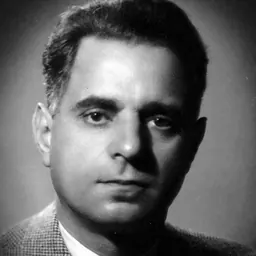
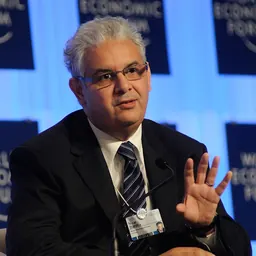
People in Allal al-Fassi's life
Named in this biography and alive at the same time






Related people
Same field, nearest in time





Contemporaries
People whose lives overlapped Allal al-Fassi's




Frequently asked questions
Who was Allal al-Fassi?
Moroccan politician and writer (1910-1974)
When was Allal al-Fassi born?
Allal al-Fassi was born on 10 January 1910 in Fez.
When did Allal al-Fassi die?
Allal al-Fassi died on 13 May 1974 in Bucharest.
What was Allal al-Fassi's occupation?
Allal al-Fassi was a politician, poet, literary scholar, revolutionary, writer and scholar.
What nationality was Allal al-Fassi?
Allal al-Fassi was Moroccan.
Sources & further reading
Cite this page
APA: Biography.guide. (2026). Allal al-Fassi. https://biography.guide/allal-al-fassi/
MLA: "Allal al-Fassi." Biography.guide, https://biography.guide/allal-al-fassi/.
Chicago: "Allal al-Fassi." Biography.guide. https://biography.guide/allal-al-fassi/.
Data last updated: 2026-09-23 · Spot an error? Report a correction.
Portrait: Wikimedia Commons · author & licence
Page generated 2026-09-27 05:06 UTC