
About Alfred Sisley
Lived 1839 – 1899 (aged 59). Alfred Sisley was a British and French painter, etcher, lithographer and visual artist.
Alfred Sisley (; ; 30 October 1839 – 29 January 1899) was an Impressionist landscape painter, born in Paris to British expatriate parents. Considered the most consistent of the Impressionists in his dedication to painting en plein air (outdoors), Sisley's oeuvre comprises almost entirely landscapes, with his most important works including series of paintings around Hampton Court on the River Thames, the floods at Marly-le-Roi in 1875, and the Gothic church at Moret-sur-Loing. He also produced notable paintings portraying riverside scenes on the Seine in the suburbs west of Paris throughout his career.
Sisley received little critical recognition or financial reward for his work during his lifetime, spending most of his career in reduced circumstances, dependent on the support of patrons and art dealers. Sisley's work has since received posthumous critical and market re-appraisal, recognising Sisley's important contribution to Impressionism and French landscape painting.
Life Sisley was born in Paris on 30 October 1839, the youngest of four children of William Sisley, an affluent merchant of imported luxury goods, and Felicia Sell. Little is known of Sisley's childhood in Paris, other than his education was bilingual (French and English).
At the age of 18 (in 1857) Sisley was sent to London to live and study with his English relatives for a career in the family import-export business. According to his confidante and biographer Gustave Geffroy, Sisley 'remained there for a few years, but above all learned painting from Turner and Constable, and literature from Shakespeare's plays.' Having shown no aptitude for business, Sisley returned to Paris in 1861.
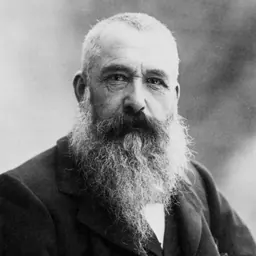
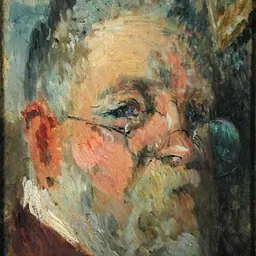
Later in 1861 Sisley began studying at the École des Beaux-Arts in Paris within the atelier of Swiss artist Marc-Charles-Gabriel Gleyre, where he befriended Frédéric Bazille, Claude Monet, and Pierre-Auguste Renoir. Frustrated with the bounds of the studio and strictures of the classicist Gleyre, the group (led by Monet) quickly began to make regular excursions to locales around Paris to paint en plein air landscapes (see Works). Unlike his friends Monet and Renoir, Sisley benefited from financial support from his family while studying. Renoir and Sisley became close friends and shared a studio, and Renoir became well known to Sisley's family: William commissioning his portrait from him (see picture).
Sisley met his future wife Eugénie Lescouezec (1834–1898) in 1866, while she was working as an artists model and florist living in the Batignolles quarter of Paris. The couple's first child, Pierre, was born in Paris in June 1867 while Sisley was based in Honfleur, Normandy, a picturesque holiday resort popular with painters. Their daughter Jeanne-Adèle was born in January 1869; their second son, Jacques, born November 1871, died in infancy.
In 1870-71 the financial security that Sisley had enjoyed via remittances from his family came to an abrupt end, due to the calamitous effect the outbreak of the Franco-Prussian War had on William Sisley's trading business, and ostracism and enstrangement on the grounds of Eugénie's humble and unmarried status. Sisley's financial position would remain precarious for the remainder of his life, dependent on the support of patrons, friends and the sale of his works (see Works).
Sisley would visit Britain on three occasions. The first occurred in 1874 after the First Impressionist Exhibition, accompanying his patron the opera singer Jean-Baptiste Faure to London, producing twenty paintings of the non-tidal Thames at East Molesey around Hampton Court Bridge later described by art historian Kenneth Clark as "a perfect moment of Impressionism." A visit to the Isle of Wight in 1881 had to be abandoned when the canvases and materials Sisley had arranged to be shipped from France were never delivered.
The third visit, in the summer of 1897, was undertaken by Alfred and Eugénie towards the end of their lives, with Eugénie in the early stages of throat cancer. Sponsored by his patron François Depeaux, who was visiting Cardiff on business, the couple settled in neighbouring Penarth, where Sisley began painting from the cliffs overlooking the town. Sisley made the acquaintance of the French consul in Cardiff Adolphe de Trobiaud, who on 3 August formally certified Eugénie the mother of Alfred's children; two days later Alfred and Eugénie were married at Cardiff Register Office, thereby legitimising their children and securing their inheritance. The couple honeymooned at the Osborne Hotel at Langland Bay on the Gower Peninsula, where Sisley painted in and around Langland Bay and Rotherslade (then called Lady's Cove).
The couple returned to Moret in October 1897. In early 1898 Sisley applied for French citizenship, but was initially refused. A second application later that year was made and supported by a police report, but illness intervened. Alfred Sisley remained solely a British citizen his entire life.
Eugénie Sisley died on 8 October 1898 and was buried in Moret cemetery the following day. Alfred was by then succumbing to the ravages of throat cancer and was unable to attend the funeral. Alfred Sisley died on 29 January 1899 at the age of 59. His funeral was held on 1 February and attended by his children Jeanne and Pierre joined by his friends Claude Monet, Auguste Renoir, Jean-Charles Cazin, Albert Lebourg, and , and dignitaries from Moret.
In the days before his death, Sisley had spoken with his friend Monet and asked him to take care of his children, who were now left without resources other than the numerous unsold paintings in their father's studio. Monet arranged for a benefit auction to be held at Galerie Georges Petit held on 1 May 1899 for sale of 'Paintings, studies and pastels from his studio and those given to his children by other artists'. The former comprised 27 paintings and 6 pastels by Sisley, the latter numerous works donated at Monet's request by Sisley's friends and contacts across the Impressionist movement. The auction and sales raised 145,000 francs for Sisley's estate.
Works
Sisley produced over 900 oil paintings, some 100 pastels and many other drawings.. Sisley's student works at the École des Beaux-Arts under Gleyre are lost, and his studio in Bougival was destroyed at the outbreak of the Franco-Prussian War.
Sisley along with Monet, Renoir and Bazille would paint landscapes en plein air rather than in the studio in order to capture the transient effects of sunlight realistically. This approach, innovative at the time, resulted in paintings more colourful and more broadly painted than the public was accustomed to seeing. Consequently, Sisley and his friends initially had few opportunities to exhibit or sell their work. Their paintings were usually rejected by the jury of the most important art exhibition in France, the annual Salon.His first landscape paintings are sombre, coloured with dark browns, greens, and pale blues. They were often executed at Marly and Saint-Cloud. Little is known about Sisley's relationship with the paintings of J. M. W. Turner and John Constable, which he may have seen in London, but some have suggested that these artists may have influenced his development as an Impressionist painter, as may have Gustave Courbet and Jean-Baptiste-Camille Corot.
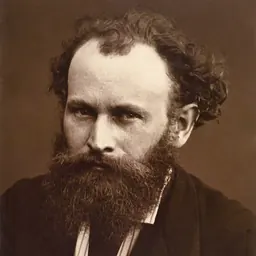
He was inspired by the style and subject matter of previous modern painters Camille Pissarro and Édouard Manet. Among the Impressionists, Sisley has been overshadowed by Monet, whose work his resembles in style and subject matter, although Sisley's effects are more subdued. Described by art historian Robert Rosenblum as having "almost a generic character, an impersonal textbook idea of a perfect Impressionist painting", his work strongly invokes atmosphere, and his skies are always impressive. He concentrated on landscape more consistently than any other Impressionist painter.
Among Sisley's best-known works are Street in Moret and Sand Heaps, both owned by the Art Institute of Chicago, and The Bridge at Moret-sur-Loing, shown at Musée d'Orsay, Paris. Allée des peupliers de Moret (The Lane of Poplars at Moret) has been stolen three times from the Musée des Beaux-Arts in Nice – once in 1978 when on loan in Marseilles (recovered a few days later in the city's sewers), again in 1998 (when the museum's curator was convicted of the theft and jailed for five years with two accomplices), and finally in August 2007 (on 4 June 2008 French police recovered it and three other stolen paintings from a van in Marseilles).
Legacy
Stolen and looted paintings During the Nazi period (1933–1945) a number of Sisley works were taken from Jewish art collectors by Nazis or their agents (such as the E.R.R.) as part of the widespread looting of property owned by Jews which preceded the Holocaust. Several of these stolen paintings have been the subject of restitution efforts and litigation.
In 2004 Sisley's Soleil de printemps, le Loing (1892) was restored to the family of Louis Hirsch, in a ceremony in Paris.
In 2008 Bateaux en Réparation à Saint Mammès (1885) was recognised as having been looted by the Nazis, and was the subject of a settlement with the heirs of Benno and Frances Bernstein (who had owned it before Nazi occupation). In 2016 a dispute erupted between Alain Dreyfus, an art dealer in Switzerland, and the auction house Christie's, over Sisley's Premier jour de printemps à Moret (1889). Dreyfus, who had purchased the painting at auction in 2008, was subject to a claim by Daniel Lindon family that the painting had been looted from his grandfather Abner Lindenbaum. Dreyfus alleged that Christie's had not sufficiently examined the work's provenance before putting it up for sale, and not disputing the Lindon family's claim, sought reimbursement of the purchase price plus interest from Christie's.
Numerous Sisleys looted by the Nazis have still have not been found. The German Lost Art Foundation has 24 listings for Sisley.
Exhibitions Significant retrospective exhibitions of Sisley's works include:
Alfred Sisley (1992-1993) - Royal Academy of Arts, London: 3 July to 18 October 1992; Musée d'Orsay, Paris: 28 October 1992 to 31 January 1993; Walters Art Museum, Baltimore: 14 March to 13 June 1993.
Alfred Sisley retrospective (2000) - Isetan Museum, Tokyo: 2 March to 17 April 2000; Takamatsu City Art Museum, Kagawa: 22 April to 21 May 2000; Hiroshima Museum of Art: 27 May to 2 July 2000; The Museum of Modern Art, Wakayama: 8 July to 10 September 2000.
Sisley: Poet of Impressionism (2002-2003) - “Alfred Sisley: Poeta dell'Impressionismo” - Palazzo dei Diamanti, Ferrara: 17 February to 19 May 2002; “Alfred Sisley: Poeta del Impresionismo” - Thyssen-Bornemisza National Museum, Madrid: 8 June to 15 September 2002; “Alfred Sisley: poète de l'impressionnisme” - Musée des Beaux-Arts de Lyon, Lyon: 10 October 2002 to 6 January 2003.
Sisley in England and Wales (2009) - National Gallery, London: 12 November 2008 to 22 February 2009; Amgueddfa Cymru / National Museum of Wales, Cardiff: 7 March to 14 June 2009. Alfred Sisley: the true Impressionist (2011-12) - "Alfred Sisley: der wahre Impressionist" Von der Heydt-Museum, Wuppertal: 13 September 2011 to 29 January 2012. Alfred Sisley: Impressionist Master / Sisley l’impressionsite (2017) - “Alfred Sisley: Impressionist Master” - Bruce Museum, Greenwich, Connecticut: 21 January to 21 May 2017. ; “Sisley l’impressionsite” - Centre d’Art Aix-en-Provence, Caumont, Aix-en-Provence: 10 June to 15 October 2017.
Selected works
Avenue of Chestnut Trees near La Celle-Saint-Cloud (1865) View of Montmartre from Cité des Fleurs to Les Batignolles (1869) The Bridge at Villeneuve-la-Garenne (1872) Ferry to the Ile-de-la-Loge – Flood (1872) La Grande-Rue, Argenteuil Square in Argenteuil (Rue de la Chaussee) (1872) (1872) Chemin de la Machine, Louveciennes (1873) (1873) Hampton Court Bridge (painting) (1874) Molesey Weir – Morning (1874) Regatta at Molesey (1874) Under Hampton Court Bridge (1874) The Terrace at Saint-Germain, Spring (1875) The Small Meadows in Spring, By
Gallery
Notes, references and sources
Don’t just read it —
keep it.
Full-length biographies made to live with: read them, listen on the way to work, watch them tonight.
- E-book
- Audio
- Video
Instant download · yours to keep · every purchase keeps this site free
Important facts
People in Alfred Sisley's life
Named in this biography and alive at the same time




Related people
Same field, nearest in time

Contemporaries
People whose lives overlapped Alfred Sisley's


Frequently asked questions
Who was Alfred Sisley?
French, British painter (1839–1899)
When was Alfred Sisley born?
Alfred Sisley was born on 30 October 1839 in former 4th arrondissement of Paris, Paris.
When did Alfred Sisley die?
Alfred Sisley died on 29 January 1899 in cemetery of Moret-sur-Loing, Moret-sur-Loing.
What was Alfred Sisley's occupation?
Alfred Sisley was a painter, etcher, lithographer and visual artist.
What nationality was Alfred Sisley?
Alfred Sisley was British and French.
Sources & further reading
Cite this page
APA: Biography.guide. (2026). Alfred Sisley. https://biography.guide/alfred-sisley/
MLA: "Alfred Sisley." Biography.guide, https://biography.guide/alfred-sisley/.
Chicago: "Alfred Sisley." Biography.guide. https://biography.guide/alfred-sisley/.
Data last updated: 2026-09-20 · Spot an error? Report a correction.
Page generated 2026-09-27 05:23 UTC