
About Alexei Kirichenko
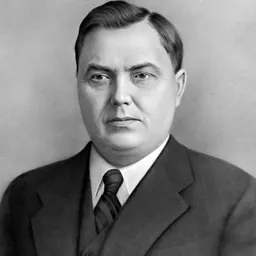
Lived 1908 – 1975 (aged 67). Alexei Kirichenko was a Ukrainian and Russian politician and official.
Alexei Illarionovich Kirichenko ( – 28 December 1975) was a Soviet Ukrainian politician, who was the first ethnic Ukrainian to head the republic's communist party during the Soviet era. Between 1957 and 1960, he was a Secretary of the Central Committee of the Communist Party of the Soviet Union and the second-highest-ranking official within the party after Nikita Khrushchev. From the age of 11, he started earning for living by working in the fields and then at railways. After graduating from a mechanical school he worked in Kazakhstan as an engineer in a sovkhoz (state farm). He then returned to Ukraine to receive a university degree and teach agricultural engineering, and graduated in 1936.
Political career
Under Stalin
In 1938, he became a member of the Central Committee of the Communist Party of Ukraine (CPU), soon after Nikita Khrushchev had been appointed as First Secretary. In 1941, he was appointed Secretary of the CPU during World War II, and served as a member of the military council.
Kirichenko was First Secretary of the Odessa Oblast party committee from 1945 to 1949, coinciding with the Soviet famine of 1946–1947. Ukraine in particular suffered from the effects of the famine, in part due to the devastating effects of World War II on Ukrainian territory. During this period, Kirichenko told Khrushchev that, while visiting the home of kolkhoz (collective farm) workers:
Kirichenko was a member of the Central Committee of the Communist Party of the Soviet Union from 1952 to 1961, and Second Secretary of the Central Committee of the CPU from 1949 to 1953.
Under Khrushchev According to Khrushchev, Kirichenko's promotion to First Secretary the CPU in June 1953 was originally proposed by chief of the NKVD Lavrentiy Beria shortly before his downfall. However, Kirichenko was one of Khrushchev's most influential allies. In July 1955, he was promoted to the 11-member Politburo. In June 1957, he rushed to Moscow at short notice to take part in a Politburo meeting at which Khrushchev's rivals, led by Georgy Malenkov were seeking to remove him from office. However, he ultimately helped Khrushchev turn the tables and oust Malenkov and others.
In December 1957, Kirichenko was transferred to Moscow as the Central Committee Secretary in charge of party appointments. This meant that he was officially ranked as one of the five most senior figures in the party. Because of his office and relative youth, Kirichenko was the person most obviously placed to succeed Khrushchev. Khrushchev mentioned this to the U.S. Ambassador W. Averell Harriman, in June 1959, but added, "I am very jealous of my prerogatives, and while I live, I will run the party." He flew into a rage, banged the desk with his fist and shouted down the phone when Kirichenko tried to transfer a senior official from Moscow to Leningrad without consulting him.
Downfall, later life, and death On 13 January 1960, it was suddenly announced that Kirichenko had been appointed First Secretary of the Rostov Oblast party committee. In May, he was formally dismissed from the Politburo and the party secretariat. On 15 June 1960, he was sacked from his post in Rostov, after just five months.
He retired in 1962, died in 1975 and was buried at the Novodevichy Cemetery in Moscow.
Don’t just read it —
keep it.
Full-length biographies made to live with: read them, listen on the way to work, watch them tonight.
- E-book
- Audio
- Video
Instant download · yours to keep · every purchase keeps this site free
Important facts
People in Alexei Kirichenko's life
Named in this biography and alive at the same time


Related people
Same field, nearest in time






Contemporaries
People whose lives overlapped Alexei Kirichenko's



Frequently asked questions
Who was Alexei Kirichenko?
Soviet politician (1908-1975)
When was Alexei Kirichenko born?
Alexei Kirichenko was born on 25 February 1908 in Chornobaivka.
When did Alexei Kirichenko die?
Alexei Kirichenko died on 28 December 1975 in Moscow.
What was Alexei Kirichenko's occupation?
Alexei Kirichenko was a politician and official.
What nationality was Alexei Kirichenko?
Alexei Kirichenko was Ukrainian and Russian.
Sources & further reading
· Wikipedia: Alexei Kirichenko
Cite this page
APA: Biography.guide. (2026). Alexei Kirichenko. https://biography.guide/alexei-kirichenko/
MLA: "Alexei Kirichenko." Biography.guide, https://biography.guide/alexei-kirichenko/.
Chicago: "Alexei Kirichenko." Biography.guide. https://biography.guide/alexei-kirichenko/.
Data last updated: 2026-09-20 · Spot an error? Report a correction.
Page generated 2026-09-27 05:27 UTC