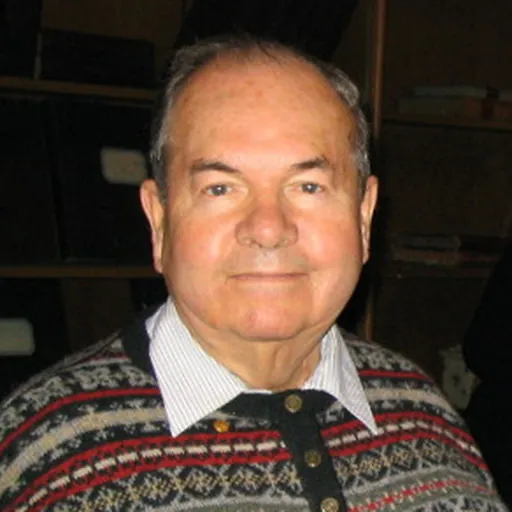
Alexei Abrikosov
Soviet, Russian and American theoretical physicist
About Alexei Abrikosov
Lived 1928 – 2017 (aged 88). Alexei Abrikosov was a Russian and American physicist and university teacher, known for Abrikosov vortex, Condensed matter physics and Fermi liquid theory.
Infobox scientist native_name = native_name_lang = ru image = AA Abrikosov ANL1.jpg caption = Abrikosov in 2003 birth_date = birth_place = Moscow, Russian SFSR, Soviet Union death_date = death_place = Palo Alto, California, United States citizenship = education = doctoral_advisor = Lev. D Landau ForMemRS (2001) ) was a Russian-American theoretical physicist whose main contributions are in the field of condensed matter physics. He was the co-recipient of the 2003 Nobel Prize in Physics, with Vitaly Ginzburg and Anthony James Leggett, for theories about how matter can behave at extremely low temperatures.
Education and early life Abrikosov was born in Moscow, Russian SFSR, Soviet Union, on June 25, 1928, to a couple of physicians: Aleksey Abrikosov and Fani ( Wulf). His mother was Jewish. After graduating from high school in 1943, Abrikosov began studying energy technology. He graduated from Moscow State University in 1948. and lived there until his death in 2017, in Palo Alto, California. While in the US, Abrikosov was elected to the National Academy of Sciences in 2000, and in 2001, to be a foreign member of the Royal Society.
Career From 1965 to 1988, he worked at the Landau Institute for Theoretical Physics (USSR Academy of Sciences). He has been a professor at Moscow State University since 1965. In addition, he held tenure at the Moscow Institute of Physics and Technology from 1972 to 1976, and at the Moscow Institute of Steel and Alloys from 1976 to 1991. He served as a full member of the USSR Academy of Sciences from 1987 to 1991. In 1991, he became a full member of the Russian Academy of Sciences.
In two works in 1952 and 1957, Abrikosov explained how magnetic flux can penetrate a class of superconductors. This class of materials are called type-II superconductors. The accompanying arrangement of magnetic flux lines is called the Abrikosov vortex lattice.
Together with Lev Gor'kov and Igor Dzyaloshinskii, Abrikosov has written an iconic book on theoretical solid-state physics, which has been used to train physicists in the field for decades.
From 1991 until his retirement, he worked at Argonne National Laboratory in the U.S. state of Illinois. Abrikosov was an Argonne Distinguished Scientist at the Condensed Matter Theory Group in Argonne's Materials Science Division. When he received the Nobel Prize, his research was focused on the origins of magnetoresistance, a property of some materials that change their resistance to electrical flow under the influence of a magnetic field.
Honours and awards Abrikosov was awarded the Lenin Prize in 1966, the Fritz London Memorial Prize in 1972, and the USSR State Prize in 1982. In 1989 he received the Landau Prize from the Academy of Sciences, Russia. He shared the 2003 Nobel Prize in Physics. He was also a member of the Royal Academy of London, a fellow of the American Physical Society, and in 2000 was elected to the prestigious National Academy of Sciences. Golden Plate Award of the American Academy of Achievement, 2004 Gold Medal of Vernadsky from National Academy of Sciences of Ukraine, 2015
Personal life Abrikosov was the son of the physicians Alexei Ivanovich Abrikosov (1875-1955) and his second wife, Fania Davidovna Woolf (1895—1965). Through his father, Abrikosov was the nephew of the martyred Catholic nun Anna Abrikosova (1882-1936).
His sister was Maria Alekseevna Abrikósova (1929-1998), physician.
He married Svetlana Yuriyevna Bunkova and had 3 children.
He died in California on 29 March 2017 at the age of 88.
Books
Don’t just read it —
keep it.
Full-length biographies made to live with: read them, listen on the way to work, watch them tonight.
- E-book
- Audio
- Video
Instant download · yours to keep · every purchase keeps this site free
Important facts
more
A.A. Abrikosov, AA Abrikosov, A. Abrikosov, A Abrikosov, Abrikosov, Abrikosov A, Abrikosov A., Abrikosov A. A., Abrikosov AA, Alexei Alexeyevich AbrikosovPeople in Alexei Abrikosov's life
Named in this biography and alive at the same time





Related people
Same field, nearest in time


Contemporaries
People whose lives overlapped Alexei Abrikosov's



Frequently asked questions
Who was Alexei Abrikosov?
Soviet, Russian and American theoretical physicist
When was Alexei Abrikosov born?
Alexei Abrikosov was born on 25 June 1928 in Moscow.
When did Alexei Abrikosov die?
Alexei Abrikosov died on 29 March 2017 in Palo Alto.
What was Alexei Abrikosov's occupation?
Alexei Abrikosov was a physicist and university teacher.
What was Alexei Abrikosov known for?
Alexei Abrikosov was known for Abrikosov vortex, Condensed matter physics, Fermi liquid theory, Quantum triviality and Type-II superconductor.
What nationality was Alexei Abrikosov?
Alexei Abrikosov was Russian and American.
Sources & further reading
· DBpedia: Alexei Abrikosov (physicist)
Cite this page
APA: Biography.guide. (2026). Alexei Abrikosov. https://biography.guide/alexei-abrikosov/
MLA: "Alexei Abrikosov." Biography.guide, https://biography.guide/alexei-abrikosov/.
Chicago: "Alexei Abrikosov." Biography.guide. https://biography.guide/alexei-abrikosov/.
Data last updated: 2026-09-21 · Spot an error? Report a correction.
Portrait: Wikimedia Commons · author & licence
Page generated 2026-09-27 05:00 UTC