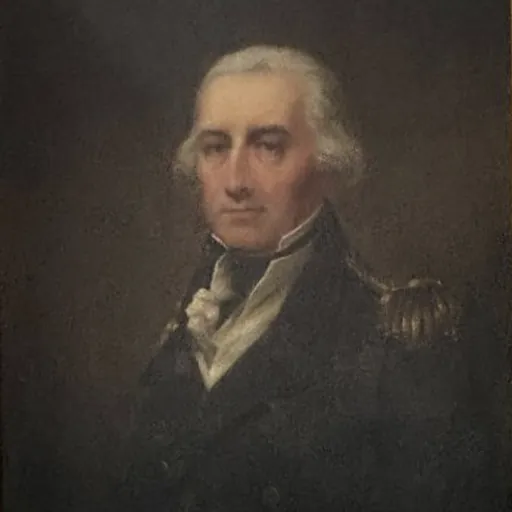
About Alexander Edgar
Lived 1737 – 1817 (aged 79). Alexander Edgar was a British naval officer.
Rear-Admiral Alexander Edgar ( – 1817) was a prominent Scottish officer of the British Royal Navy. His early career saw him fighting in the Seven Years' War, where he would participate in the Capture of Quebec. He would later take part in the American War of Independence, where he would participate in the First Battle of Ushant, The Siege of Gibraltar, and The Second Battle of Ushant. Edgar served on a variety of ships, from the fireship HMS Vesuvius to the 1st rate ship-of-the-line HMS Victory.
He was also historically significant as the final male heir and last Laird of Wedderlie, marking the end of an ancient Scottish Border lineage that appears by deeds as far back as 1170.
Early life and family background Alexander Edgar was born on 17 August 1736 in Westruther, Scotland His father ultimately died bankrupt, leaving Edgar without an inheritance or the familial financial backing typical for naval officers of his class. Alexander Edgar entered the Royal Navy at approximately 11 years of age on December 29, 1747.
Early career and the Seven Years War
Edgar entered the service on December 29, 1747, as a Midshipman. During his time as a Midshipman, he would serve on several vessels. He notably served aboard the HMS Vestal under Captain Sir William Trelawny.
Help from David Hume
Edgar's family's financial ruin and lack of political influence led to him having to advance his career through his connections to the Enlightenment philosopher David Hume. Hume was cousins with Alexander Edgar and would use his social and political influence to help promote Edgar to lieutenant. Hume would write several letters to Gilbert Elliot, who held positions both as a "Man of Letters" and a "Lord of the Admiralty", praising Alexander as "modest, sober, frugal, and attentive," and lobbying for Alexander Edgar's military promotion. Hume would also secure Edgars spot aboard the HMS Hussar under Captain John Elliot where he served for a brief period in late 1758. Under the overall naval command of Vice-Admiral Charles Saunders, the HMS Vesuvius was part of the massive British fleet tasked with navigating the difficult St. Lawrence River to transport and support Major-General James Wolfe's army. The ship sailed from Halifax to Cape Breton in June 1759 to gather troops before moving up the St. Lawrence River. During the summer-long siege, bomb vessels like the Vesuvius were crucial for shelling French positions and distracting the forces of the Marquis de Montcalm, helping pave the way for the decisive British victory at the Plains of Abraham in September 1759. Post-War service
From 1761 to 1763, Edgar would serve aboard the HMS Eolus under Captain Sir William Hotham in the Caribbean and home waters. From 1765 to 1766, he served as first Lieutenant on the HMS Africa in the West Indies under captains Henry Marsh and his mentor, the Honorable John Leveson Gower. 1766 to 1771 saw him serving as first Lieutenant aboard both the HMS Eolus and the HMS Dorsetshire in the Mediterranean. Before being put on shore leave in 1772, Edgar would serve as the third Lieutenant aboard the HMS Ocean under Captains James Cranston and Joseph Knight.
In March 1776, Edgar would serve as second Lieutenant on the HMS Princess Amelia under Captain Digby Dent. The HMS Vulcan was a part of Admiral Keppels Channel fleet and would participate in a brief cruise to protect incoming British merchant convoys from French privateers. By May 1779, the Vulcan would sail to Torbay to join Admiral Arbuthnots fleet. From Torbay, they would sail to North America, arriving in New York by August 1779. Edgar would later command the HMS Strombolo for a brief period before it was eventually hulked and turned into a prison ship. The armada consisted of 29 ships of the line escorting a convoy of roughly 100 merchant vessels. After nearly a month of steady sailing southward while shielding the vulnerable merchantmen, HMS Ocean and the fleet officially entered the Strait of Gibraltar. The fleet had also successfully evaded French interception. On April 12th, the leading edge of the supply convoy successfully dropped anchor off Gibraltar's New Mole. Recognizing that the fortress was being saved, Spanish shore batteries opened a furious, relentless bombardment. HMS Ocean and the heavy ships of the line formed a formidable defensive line at the mouth of the bay, deterring the Spanish fleet at Cádiz from intervening.
From April 13 to April 19, the Spanish continued their relentless bombardment, with over 100 heavy mortars and cannons firing relentlessly on the bay. The Spanish also deployed a swarm of small, highly maneuverable gunboats. The fleet was stationed to the Southward of Brest Harbour. By sitting off the coast of Brest, the British fleet was positioned specifically to prevent the French and Spanish fleets from joining forces. A sailor aboard the HMS Ocean noted that this position was so effective that the enemy fleets could not have met "without a Battle". The HMS Ocean would return to the Plymouth Sound in early July, and in late July would sail on a cruise with the Grand Fleet under Admiral Darby, alongside major vessels from the British fleet, such as the Victory, Britannia, and Royal George, along with 28 other ships of the line, to engage the French fleet.
By August, the HMS Ocean anchored at Torbay with Admiral Darbys fleet. When the Combined French and Spanish Fleet entered the Channel, Admiral Darby took a defensive position at Torbay. They anchored the fleet in a line to act as a floating fortress, daring the French and Spanish to attack them under the cover of shore batteries. By late September, the grand fleet had left Torbay and sailed westward, passing Falmouth. From September to October, the HMS Ocean and the rest of Admiral Darbys fleet suffered a massive outbreak of scurvy and was battered by storms. The campaign officially ended on November 5th when the fleet anchored at Spithead. For ten days, the fleet battled severe storms in the Bay of Biscay.
Edgar and the HMS Oceans journey would be briefly halted at the start. On December 5th, Edgar participated in a rescue operation off the coast of the Eddystone, a lighthouse near Plymouth. Edgar saw the Clarendon, a merchant ship coming from Jamaica, the ship had endured a storm, lacking provisions and supplies. Crucially, the ship was leaking so badly that the crew had to pump water out constantly, and they only had four healthy men fit for duty. Captain Edgar sent five of his own men to help the Clarendon and supplied them with as many provisions as he could spare, later towing them to shore. The Second Battle of Ushant
Edgar would participate in Second Battle of Ushant on December 12th, 1781, where the British fleet of 12 ships of the line intercepted a larger French convoy escorted by 19 ships of the line under Luc Urbain de Bouëxic, Comte de Guichen. The French convoy was transporting vital troops and military supplies to the West and East Indies. Despite being significantly outnumbered in warships, Admiral Kempenfelt was able to capitalize on a tactical error by the French commander, who had allowed his escort ships to drift well ahead of the transport vessels.
Taking advantage of the gap, the British fleet sailed towards the unprotected convoy. The British successfully captured 21 French transport ships carrying 1,620 soldiers and valuable military stores, while forcing the remainder of the convoy to scatter and retreat. De Guichen's warships could only watch helplessly from a distance, unable to intervene due to the unfavorable wind conditions. This decisive British victory severely disrupted French military plans in the Americas.
After completing this mission, the Medway would directly join Admiral Kempenfelt's fleet, participating in the blockading of the English Channel. On May 17, 1782, Kempenfelt's fleet, including the HMS Medway, successfully intercepted a French fleet on their way to join the Dutch in the Texel. They captured four ships of the line and drove three others ashore on the coast of Normandy, a major strategic victory that prevented the enemy fleets from combining. After this, the Medway would return to blockading the English Channel, before joining Admiral Howes fleet in June 1782.
By July 2nd, 1782, Edgar, alongside Admiral Howe's fleet, departed to protect a British merchant fleet returning from the West Indies. This convoy was carrying immense wealth in cargo, and a combined French and Spanish fleet was already at sea specifically to capture it. In later July, Howes fleet would participate in a naval blockade around Texel, a Dutch naval fortification.
Edgar was ordered in October of 1782, responsible for escorting 4 East India convoys into Plymouth from St. Helena, also bringing dispatches from Sir Edward Hughes with vital updates and accounts regarding British fleet operations in the Indian Ocean against the French. This was an integral part in helping the British economy during the American revolution, as North American and French forces targeted British trading vessels in order to damage the British economy. During his voyage, Edgar met with a ship belonging to the Jamaica fleet bound for London, which would arrive safely with his convoy.
On March 24th, 1783, the Medway arrived at Plymouth from Portsmouth. The Preliminary Articles of Peace had been signed, and the cessation of British fleets was being underway. On April 1st, 300 members of Edgar's crew engaged in a violent street riot in Plymouth. Armed with bludgeons, the crew faced off against 800 sailors from the Crown and Vengeance.
Post-War service in Newfoundland
On April 18, 1783, Edgar took command of the HMS Leocadia.
From July to August of 1785, Edgar participated in a mission where he conducted a systematic survey of Cape Broyle Harbour to identify and confirm vacant land suitable for new colonial grants. Working under the authority of Governor John Campbell, Edgar sought to distinguish available territory from "ships' rooms" and existing seasonal claims, effectively creating a legal framework for permanent settlement in the area. This mission was punctuated by the creation of a detailed harbor diagram, which functioned as a vital zoning document to delineate private property boundaries and public access to the shoreline. By formalizing these land allocations, Edgar provided the necessary legal security for merchants and settlers to establish permanent roots, marking a pivotal moment in the organized civil development of the Newfoundland coastline.
The standoff brought Europe to the brink of war, Edgar sailed the HMS Illustrious to join the fleet stationed in Torbay. Faced with the overwhelming sight of the British fleet fully mobilized at Torbay and Spithead, Spain backed down. Furthermore, Spain's traditional ally, France, was engulfed in the early stages of the French Revolution and could not provide enough military support. Lacking allies and facing a massive British fleet, Spain signed the Nootka Conventions, agreeing to return the seized property, compensate British merchants, and yield its monopoly on trade and settlement in the Pacific Northwest.
Later career
After the Spanish Armament, Edgar is put on shore leave. From 1795 to 1797, Edgar writes a series of letters to the Admirality, seeking the command of a ship of the line. As the French Revolutionary wars ramped up, Edgar wrote that he noticed the increase in enemy forces and requested to command a vessel to aid in the war effort. Though Edgar would not serve out at sea, he continued his naval career reporting key information to the British admiralty about the arrival and departure of important ships and merchant convoys.
On February 20, 1799, after a decorated 52-year long career, Alexander Edgar was promoted to the rank of Superannuated Rear-Admiral, an honorary promotion upon his retirement.
Post career life and family
On January 18, 1783, Alexander Edgar married Sophia Margaret Johnstone. They would have a daughter named Sophia Batha Edgar.
Alexander Edgar chose to settle into the maritime hub of Great Yarmouth on the Norfolk coast of England. Backed by a substantial Admiral's half-pay pension and the prize money accumulated from his decades of seizing enemy ships, Edgar lived comfortably.
Edgar's retirement years were deeply shadowed by personal tragedy and isolation. In January 1807, after twenty-four years of marriage, his wife, Sophia Margaret Johnstone, passed away from illness. Because the couple had no surviving male heirs, Edgar was aware that his direct branch of the ancient House of Wedderlie would die with him. His world narrowed to his surviving daughter, Sophia Batha Edgar. Sophia would marry Captain Robert Campbell in 1804. Campbell briefly served alongside Alexander Edgar during Edgar's command of the HMS Illustrious in 1790.
As Edgar aged into his late seventies, he left Great Yarmouth behind and relocated to Bedford Street, Bedford Square, London. Alexander Edgar died on February 17, 1817 , as the last male descendant of the Edgars of Wedderlie in Berwickshire, one of the oldest families in Scotland.
In his will, Edgar left £100 to his nephew. He left £1500 to his daughter, along with liquidating all four of his estates and leaving that money, and all his belongings to her as well.
Don’t just read it —
keep it.
Full-length biographies made to live with: read them, listen on the way to work, watch them tonight.
- E-book
- Audio
- Video
Instant download · yours to keep · every purchase keeps this site free
Important facts
People in Alexander Edgar's life
Named in this biography and alive at the same time



Related people
Same field, nearest in time



Contemporaries
People whose lives overlapped Alexander Edgar's



Frequently asked questions
Who was Alexander Edgar?
British Royal Navy Rear-Admiral (1737 to 1817)
When was Alexander Edgar born?
Alexander Edgar was born on 17 August 1737 in Westruther.
When did Alexander Edgar die?
Alexander Edgar died on 20 February 1817 in Bedford Square.
What was Alexander Edgar's occupation?
Alexander Edgar was a naval officer.
What nationality was Alexander Edgar?
Alexander Edgar was British.
Sources & further reading
· DBpedia: Alexander Edgar (Royal Navy officer)
Cite this page
APA: Biography.guide. (2026). Alexander Edgar. https://biography.guide/alexander-edgar/
MLA: "Alexander Edgar." Biography.guide, https://biography.guide/alexander-edgar/.
Chicago: "Alexander Edgar." Biography.guide. https://biography.guide/alexander-edgar/.
Data last updated: 2026-09-24 · Spot an error? Report a correction.
Portrait: Wikimedia Commons · author & licence
Page generated 2026-09-27 05:08 UTC