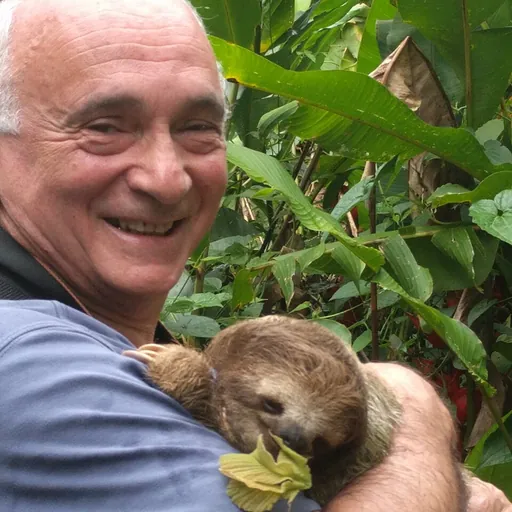
Alexander Bogomolny
Soviet-born Israeli American mathematician
About Alexander Bogomolny
Lived 1948 – 2018 (aged 70). Alexander Bogomolny was a Russian mathematician and university teacher.
Alexander Bogomolny (January 4, 1948 July 7, 2018) was a Soviet-born Israeli-American mathematician. He was Professor Emeritus of Mathematics at the University of Iowa, and formerly research fellow at the Moscow Institute of Electronics and Mathematics, senior instructor at Hebrew University and software consultant at Ben Gurion University. He wrote extensively about arithmetic, probability, algebra, geometry, trigonometry and mathematical games.
He was known for his contribution to heuristics and mathematics education, creating and maintaining the mathematically themed educational website Cut-the-Knot. He was a pioneer in mathematical education on the internet, having started Cut-the-Knot in October 1996.
Education and academic career Bogomolny attended Moscow school No. 444, for gifted children, then entered Moscow State University, where he graduated with a master's degree in mathematics in 1971. From 1981 to 1982 he was also a visiting professor at Ohio State University, where he taught mathematics.
Cut-the-Knot Cut-the-Knot (CTK) is a free, advertisement-funded educational website which Bogomolny maintained from 1996 to 2018. It is devoted to popular exposition of various topics in mathematics. The site was designed for teachers, children and parents, and anyone else curious about mathematics, with an eye to educating, encouraging interest, and provoking curiosity. Its name is a reference to the legend of Alexander the Great's solution to the Gordian knot.
CTK won more than 20 awards from scientific and educational publications, including a Scientific American Web Award in 2003, the Encyclopædia Britannicas Internet Guide Award, and Sciences NetWatch award.
The site contains extensive analysis of many of the classic problems in recreational mathematics including the Apollonian gasket, Napoleon's theorem, logarithmic spirals, the "Futurama Theorem" from the episode "The Prisoner of Benda", the Pitot theorem, and the monkey and the coconuts problem. One page includes 122 proofs of the Pythagorean theorem.
Bogomolny wrote a manifesto for CTK in which he said that "Judging Mathematics by its pragmatic value is like judging symphony by the weight of its score." He described the site as "a resource that would help learn, if not math itself, then, at least, ways to appreciate its beauty," and he wondered why it is acceptable among otherwise well-educated people "to confess a dislike and misunderstanding of Mathematics as a whole."
Many mathematical ideas were originally illustrated by Java applets, but most were later replaced by GeoGebra applications, also used for material added later. CTK wiki (powered by PmWiki) extends the main site with additional mathematical content, especially that with more complicated formulae than available on the main site.
From 2001–2004 several CTK articles with interactive applets were also hosted as a column at the Mathematical Association of America website.
Book Cut the Knot: Probability Riddles. Champaign, IL: Wolfram Media, 2020.
Published after Bogomolny's death, with a foreword by his friend Nassim Nicholas Taleb, this book is based on the collection of probability riddles curated by Bogomolny on his website cut-the-knot.org, presented by topical progression.
Personal life Bogomolny had to leave academia because he had an uncorrectable hearing problem and was practically deaf in his later years.
Tribute Bogomolny's older son David chronicled his yearlong recitation of kaddish in honor of his father, originally on The Times of Israel blogs, in a series titled, "The skeptic's kaddish for the atheist", consisting of traditional Jewish sources, religious text analysis, modern interpretations and expressions of kaddish, philosophy, theology, eschatology, creative writing, and the personal reflections; memories; and experiences of a son in mourning.
Don’t just read it —
keep it.
Full-length biographies made to live with: read them, listen on the way to work, watch them tonight.
- E-book
- Audio
- Video
Instant download · yours to keep · every purchase keeps this site free
Important facts
People in Alexander Bogomolny's life
Named in this biography and alive at the same time


Related people
Same field, nearest in time


Contemporaries
People whose lives overlapped Alexander Bogomolny's


Frequently asked questions
Who was Alexander Bogomolny?
Soviet-born Israeli American mathematician
When was Alexander Bogomolny born?
Alexander Bogomolny was born on 4 January 1948 in Moscow.
When did Alexander Bogomolny die?
Alexander Bogomolny died on 7 July 2018 in New Brunswick.
What was Alexander Bogomolny's occupation?
Alexander Bogomolny was a mathematician and university teacher.
What nationality was Alexander Bogomolny?
Alexander Bogomolny was Russian.
Sources & further reading
· Wikipedia: Alexander Bogomolny
· DBpedia: Alexander Bogomolny
Cite this page
APA: Biography.guide. (2026). Alexander Bogomolny. https://biography.guide/alexander-bogomolny/
MLA: "Alexander Bogomolny." Biography.guide, https://biography.guide/alexander-bogomolny/.
Chicago: "Alexander Bogomolny." Biography.guide. https://biography.guide/alexander-bogomolny/.
Data last updated: 2026-09-20 · Spot an error? Report a correction.
Page generated 2026-09-27 05:09 UTC