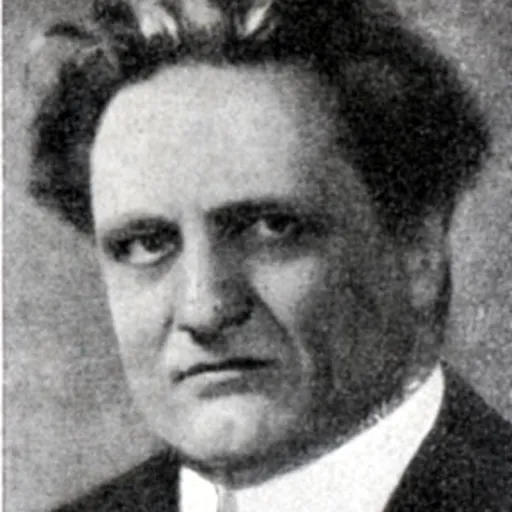
About Alberto de' Stefani
Lived 1879 – 1969 (aged 89). Alberto de' Stefani was an Italian economist, politician and secondary school teacher.
Alberto de' Stefani (6 October 1879 – 15 January 1969) was an Italian politician and economist. Coming from a background in liberalism to Benito Mussolini's Italian fascism, De Stefani was in charge of Italian economics from 1922 to 1925. His time in charge was characterized by laissez-faire ideals.
Minister of treasury De Stefani was appointed by Mussolini as Italy's minister of treasury in December 1922 when Vincenzo Tangorra suddenly died. He was a liberal economist and a former stalwart leader in the Centre Party who favoured policies such as free-trade, tax cuts without too much government interference, and privatisation of businesses such as the communications industry. He also undertook a thorough reform of the taxation system in Italy, which was adjudged a success at the time, although it has been noted that the reforms he enacted had been laid out by his predecessor Filippo Meda but not enacted.
De Stefani took advantage of the dictatorial powers afforded to Mussolini's regime to enact these reforms, which had previously been blocked by parliament, but in exchange he was among the acolytes who continued to serve Mussolini despite being aware of his responsibilities in the Matteotti crime.
The economy prospered under de Stefani's direction, as part of a Europe-wide growth. Both wages and the cost of living fell under his direction. By mid-1925, the economy was heading towards crisis and Mussolini dismissed de Stefani, replacing him with Giuseppe Volpi, a corporatist.
Later political career Although removed from his position as minister de Stefani remained a member of the Grand Council of Fascism until the collapse of Mussolini's regime. From this position, de Stefani often criticised some of the actions of Mussolini's government. He was socially conservative and in 1928 launched an attack on what he felt was the "abundantly liberal" legislation being passed on marriage, arguing that those who chose not to procreate should be denied the same legal rights as parents. He would later become associated with a tendency that included fellow movement veterans Emilio De Bono, Italo Balbo, and Luigi Federzoni that was highly critical of the introduction of Nazi Germany-influenced racial laws into Italy.
Academic career Away from politics, de Stefani served as a lecturer in economics at the Vicenza Institute of Technology. He later was appointed a professor at the Sapienza University of Rome.
Don’t just read it —
keep it.
Full-length biographies made to live with: read them, listen on the way to work, watch them tonight.
- E-book
- Audio
- Video
Instant download · yours to keep · every purchase keeps this site free
Important facts
People in Alberto de' Stefani's life
Named in this biography and alive at the same time




Related people
Same field, nearest in time


Contemporaries
People whose lives overlapped Alberto de' Stefani's



Frequently asked questions
Who was Alberto de' Stefani?
Italian politician (1879–1969)
When was Alberto de' Stefani born?
Alberto de' Stefani was born on 6 October 1879 in Verona.
When did Alberto de' Stefani die?
Alberto de' Stefani died on 22 January 1969 in Rome.
What was Alberto de' Stefani's occupation?
Alberto de' Stefani was an economist, politician and secondary school teacher.
What nationality was Alberto de' Stefani?
Alberto de' Stefani was Italian.
Sources & further reading
· Wikipedia: Alberto de' Stefani
· DBpedia: Alberto de' Stefani
Cite this page
APA: Biography.guide. (2026). Alberto de' Stefani. https://biography.guide/alberto-de-stefani/
MLA: "Alberto de' Stefani." Biography.guide, https://biography.guide/alberto-de-stefani/.
Chicago: "Alberto de' Stefani." Biography.guide. https://biography.guide/alberto-de-stefani/.
Data last updated: 2026-09-20 · Spot an error? Report a correction.
Page generated 2026-09-27 05:10 UTC