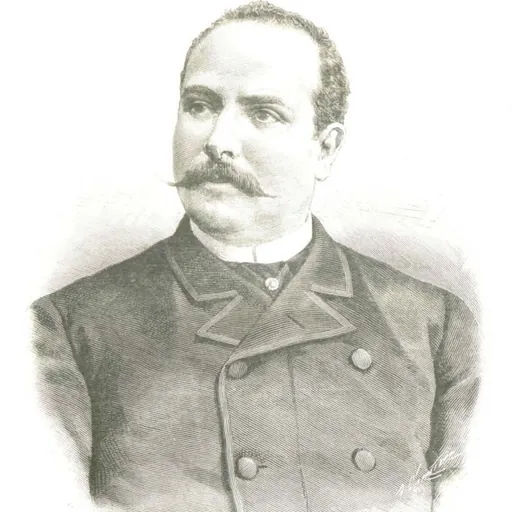
About Albert Bosch i Fustegueras
Lived 1848 – 1900 (aged 51). Albert Bosch i Fustegueras was a Spanish politician.
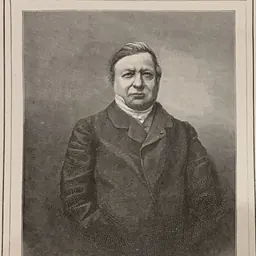
Alberto Bosch y Fustegueras (26 December 1848 – 13 May 1900 ) was a Spanish engineer, lawyer, and politician, who served as a Mayor of Madrid twice, in 1885 and in 1891–92, and later as a Development Minister of Spain during the Regency of Maria Christina of Austria. He was also a Deputy of Spain for Roquetes, Tarragona, between 1881 and 1884,
He was a president of the and of the Faculty of Sciences and Letters, and also worked as an assistant professor of Mathematical Physics at the Central University. He was the author of many and varied scientific productions, most notably Estudios trigonométricos, Manual de Astronomía popular, La agricultura española en el siglo XIX, and Geometría aplicada a las Artes. His father, a forestry engineer and surgeon at the same time, had a certain public profile in the former area, as a member of official organizations and author of technical works. With Romero again in the Government, in January 1884 he was appointed undersecretary of the Ministry and took care of several specific missions, as delegate of the Government in Catalonia for the organization of the health service and interim general director of Charity and Health and also of Posts and Telegraphs. In November 1891, and in the context of distancing between Francisco Silvela and Cánovas and rapprochement between him and Romero, he again held the mayor's office of Madrid between 26 November 1891 and 6 November 1892, while Romero held the Ultramar portfolio. With a delicate municipal situation and the hostility of the Silvela faction, his approval of the municipal budgets and an unpopular tax that caused street riots, such as the so-called in July 1892, and triggered a relentless investigation of the municipality by the Minister of the Interior, Raimundo Fernández-Villaverde, until Bosch finally presented his resignation in November 1892 and Romero followed his lead, willing to support the former lieutenant of his hussars. Villaverde also proposed a prosecution for alleged irregularities, but the request to prosecute him did not prosper in the Senate. In the subsequent strong debates in Congress and the Senate, Bosch led a new challenge to the Government with harsh accusations against Villaverde, which precipitated the fall of the Conservative Government.
In 1895, in a new Government chaired by Cánovas and in a position of challenging the causes that had motivated the crisis of 1892, Romero took over the portfolio of Grace and Justice, while Bosch held his first and only portfolio, that of Development between 23 March and 14 December 1895. In the few months he held the office, he organized the State's civil engineering corps, secondary education, arts and crafts education, and promoted fish farming, among other actions. However, the issue of the City Council reappeared, in a new episode of the confrontation between Romero and Silvela, with the opening of a judicial process against councilors and contractors and a large citizen demonstration, sponsored by the Círculo de la Unión Mercantil. The involvement of people trusted by Bosch led him to resign, and he was once again followed by Romero, who also presented his own.
In 1897, Bosch distanced himself from Romero due to his position regarding the reforms in Cuba. After the murder of Cánovas in that same year and the reorganization of the different conservative factions, the separation became even greater, and Bosch then approached the group called the Santo Sepulcro. In March 1900, shortly before his death, he was appointed member of the Technical Board created at the initiative of the Social Reform Commission for the prevention of accidents at work.
Bosch continued his career in the Senate, first as a senator for the Economic Society of Madrid between 1886 and 1890, and then for life between 1891 and 1900.
Personal life His sister Josefa was married to the politician Carlos Martín Murga. His son, Enrique Bosch y Herrera, was also a deputy. He had several decorations, such as the Grand Cross of the Order of Naval Merit.
During his second mayorship of Madrid, the Count of Romanones delivered an ignominious tirade to Bosch from his parliamentary seat in 1892, so much that the offended called for a duel, which was held on 10 July 1892 in Leganés. The combatants crossed two shots.
Death Bosch died in Madrid on 13 May 1900, at the age 51, due to uremia, he was buried on his farm in El Bonillo.
Works
Estudios trigonométricos ("Trigonometric Studies") (1875) El Centenario: apuntes para la historia de la Sociedad Económica Matritense (The centenary: notes for the history of the Matritense Economic Society) 1875 Manual de Astronomía popular ("Manual of Popular Astronomy") (1879) Elementos de fisiología ("Elements of Physiology") (1882) La agricultura española en el siglo XIX ("Spanish Agriculture in the 19th Century") Geometría aplicada a las Artes ("Geometry Applied to the Arts")
Don’t just read it —
keep it.
Full-length biographies made to live with: read them, listen on the way to work, watch them tonight.
- E-book
- Audio
- Video
Instant download · yours to keep · every purchase keeps this site free
Important facts
People in Albert Bosch i Fustegueras's life
Named in this biography and alive at the same time

Related people
Same field, nearest in time




Contemporaries
People whose lives overlapped Albert Bosch i Fustegueras's




Frequently asked questions
Who was Albert Bosch i Fustegueras?
Spanish politician (1848-1900)
When was Albert Bosch i Fustegueras born?
Albert Bosch i Fustegueras was born on 26 December 1848 in Tortosa.
When did Albert Bosch i Fustegueras die?
Albert Bosch i Fustegueras died on 13 May 1900 in Madrid.
What was Albert Bosch i Fustegueras's occupation?
Albert Bosch i Fustegueras was a politician.
What nationality was Albert Bosch i Fustegueras?
Albert Bosch i Fustegueras was Spanish.
Sources & further reading
· Wikipedia: Albert Bosch i Fustegueras
· DBpedia: Alberto Bosch y Fustegueras
Cite this page
APA: Biography.guide. (2026). Albert Bosch i Fustegueras. https://biography.guide/albert-bosch-i-fustegueras/
MLA: "Albert Bosch i Fustegueras." Biography.guide, https://biography.guide/albert-bosch-i-fustegueras/.
Chicago: "Albert Bosch i Fustegueras." Biography.guide. https://biography.guide/albert-bosch-i-fustegueras/.
Data last updated: 2026-09-23 · Spot an error? Report a correction.
Portrait: Wikimedia Commons · author & licence
Page generated 2026-09-27 05:08 UTC