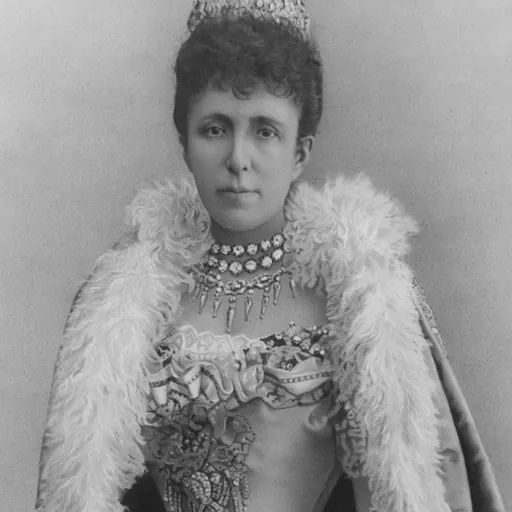
About Maria Christina of Austria
Lived 1858 – 1929 (aged 70). Maria Christina of Austria was a Spanish politician.
Maria Christina Henriette Desideria Felicitas Raineria of Austria (; 21 July 1858 – 6 February 1929) was Queen of Spain as the second wife of Alfonso XII. She was queen regent during the vacancy of the throne between her husband's death in November 1885 and the birth of their son Alfonso XIII in May 1886, and subsequently also until her son came of age in May 1902.
Early life Known to her family as Christa, she was born at Židlochovice Castle (Groß Seelowitz), near Brno, in Moravia, a daughter of Archduke Karl Ferdinand of Austria and his wife, Archduchess Elisabeth Franziska of Austria. She was Princess-Abbess of the Theresian Royal and Imperial Ladies Chapter of Prague Castle (1875–1879).
Queen consort Maria Christina with Alfonso XII and the Princess of Asturias in 1880.
After the death of Queen María de las Mercedes in June 1878, King Alfonso XII was determined to remarry to produce an heir. The Queen had died childless just a few months after her marriage and negotiations started with the court of Vienna. In August, Alfonso XII traveled to Arcachon, Gironde, with the specific purpose of meeting Archduchess Maria Christina and her mother Archduchess Elisabeth. In this first meeting, the King proposed to her and she accepted.
In early September 1878, the Spanish Government approved the engagement and Emperor Franz Joseph asked his niece to officially relinquish her title of Abbess of the Theresian Convent of Prague as it was necessary for the future queen to abandon all her Austrian appointments. The proposal was gazetted in the Wiener Zeitung on 7 September: "His Majesty the King of Spain, during his visit to Arcachon, has requested the hand of the Most Serene Lady Archduchess Maria Christina... with previous consent of His Imperial and Royal Apostolic Majesty, as Chief of the Imperial Family, the Most Serene Lady Archduchess has accepted the said proposal".
In compliance with Article 56 of the Constitution of Spain, the Cortes passed a law granting a 500.000 pesetas annuity for the future queen consort on 2 November. The terms of the marriage were settled in an agreement executed between Austria and Spain in Vienna on 15 November by their respective plenipotentiaries. That same day Maria Christina renounced her succession rights to the Austrian throne before the Emperor and the court according to the tradition imposed to the archduchesses who were to marry a foreign prince. Another marriage agreement was signed in Madrid on 28 November by the King and Maria Christina themselves.
The wedding took place on 29 November 1879 at the Basilica of Atocha in Madrid. The arranged marriage (the second of Alfonso XII after the death of his first wife María de las Mercedes of Orléans), was concerted on the basis of the conservative profile espoused by the Austro-Hungarian Empire as well as by the prestige attained by the Habsburgs in their previous involvement in the history of Spain, and blocked the possibility of a prospective Austrian endorsement to the Carlist cause.
After giving birth to two daughters —María de las Mercedes (born 1880) and María Teresa (born 1882)— she ensured dynastic continuity, yet, with the threatening landmark for the ruling dynasty set by the previous Carlist Wars, she was still pressured to undergo a new pregnancy and give birth to a male child in order to consolidate the political system, as it was considered at the time.
She became pregnant again before the death of her husband in November 1885 (the king suffered from tuberculosis yet he led an active life). While possibly apocryphal, it is representative of the Restoration era. She rejected the title of reina gobernadora ("Queen Governor"), distancing from the memory of the previous regent Maria Christina of Bourbon-Two Sicilies, who had used it in the 1830s.
When the King died on 25 November 1885, Maria Christina was pregnant, so the throne was vacant, depending on whether Maria Christina's unborn child was a male or a female; a male would make that child king, while a female would place the elder daughter, the Princess of Asturias, María de las Mercedes, on the throne. During this period, Maria Christina ruled as regent until her child Alfonso, a son, was born on 17 May 1886; he was King (Alfonso XIII) from birth.
She nurtured a persona of austerity and staidness, and became known among the populace as Doña Virtudes, María la Seca ("Mary the Curt One") and la institutriz ("the governess"). She displayed strong religious beliefs which gained her the endorsement of Pope Leo XIII, weakening the adherence to Carlist stances within the clergy.
Her chief adviser and head of government was Práxedes Mateo Sagasta. Her rule is described as well-balanced and in accordance with respect for constitutional rights, and many political reforms were instated during her regency to prevent political conflicts and chaos. Her role was mostly ceremonial, and her purpose was to preserve the crown for her son until he became an adult.
Her time as regent saw the loss of Cuba, Puerto Rico, and the Philippines after the 1898 Spanish–American War. Nevertheless, Alfonso XIII continued to look to her on many occasions for advice.
She was the leading figure around which the Germanophile stronghold within the Royal Court coalesced during World War I, in contrast to the pro-Entente minority faction represented by her daughter-in-law, the British-born Victoria Eugenie. Spain remained a neutral country during the conflict.
She died on 6 February 1929, at the Royal Palace of Madrid, after some weeks of heart disease. She is buried at El Escorial.
Sir Charles Petrie, Alfonso XIII's biographer, maintained that the Queen dowager's death had a disastrous effect on her son, and that the latter never recovered politically from the blow. Within little more than two years the monarchy had collapsed.
Grand Duchess Maria Pavlovna of Russia described her in her 1932 memoirs as "Queen Christine, a trim vivacious little old lady with an intelligent, sharp face and white hair. Her manner was perfectly simple and cordial, but you felt, nevertheless, that she was a sovereign of the old school, who had never stepped outside the palace walls."
Honours She received the following awards:
Heraldry
Ancestry
Don’t just read it —
keep it.
Full-length biographies made to live with: read them, listen on the way to work, watch them tonight.
- E-book
- Audio
- Video
Instant download · yours to keep · every purchase keeps this site free
Important facts
Family & relationships
People in Maria Christina of Austria's life
Named in this biography and alive at the same time



Related people
Same field, nearest in time


Contemporaries
People whose lives overlapped Maria Christina of Austria's

Frequently asked questions
Who was Maria Christina of Austria?
Queen consort of Spain (1858-1929)
When was Maria Christina of Austria born?
Maria Christina of Austria was born on 21 July 1858 in Židlochovice, Židlochovice Castle.
When did Maria Christina of Austria die?
Maria Christina of Austria died on 6 February 1929 in Madrid.
What was Maria Christina of Austria's occupation?
Maria Christina of Austria was a politician.
What nationality was Maria Christina of Austria?
Maria Christina of Austria was Spanish.
Sources & further reading
· Wikipedia: Maria Christina of Austria
· DBpedia: Maria Christina of Austria
Cite this page
APA: Biography.guide. (2026). Maria Christina of Austria. https://biography.guide/maria-christina-of-austria/
MLA: "Maria Christina of Austria." Biography.guide, https://biography.guide/maria-christina-of-austria/.
Chicago: "Maria Christina of Austria." Biography.guide. https://biography.guide/maria-christina-of-austria/.
Data last updated: 2026-09-28 · Spot an error? Report a correction.
Portrait: Wikimedia Commons · author & licence
Page generated 2026-10-04 12:34 UTC