About Albert Austin Harding
Lived 1880 – 1958 (aged 78). Albert Austin Harding was a conductor and director of Bands.
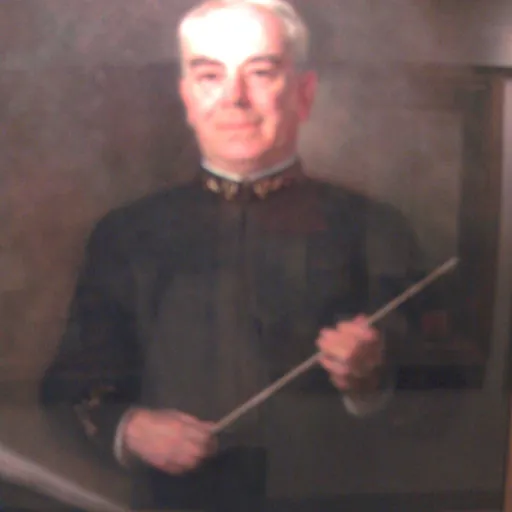
Albert Austin Harding (February 10, 1880 – December 3, 1958) was the first Director of Bands at the University of Illinois and the first band director at an American university to hold a position of full professorship. The Harding Band Building, the first dedicated building for a University Band Department, was named for him.
His full-length portrait painted by Earl Bradbury in 1950 hangs in the Harding Band Building.
Early life
Albert Austin Harding was born February 10, 1880, in Georgetown, Illinois, the son of Conway A. and Jennie Stewart Harding. Unfortunately, Jennie died shortly after his birth, and Conway moved his son to Paris, Illinois, to live with his maternal grandparents, Vincent and Mary Stewart. He lived with them until the age of 10. After their deaths in February 1890 he went to live with his paternal grandmother, Mrs. Adelia Austin Harding, and her brother Wallace Austin in the Austin house in Paris. He lived there until he was 21.
In 1894 at age 14 Harding bought his first cornet, a French Jaubert for only nine or ten dollars. This cornet was probably the cheapest type of cornet available at that time and was nicknamed "Jawbreakers". Recognizing beauty in the instrument, he quickly mastered it and moved on to the fife. By the age of 16, he had also learned the piccolo. This concert, called the Sixteenth Annual Concert, was one in a long series of incorrectly numbered ″annual concerts″ and ″anniversary concerts″. The first formal band concert of record had been played 3 May 1892 at the Walker Opera House in Champaign.
Director of bands
In 1907 Harding was appointed Director of Bands after two years of conducting the band. He was listed as both conductor and director of the Military Band for the first time in the program for the 1908 annual spring concert. Later he earned a full professorship in music, becoming the first band director to do this on an American campus. These popular concerts were started by Director Harding following a request by the university president Edmund J. James that the band do something more for the cultural life of the university. The spring series of Twilight Concerts in April and May continued through 1984. Summer session Twilight Concerts in June and July played by the Summer Band on the Illini Union terrace continue to the present.
On Commencement Day, 11 June 1913, Harding married Margaret Rogers, a high school friend from Paris. He was 33 and she was 32. This band has continued relatively unchanged since that time.
When Harding became conductor there was very little original music written for band by outstanding composers. Published concert music consisted mainly of transcriptions of orchestral music for small bands of limited ability and instrumentation, so he began to transcribe brilliant, colorful orchestral compositions to fit the instrumentation and ability of his band. These transcriptions were done under an agreement with publishers that they be used exclusively by the University of Illinois bands and not be copied or loaned out to other bands. The list grew to more than 150 handwritten manuscripts by the time he retired in 1948.
He continued to increase the dimensions of the band program by adding concert band music and his own transcriptions of symphonic and chamber pieces to performances at ceremonies and sporting events. He also enforced professionalism within the bands. The Concert Band became unique, especially because of his interest in unusual instruments. Not only did he utilize typical band instruments but in 1924 he added many unusual instruments such as the basset horn, saxonet, B-flat bass sarrusophone, E-flat bass sarrusophone, CC contra-bass sarrusophone, terz flute, A-flat flute, musette, valve trombone, tenor antoniophone, bass antoniophone, bellstedtromba, bass cornophone and ophicleide. John Philip Sousa called the Concert Band "the world's greatest college band."
On 29 October 1933 the Concert Band made an all expenses paid trip to Chicago to play at the Century of Progress International Exposition, the World′s Fair. The band played a one-hour concert in the Hall of States and another in the Hall of Science. They returned home the same day.
While Harding was director, the Concert Band had many guest conductors. On March 20, 1930, the band performed a "Complimentary Concert". Harding conducted the first half of the concert, and Sousa conducted the second half. Among the works Harding conducted were those composed by Saint-Saëns, Respighi, Haydn Wood, Glazunov, and Rimsky-Korsakov. Sousa then conducted various works including a "Symposium of Marches by the March King" which consisted of "The University of Illinois", "Semper Fidelis", and "The Stars and Stripes Forever". Other guest conductors at various times were Edwin Franko Goldman, Henry Fillmore, Frank Simon, Harold Bachman, Guy Holmes, and Victor Grabel. In 1929 the idea of a clinic for high school band directors grew out of the annual High School Teachers Conference held at the university. Harding and his assistants organized the first clinic held on 9–10 January 1930. Along with demonstrations of contest music played by the university bands there were meetings and discussions of band topics. The clinics were discontinued in the 1950s. In 1955 they were replaced with the Festival of Concert Band Music, a two–day series of formal concerts by the three university bands.
In January 1945 Margaret Harding was bedridden. The 16th annual band clinic was in session at the time, so Clarence Sawhill, Assistant Director of Bands, conducted the band clinic. On January 16, 1945, Margaret died. She was survived by her husband and their only child Jane Austin Harding. Sousa planned on giving the university the materials from his band library as a "gesture of his high esteem" for Harding and his band.
As Director of Bands Harding transcribed more than 150 orchestral compositions for his concert bands. Most of these remain unpublished. However he allowed six transcriptions to be published by Neil Kjos Music Company so that the royalties could be used to fund the A.A. Harding Awards given annually to outstanding band members. The six with dates of publication are:
Finale from ″Death and Transfiguration″ — Richard Strauss (1950) A Hero′s Courtship from ″Ein Heldenleben″ — Richard Strauss (1956) Introduction and Wedding March from ″The Golden Cockerel″ — Nikolai Rimsky−Korsakov (1957) Overture to ″The Tsar′s Bride″ — Nikolai Rimsky−Korsakov (1954) Psyche and Eros from ″Psyche″ — César Franck (1952) Valzer Campestre from ″Suite Siciliana″ — Giuseppe Marinuzzi (1957)
In 2021 Harding was inducted into The Guild of the University of Illinois College of Fine and Applied Arts. This is a group of noteworthy alumni, faculty and friends of the college who are recognized posthumously for their contributions to the arts. This honor is a further indication that his influence has continued through the years following his death.
Harding Band Building
The University of Illinois Bands moved into the Band Building in 1957 (renamed Harding Band Building in 1974). In 1928 the bands had moved from basement space in University Hall into the Military Office Building, a 1915 wooden frame structure east of the Armory, and remained there until 1956 when work was started on the new building occupying the same site at 1103 South Sixth Street, Champaign. This new building was the "first building built solely for use by a college band program." Today, it is home to the University of Illinois Bands, the Sousa Archives and Center for American Music, and "one of the world's greatest band libraries". Most of the rehearsal and practice rooms were built to achieve maximum acoustical effectiveness. These include a main rehearsal room, six sectional rehearsal rooms, and twelve practice rooms. Also, the band library utilizes five rooms; the Sousa Archives and Center for American Music and the Carl Busch Instrument Collection occupy five more rooms.
Don’t just read it —
keep it.
Full-length biographies made to live with: read them, listen on the way to work, watch them tonight.
- E-book
- Audio
- Video
Instant download · yours to keep · every purchase keeps this site free
Important facts
People in Albert Austin Harding's life
Named in this biography and alive at the same time






Related people
Same field, nearest in time
Contemporaries
People whose lives overlapped Albert Austin Harding's




Frequently asked questions
Who was Albert Austin Harding?
American academic (1880–1958)
When was Albert Austin Harding born?
Albert Austin Harding was born on 10 February 1880 in Illinois.
When did Albert Austin Harding die?
Albert Austin Harding died on 3 December 1958 in Illinois.
What was Albert Austin Harding's occupation?
Albert Austin Harding was a conductor and director of Bands.
Sources & further reading
· Wikipedia: Albert Austin Harding
· DBpedia: Albert Austin Harding
Cite this page
APA: Biography.guide. (2026). Albert Austin Harding. https://biography.guide/albert-austin-harding/
MLA: "Albert Austin Harding." Biography.guide, https://biography.guide/albert-austin-harding/.
Chicago: "Albert Austin Harding." Biography.guide. https://biography.guide/albert-austin-harding/.
Data last updated: 2026-09-23 · Spot an error? Report a correction.
Portrait: Wikimedia Commons · author & licence
Page generated 2026-09-27 05:05 UTC