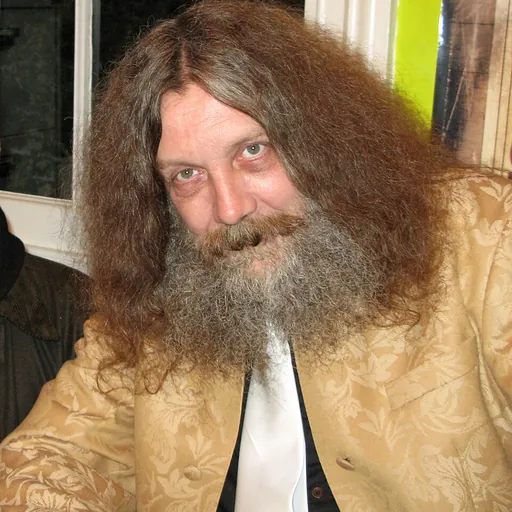
Alan Moore
British comic book author (born 1953)
About Alan Moore
Born 1953. Alan Moore is a British comics writer, novelist, science fiction writer, opinion journalist, writer and comics artist.
Alan Moore (born 18 November 1953) is an English author known primarily for his work in comics including Watchmen, V for Vendetta, The Ballad of Halo Jones, Swamp Thing, Batman: The Killing Joke, Superman: Whatever Happened to the Man of Tomorrow? and From Hell. He is widely recognised among his peers and critics as one of the best comic book writers in the English language. Moore has occasionally used such pseudonyms as Curt Vile, Jill de Ray, Brilburn Logue and Translucia Baboon; also, reprints of some of his work have been credited to The Original Writer when Moore requested that his name be removed.
Moore started writing for British underground and alternative fanzines in the late 1970s before achieving success publishing comic strips in such magazines as 2000 AD and Warrior. He was subsequently picked up by DC Comics as "the first comics writer living in Britain to do prominent work in America", In the late 1980s and early 1990s he left the comic industry mainstream and went independent for a while, working on experimental work such as the epic From Hell and the prose novel Voice of the Fire. He subsequently returned to the mainstream later in the 1990s, working for Image Comics, before developing America's Best Comics, an imprint through which he published works such as The League of Extraordinary Gentlemen and the occult-based Promethea. In 2016, he published Jerusalem: a 1,266-page experimental novel set in his hometown of Northampton, UK.
Moore is an occultist, ceremonial magician, and anarchist, and Damon Lindelof. He has lived a significant portion of his life in Northampton, England, and he has said in various interviews that his stories draw heavily from his experiences living there.
Early life
Moore was born on 18 November 1953, at St Edmund's Hospital in Northampton to a working-class family who he believed had lived in the town for several generations. He "read omnivorously" from the age of five, getting books out of the local library, and subsequently attended Spring Lane Primary School. where he first came into contact with people who were middle class and better educated, and he was shocked at how he went from being one of the top pupils at his primary school to one of the lowest in the class at secondary. Subsequently, disliking school and having "no interest in academic study", he believed that there was a "covert curriculum" being taught that was designed to indoctrinate children with "punctuality, obedience and the acceptance of monotony". Through Embryo, Moore became involved in a group known as the Northampton Arts Lab. The Arts Lab subsequently made significant contributions to the magazine. The headmaster of the school subsequently "got in touch with various other academic establishments that I'd applied to and told them not to accept me because I was a danger to the moral well-being of the rest of the students there, which was possibly true." In late 1973, he met and began a relationship with Northampton-born Phyllis Dixon, with whom he moved into "a little one-room flat in the Barrack Road area in Northampton". Soon marrying, they moved into a new council estate in the town's eastern district while he worked in an office for a sub-contractor of the local gas board. Moore felt that he was not being fulfilled by this job, and so decided to try to earn a living doing something more artistic. earning £35 a week. Alongside this, he and Phyllis, with their newborn daughter Leah, began claiming unemployment benefit to supplement this income. Meanwhile, Moore decided to focus more fully on writing comics rather than both writing and drawing them, stating that "After I'd been doing [it] for a couple of years, I realised that I would never be able to draw well enough and/or quickly enough to actually make any kind of decent living as an artist."
To learn more about how to write a successful comic-book script, he asked for advice from his friend Steve Moore. Interested in writing for 2000 AD, one of Britain's most prominent comic magazines, Alan Moore then submitted a script for their long-running and successful series Judge Dredd. While having no need for another writer on Judge Dredd, which was already being written by John Wagner, fellow writer Alan Grant saw promise in Moore's work—later remarking that "this guy's a really fucking good writer" —and instead asked him to write some short stories for the publication's Future Shocks series. While the first few were rejected, Grant advised Moore on improvements, and eventually accepted the first of many. Meanwhile, Moore had also begun writing minor stories for Doctor Who Weekly and later commented that "I really, really wanted a regular strip. I didn't want to do short stories ... But that wasn't what was being offered. I was being offered short four or five-page stories where everything had to be done in those five pages. And, looking back, it was the best possible education that I could have had in how to construct a story." The editors at the magazine were impressed by Moore's work and decided to offer him a more permanent strip, starting with a story that they wanted to be vaguely based upon the hit film E.T. the Extra-Terrestrial. The result, Skizz, which was illustrated by Jim Baikie, told the story of the titular alien who crashes to Earth and is cared for by a teenager named Roxy, and Moore later noted that in his opinion, this work "owes far too much to Alan Bleasdale." Another series he produced for 2000 AD was D.R. and Quinch, which was illustrated by Alan Davis. The story, which Moore described as "continuing the tradition of Dennis the Menace, but giving him a thermonuclear capacity", He replaced the former writer Dave Thorpe but maintained the original artist, Alan Davis, whom Moore described as "an artist whose love for the medium and whose sheer exultation upon finding himself gainfully employed within it shine from every line, every new costume design, each nuance of expression." The third series that Moore produced for Warrior was The Bojeffries Saga, a comedy about a working-class English family of vampires and werewolves, drawn by Steve Parkhouse. Warrior closed before these stories were completed, but under new publishers both Miracleman and V for Vendetta were resumed by Moore, who finished both stories by 1989. Moore's biographer Lance Parkin remarked that "reading them through together throws up some interesting contrasts—in one the hero fights a fascist dictatorship based in London, in the other an Aryan superman imposes one."
Meanwhile, during this same period, he—using the pseudonym of Translucia Baboon—became involved in the music scene, founding his own band, The Sinister Ducks, with David J (of goth band Bauhaus) and Alex Green, and in 1983 released a single, March of the Sinister Ducks, with sleeve art by illustrator Kevin O'Neill. In 1984, Moore and David J released a 12-inch single featuring a recording of "This Vicious Cabaret", a song featured in V for Vendetta, which was released on the Glass Records label.
The American mainstream and DC Comics: 1983–1988 Moore's work in 2000 AD brought him to the attention of DC Comics editor Len Wein, who hired him in 1983 to write The Saga of the Swamp Thing, then a formulaic and poor-selling monster comic. Moore, with artists Stephen R. Bissette, Rick Veitch and John Totleben, deconstructed and reimagined the character, writing a series of formally experimental stories that addressed environmental and social issues alongside the horror and fantasy, bolstered by research into the culture of Louisiana, where the series was set. an English working-class magician based visually on the British musician Sting; Constantine later became the protagonist of the series Hellblazer, which became Vertigo's longest-running series at 300 issues. Moore wrote Swamp Thing for almost four years, from issue No. 20 (January 1984) through to issue No. 64 (September 1987) with the exception of issues No. 59 and 62. These titles laid the foundation of what became the Vertigo line.
Moore began producing further stories for DC Comics, including a two-part story for Vigilante which dealt with domestic abuse. He was eventually given the chance to write a story for one of DC's best-known superheroes, Superman, entitled "For the Man Who Has Everything", which was illustrated by Dave Gibbons and published in 1985. In this story, Wonder Woman, Batman and Robin visit Superman on his birthday, only to find that he has been overcome by an alien organism and is hallucinating about his heart's desire.
The threat of nuclear war during the Cold War influenced the setting and tone of Watchmen.
The limited series Watchmen, begun in 1986 and collected as a trade paperback in 1987, cemented Moore's reputation. Imagining what the world would be like if costumed heroes had really existed since the 1940s, Moore and artist Dave Gibbons created a Cold War mystery in which the shadow of nuclear war threatens the world. The heroes who are caught up in this escalating crisis either work for the US government or are outlawed, and are motivated to heroism by their various psychological hang-ups. Watchmen is non-linear and told from multiple points of view, and includes highly sophisticated self-references, ironies and formal experiments such as the symmetrical design of issue 5, "Fearful Symmetry", where the last page is a near mirror-image of the first, the second last of the second, and so on, and in this manner is an early example of Moore's interest in the human perception of time and its implications for free will. It was the first comic to win the Hugo Award, in a one-time category ("Best Other Form"). It is widely seen as Moore's best work, and has been regularly described as the greatest comic book ever written. Comics historian Les Daniels noted that Watchmen "called into question the basic assumptions on which the superhero genre is formulated". DC Comics writer and executive Paul Levitz observed in 2010 that "As with The Dark Knight Returns, Watchmen set off a chain reaction of rethinking the nature of superheroes and heroism itself, and pushed the genre darker for more than a decade. The series won acclaim ... and would continue to be regarded as one of the most important literary works the field ever produced." Moore briefly became a media celebrity, and the resulting attention led to him withdrawing from fandom and no longer attending comics conventions (at one UKCAC in London he is said to have been followed into the toilet by eager autograph hunters).
He and Gibbons had earlier created the character Mogo as part of DC's Green Lantern Corps and a short story by Moore and artist Kevin O'Neill published in Green Lantern Corps Annual No. 2 (1986) was one of the inspirations for the "Blackest Night" storyline in 2009–2010.
Richard Wagner's opera Götterdämmerung inspired the title and story of Moore's proposed Twilight of the Superheroes.
In 1987, Moore submitted a proposal for a miniseries called Twilight of the Superheroes, the title a twist on Richard Wagner's opera Götterdämmerung (meaning "Twilight of the Gods"). The series was set in the future of the DC Universe, where the world is ruled by superheroic dynasties, including the House of Steel (presided over by Superman and Wonder Woman) and the House of Thunder (led by the Captain Marvel family). These two houses are about to unite through a dynastic marriage, their combined power potentially threatening freedom, and several characters, including John Constantine, attempt to stop it and free humanity from the power of superheroes. The series would also have restored the DC Universe's multiple earths, which had been eliminated in the continuity-revising 1985 limited series Crisis on Infinite Earths. The series was never commissioned, but copies of Moore's detailed notes have appeared on the Internet and in print despite the efforts of DC, who consider the proposal their property.
Moore wrote the lead story in Batman Annual No. 11 (1987) drawn by George Freeman. The following year saw the publication of The Killing Joke, written by Moore and illustrated by Brian Bolland. It revolved around The Joker, who had escaped Arkham Asylum and gone on a killing spree, and Batman's effort to stop him. Despite being a key work in helping to redefine Batman as a character, along with Frank Miller's The Dark Knight Returns and Batman: Year One, Lance Parkin believed that "the theme isn't developed enough" and "it's a rare example of a Moore story where the art is better than the writing," and according to certain reports, he and Gibbons gained only 2% of the profits earned by DC for Watchmen. Moore stopped working for DC.
Moore later claimed that fine print in the contracts regarding Watchmen and V for Vendetta, which stipulated that the ownership rights would revert to Moore and the artists after the stories had gone out of publication, had tricked him into believing he would eventually retain ownership, only to discover that DC had no intention of ceasing publication of the stories, effectively preventing the ownership from ever returning to Moore. Moore followed this with a second political work, Shadowplay: The Secret Team, a comic illustrated by Bill Sienkiewicz for Eclipse Comics and commissioned by the Christic Institute, which was included as a part of the anthology Brought to Light, a description of the CIA's covert drug smuggling and arms dealing. Following this, in 1991 the company Victor Gollancz Ltd published Moore's A Small Killing, a full-length story illustrated by Oscar Zárate, about a once idealistic advertising executive haunted by his boyhood self. According to Lance Parkin, A Small Killing is "quite possibly Moore's most underrated work". Moore reasoned that to solve a crime holistically, one would need to solve the entire society it occurred in, and depicts the murders as a consequence of the politics and economics of the time. Just about every notable figure of the period is connected with the events in some way, including "Elephant Man" Joseph Merrick, Oscar Wilde, Native American writer Black Elk, William Morris, artist Walter Sickert and Aleister Crowley, who makes a brief appearance as a young boy. Illustrated in a sooty pen-and-ink style by Eddie Campbell, From Hell took nearly ten years to complete, outlasting Taboo and going through two more publishers before being collected as a trade paperback by Eddie Campbell Comics. It was widely praised, with comics author Warren Ellis citing it as his "all-time favourite graphic novel".
The other series that Moore began for Taboo was Lost Girls, which he described as a work of intelligent "pornography". Illustrated by Melinda Gebbie, with whom Moore subsequently entered into a relationship, it was set in 1913, where Alice from Alice in Wonderland, Dorothy from The Wizard of Oz and Wendy from Peter Pan—who are each of a different age and class—all meet in a European hotel and regale each other with tales of their sexual encounters. Moore decided that there were too many people involved to back out from the project, and so ABC was launched in early 1999. A third volume entitled The Black Dossier was set in the 1950s. The series was well received, and Moore was pleased that an American audience was enjoying something he considered "perversely English", and that it was inspiring some readers to get interested in Victorian literature. and two sequel miniseries, Top 10: Beyond the Farthest Precinct, which was written by Paul Di Filippo and drawn by Jerry Ordway, and Top 10: Season Two, written by Cannon and drawn by Ha.
Moore's series Promethea, which told the story of a teenage girl, Sophie Bangs, who is possessed by an ancient pagan goddess, the titular Promethea, explored many occult themes, particularly the Qabalah and the concept of magic, with Moore stating that "I wanted to be able to do an occult comic that didn't portray the occult as a dark, scary place, because that's not my experience of it ... [Promethea was] more psychedelic ... more sophisticated, more experimental, more ecstatic and exuberant." A Cobweb story Moore wrote for Tomorrow Stories No. 8 featuring references to L. Ron Hubbard, American occultist Jack Parsons, and the "Babalon Working", was blocked by DC Comics due to the subject matter. DC had already published a version of the same event in their Paradox Press volume The Big Book of Conspiracies.
In 2003, a documentary about him was made by Shadowsnake Films, titled The Mindscape of Alan Moore, which was later released on DVD.
Return to independents: 2009–present
With many of the stories he had planned for America's Best Comics brought to an end, and with his increasing dissatisfaction with how DC Comics were interfering with his work, he decided to once more pull out of the comics mainstream. In 2005, he remarked that "I love the comics medium. I pretty much detest the comics industry. Give it another 15 months, I'll probably be pulling out of mainstream, commercial comics." He expanded on this for a 2009 book-length essay entitled 25,000 years of Erotic Freedom, which was described by a reviewer as "a tremendously witty history lecture—a sort of Horrible Histories for grownups."
In 2007, Moore appeared in animated form in an episode of The Simpsons—a show of which he is a fan —entitled "Husbands and Knives", which aired on his fifty-fourth birthday.
Since 2009, Moore has been a panellist on the BBC Radio 4 programme The Infinite Monkey Cage, which is hosted by physicist Brian Cox and comedian Robin Ince.
In 2010, Moore began what he described as "the 21st century's first underground magazine". Titled Dodgem Logic, the bi-monthly publication consisted of work by a number of Northampton and Midlands-based authors and artists, as well as original contributions from Moore. Despite Dodgem Logic's content not being particularly regional or parochial, its advertising sales remained mainly Midland's based, limiting its financial stability, and making it unusually dependent upon sales revenues. It ran for eight issues and folded in April 2011.
In 2010 Moore began publishing a series of comics set in the H. P. Lovecraft universe returning to an earlier interest in the work and worlds of the author. Avatar Press had previously published Alan Moore's Yuggoth Cultures and Other Growths, a compilation of unpublished scripts and strips and comic adaptations of previously published poems by Moore themed around or based upon Lovecraft's work in 2003, followed by the two part The Courtyard adapted from a previously published Lovecraftian Moore short story. The horror miniseries Neonomicon, the first of Moore's original comic works released by Avatar Press, were illustrated by Jacen Burrows who had also illustrated the earlier adaptations, and the fourth and final issue was released in January 2011. In 2014 a twelve-part series reuniting Moore with Jacen Burrows was announced titled Providence on Lovecraft and the sources of the Cthulhu Mythos forming a prequel to Neonomicon. It was published in twelve issues from 2015 to 2017.
Moore has appeared live at music events collaborating with a number of different musicians, including a 2011 appearance with Stephen O'Malley at the All Tomorrow's Parties 'I'll Be Your Mirror' music festival in London.
A planned future project is an occult textbook known as The Moon and Serpent Bumper Book of Magic, written with Steve Moore. It will be published by Top Shelf on 15 October 2024. In September 2016, he published a novel called Jerusalem, which is also set in Northampton.
Alan Moore has joined the Occupy Comics Kickstarter project. Moore contributed an essay on comics as counter-culture.
In 2014, Moore announced that he was leading a research and development project to "create an app enabling digital comics to be made by anyone". Electricomics premiered in 2015. It is an open source app for reading and creating interactive comics. Moore wrote the story Big Nemo, a dystopian sequel to Winsor McCay's Little Nemo. It was illustrated by Colleen Doran and animated by Ocasta Studios with colours by Jose Villarubia. The Guardian chose it as one of the best iPhone/iPad apps of 2015. Pipedream Comics named it the Digital Comics App of the Year.
In 2016, Moore confirmed that after authoring a final League of Extraordinary Gentlemen book, he planned on retiring from regularly writing comic books.
In April 2016, Moore began curating a comic book anthology series entitled Cinema Purgatorio published by Avatar Press, each issue opening with a story written by Moore and illustrated by Kevin O'Neill. The book also features the writing and artist team-ups of Garth Ennis and Raulo Cáceres (Code Pru), Max Brooks and Michael DiPascale (A More Perfect Union), Kieron Gillen and Ignacio Calero (Modded), and Christos Gage and Gabriel Andrade (The Vast). The anthology series has been described as "Classic tropes of pulp fiction, either turned on their head, given new filters or explored in ridiculous detail, by some of the very best comic creators we have today."
In 2018, Moore contributed to the comic anthology 24 Panels. The publication was curated by Kieron Gillen and intended to raise funds for those affected by the Grenfell Tower fire of 2017.
With the end of the fourth volume of League of Extraordinary Gentlemen, the conclusion of his Lovecraft sequence and some short stories appearing in Cinema Purgatorio, Moore has retired from comics as of mid-2019. In 2022 he confirmed it, saying "I'm definitely done with comics, I haven't written one for getting on for five years. I will always love and adore the comics medium but the comics industry and all of the stuff attached to it just became unbearable."
In 2021, it was announced that Moore was a writing a five-volume fantasy series titled Long London. The first book of the series, The Great When, was released on 1 October 2024,
Work
Themes In a number of his comics, where he was taking over from earlier writers, including Marvelman, Swamp Thing and Supreme, he used the "familiar tactic of wiping out what had gone before, giving the hero amnesia and revealing that everything we'd learned to that point was a lie."
As a comics writer, Moore applies literary sensibilities to the mainstream of the medium as well as including challenging subject matter and adult themes. He brings a wide range of influences to his work, such as William S. Burroughs, William Blake, Thomas Pynchon and Iain Sinclair, New Wave science fiction writers like Michael Moorcock, and horror writers such as Clive Barker. Influences within comics include Will Eisner, Steve Ditko, Harvey Kurtzman, Jack Kirby and Bryan Talbot.
Recognition and awards Moore's work in the comic book medium has been widely recognised by his peers and by critics. Comics historian George Khoury asserted that "to call this free spirit the best writer in the history of comic books is an understatement" Douglas Wolk observed: "Moore has undisputably made it into the Hall of Fame: he's one of the pillars of English-language comics, alongside Jack Kirby and Will Eisner and Harvey Kurtzman and not many others. He's also the grand exception in that hall, since the other pillars are artists—and more often than not, writer/artists. Moore is a writer almost exclusively, though his hyper detailed scripts always play to the strengths of the artists he works with. That makes him the chief monkey wrench in comics author theory. The main reason that almost nobody's willing to say that a single cartoonist is categorically superior to a writer/artist team is that such a rule would run smack into Moore's bibliography. In fact, a handful of cartoonists who almost always write the stories they draw have made exceptions for Moore—Jaime Hernández, Mark Beyer and most memorably Eddie Campbell."
Moore was voted Best Writer by the Society of Strip Illustration in both 1982 and 1983.
Moore won numerous Jack Kirby Awards, including for Best Single Issue for Swamp Thing Annual No. 2 in 1985 with John Totleben and Steve Bissette, for Best Continuing Series for Swamp Thing in 1985, and 1987 with Totleben and Bissette, Best Writer for Swamp Thing in 1985
Moore has won multiple Eagle Awards, including virtually a "clean sweep" in 1986 for his work on Watchmen and Swamp Thing. Moore not only won "favourite writer in both the US and UK categories", but had his work win for favourite comic book, supporting character and new title in the US; and character, continuing story and "character worthy of own title" in the UK (in which last category his works held all top three spots).
Moore has been nominated for the Comics Buyer's Guide Fan Awards several times, winning for Favorite Writer in 1985, 1986, 1987, 1999 and 2000. He won the CBG Fan Award for Favorite Comic Book Story (Watchmen) in 1987 and Favorite Original Graphic Novel or Album (Batman: The Killing Joke with Brian Bolland) in 1988.
He was given the "Best Comics Writer Ever" National Comics Award in 2001, 2002, and 2003. In addition, he was added to the National Comics Award's Roll of Honour in 2002. for 1995 and 1996 (for From Hell), for 1999 (for his body of work, including From Hell and Supreme), for 2000 (for The League of Extraordinary Gentlemen), and for 2001 and 2003 (for Promethea).
Among his numerous international prizes are the German Max & Moritz Prize for an exceptional oeuvre (2008) and the British National Comics Award for Best Comics Writer Ever (in 2001 and 2002). He also won French awards like the Angoulême International Comics Festival Prize for Best Album for Watchmen in 1989 and V for Vendetta in 1990, and the Prix de la critique for From Hell in 2001, the Swedish Urhunden Prize in 1992 for Watchmen and several Spanish Haxtur Awards, in 1988 for Watchmen and 1989 for Swamp Thing (both for Best Writer).
In 1988 he received a World Fantasy Award for Best Novella for A Hypothetical Lizard, which Avatar Press published in 2004 as a comics adaption by Antony Johnston. Moore also won two International Horror Guild Awards in the category Graphic Story/Illustrated Narrative (in 1995 with Eddie Campbell for From Hell and in 2003 with Kevin O'Neill for The League of Extraordinary Gentlemen). Moore received a Bram Stoker Award in the category Best Illustrated Narrative for The League of Extraordinary Gentlemen in 2000, then again in 2012 for Neonomicon as Best Graphic Novel.
In 2005, Watchmen was the only graphic novel to make it on to Time's "The 100 Best Novels from 1923 to the Present" list.
Eisner Awards Best Writer 1988 Watchmen (DC) 1989 Batman: The Killing Joke (DC Comics) 1995 From Hell (Kitchen Sink) 1996 From Hell (Kitchen Sink) 1997 From Hell (Kitchen Sink); Supreme (Maximum Press) 2000 The League of Extraordinary Gentlemen, Promethea, Tom Strong, Tomorrow Stories, Top 10 (America's Best Comics (ABC)) 2001 The League of Extraordinary Gentlemen, Promethea, Tom Strong, Tomorrow Stories, Top 10 (ABC) 2004 The League of Extraordinary Gentlemen, Promethea, Smax, Tom Strong, Tom Strong's Terrific Tales (ABC) 2006 Promethea, Top 10: The Forty-Niners (ABC)
Best Writer/Artist 1988 With Dave Gibbons, Watchmen (DC)
Best Single Issue/Single Story 2000 Tom Strong #1: "How Tom Strong Got Started", with Chris Sprouse and Al Gordon (ABC) 2001 Promethea #10: "Sex, Stars, and Serpents", with J.H. Williams III and Mick Gray (ABC)
Best Serialized Story 1993 From Hell with Eddie Campbell in Taboo (SpiderBaby Graphix/Tundra)
Best Continuing Series 2001 Top 10, with Gene Ha and Zander Cannon (ABC)
Best Finite Series/Limited Series 1988 Watchmen, with Dave Gibbons (DC) 2003 The League of Extraordinary Gentlemen, Volume II, with Kevin O'Neill (ABC)
Best New Series 2000 Top 10, with Gene Ha and Zander Cannon (ABC)
Best Anthology 2000 Tomorrow Stories, with Rick Veitch, Kevin Nowlan, Melinda Gebbie and Jim Baikie (ABC)
Best Graphic Album/Best Graphic Album: New 1988 Watchmen, with Dave Gibbons (DC) 1989 Batman: The Killing Joke, with Brian Bolland (DC) 1994 A Small Killing, with Oscar Zarate (Dark Horse) 2006 Top 10: The Forty-Niners, with Gene Ha (ABC) Best Graphic Album: Reprint 2000 From Hell, with Eddie Campbell (Eddie Campbell Comics)
The Will Eisner Award Hall of Fame Class of 2014
Film adaptations Due to the success of his comics, a number of filmmakers have expressed a desire to make film adaptations over the years. Moore himself has consistently opposed such ventures, stating that "I wanted to give comics a special place when I was writing things like Watchmen. I wanted to show off just what the possibilities of the comic book medium were, and films are completely different." Expressing similar sentiments, he also remarked that:
In December 2011, Moore responded to Frank Miller's attack on the Occupy movement, calling his more recent work misogynistic, homophobic and misguided. Worldwide, Occupy protesters adopted the Guy Fawkes mask from V for Vendetta. The mask has also been adopted by Anonymous, Egyptian revolutionaries, and anti-globalisation demonstrators. Moore described Occupy as "ordinary people reclaiming rights which should always have been theirs", and added:
I can't think of any reason why as a population we should be expected to stand by and see a gross reduction in the living standards of ourselves and our kids, possibly for generations, when the people who have got us into this have been rewarded for it – they've certainly not been punished in any way because they're too big to fail. I think that the Occupy movement is, in one sense, the public saying that they should be the ones to decide who's too big to fail. As an anarchist, I believe that power should be given to the people whose lives this is actually affecting.
In August 2016, Moore endorsed Jeremy Corbyn's campaign in the Labour Party leadership election. In the 2017 UK general election, Moore expressed guarded support for the Labour Party, mainly due to the left-wing socialist Corbyn being elected leader, although he does not vote as a matter of political principle. In November 2019, Moore again expressed guarded support for Labour, saying that he was voting for the first time in over forty years. He wrote: "Although my vote is principally against the Tories rather than for Labour, I'd observe that Labour's current manifesto is the most encouraging set of proposals that I've ever seen from any major British party. Though these are immensely complicated times and we are all uncertain as to which course we should take, I'd say the one that steers us furthest from the glaringly apparent iceberg is the safest bet."
In 2022, Moore published a letter supporting Brazilian presidential candidate Luiz Inácio Lula da Silva from the Workers' Party.
On conspiracy theories Doing research into conspiracy theories for his work on Brought to Light, Moore came to develop his own view about why people accept conspiracy theories, stating: Yes, there is a conspiracy, indeed there are a great number of conspiracies, all tripping each other up ... the main thing that I learned about conspiracy theories is that conspiracy theorists actually believe in the conspiracy because that is more comforting. The truth of the world is that it is chaotic. The truth is, that it is not the Jewish banking conspiracy, or the grey aliens, or the twelve-foot reptiloids from another dimension that are in control, the truth is far more frightening; no-one is in control, the world is rudderless.
Moore explained his preference for comic book writing over other mediums: "In comics, I have complete control, other than the input of my artists... every full stop and comma that I put down on that script is going to end up in the finished comic." Moore complimented Frank Miller's realistic use of minimal dialogue in fight scenes, which "move very fast, flowing from image to image with the speed of a real-life conflict, unimpeded by the reader having to stop to read a lot of accompanying text".
Selected bibliography
Comics Marvelman/Miracleman (1982–1984, 1985–1989) V for Vendetta (1982–1985, 1988–1989) Skizz (1983–1985) The Ballad of Halo Jones (1984–1986) Swamp Thing (1984–1987) For the Man Who Has Everything (1985) Watchmen (1986–1987) Superman: Whatever Happened to the Man of Tomorrow? (1986) Batman: The Killing Joke (1988) From Hell (1989–1996) Big Numbers (1990) A Small Killing (1991) Lost Girls (1991–1992, 2006) Top 10 (1999–2001) Promethea (1999–2005) Tom Strong (1999–2006) The League of Extraordinary Gentlemen (1999–2019) The Courtyard (2003) Neonomicon (2010) Fashion Beast (2012–2013) Providence (2015–2017)
Novels Voice of the Fire (1996) Jerusalem (2016) The Great When: A Long London Novel (2024) I Hear a New World (2026)
Short stories Illuminations (2022)
Non-fiction Alan Moore's Writing for Comics (2003)
Don’t just read it —
keep it.
Full-length biographies made to live with: read them, listen on the way to work, watch them tonight.
- E-book
- Audio
- Video
Instant download · yours to keep · every purchase keeps this site free
Important facts
Family & relationships
People in Alan Moore's life
Named in this biography and alive at the same time
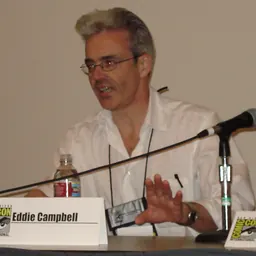

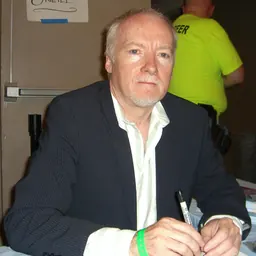

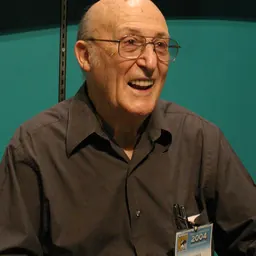



Related people
Same field, nearest in time




Contemporaries
People whose lives overlapped Alan Moore's



Frequently asked questions
Who is Alan Moore?
British comic book author (born 1953)
When was Alan Moore born?
Alan Moore was born on 18 November 1953 in Northampton.
What is Alan Moore's occupation?
Alan Moore is a comics writer, novelist, science fiction writer, opinion journalist, writer and comics artist.
What nationality is Alan Moore?
Alan Moore is British.
Sources & further reading
Cite this page
APA: Biography.guide. (2026). Alan Moore. https://biography.guide/alan-moore-comics-writer/
MLA: "Alan Moore." Biography.guide, https://biography.guide/alan-moore-comics-writer/.
Chicago: "Alan Moore." Biography.guide. https://biography.guide/alan-moore-comics-writer/.
Data last updated: 2026-09-20 · Spot an error? Report a correction.
Page generated 2026-09-27 05:09 UTC