
About Dave Gibbons
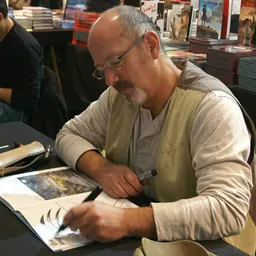
Born 1949. Dave Gibbons is a British comics artist, illustrator, draftsperson and artist.
David Chester Gibbons (born 14 April 1949) is an English comics artist, writer and sometimes letterer. He is best known for his collaborations with writer Alan Moore, which include the miniseries Watchmen and the Superman story "For the Man Who Has Everything". He was an artist for 2000 AD, for which he contributed a large body of work from its first issue in 1977.
Early life Gibbons was born on 14 April 1949, at Forest Gate Hospital in London, to Chester, a town planner, and Gladys, a secretary. He began reading comic books at the age of seven. A self-taught artist, he illustrated his own comic strips. Gibbons became a building surveyor but eventually entered the UK comics industry as a letterer for IPC Media. He left his surveyor job to focus on his comics career.
British comics work Gibbons's earliest published work was in British underground comics, starting with The Trials of Nasty Tales, including the main cover illustration, and continuing in cOZmic Comics produced by Felix Dennis.
IPC Comics Gibbons entered the British comics industry by working on horror and action titles for both DC Thomson and IPC. One of his earlier works was a 12-part comic-series titled Year of the Shark Men for DC Thomson's The Wizard magazine, in April 1976 – July 1976. When the science-fiction title 2000 AD was set up in the mid-1970s, Gibbons contributed artwork to the first issue, Prog 01 (February 1977), and went on to draw the first 24 instalments of Harlem Heroes, one of the founding (and pre-Judge Dredd) strips.
Midway through the comic's first year he began illustrating Dan Dare, a cherished project for Gibbons who had been a fan of the original series and artist Frank Hampson who, alongside Frank Bellamy, Don Lawrence and Ron Turner are well-liked and inspirational artists to Gibbons, whose "style evolved out of [his] love for the MAD magazine artists like Wally Wood and Will Elder". Gibbons drew the lead story in The Brave and the Bold No. 200 (July 1983) which featured a team-up of the Batmen of Earth-One and Earth-Two. With Green Lantern No. 172 (Jan. 1984), Gibbons joined writer Wein on the main feature while continuing to illustrate the backup features. In issue No. 182, Wein and Gibbons made architect John Stewart, who had been introduced previously in issue No. 87, the title's primary character. Ceding the "Tales of the Green Lantern Corps" backup features to various other individuals from No. 181, Gibbons's last issue with Wein was issue No. 186 (March 1985). Gibbons returned to pencil the backup story "Mogo Doesn't Socialize" with Alan Moore in issue No. 188.
While Marvel Comics reprinted some of Gibbons's Marvel UK Doctor Who work, Eclipse Comics reprinted some of his Warrior work and Eagle reprinted various Judge Dredd tales, Gibbons continued to produce new work almost exclusively for DC throughout the 1980s.
During 1985 and 1986, Gibbons's artwork appeared in several issues of both DC's Who's Who: The Definitive Directory of the DC Universe and Marvel's The Official Handbook of the Marvel Universe Deluxe Edition. He was one of the contributors to the DC Challenge limited series and in December 1986, he contributed to Harrier Comics' Brickman No. 1 alongside Kevin O'Neill, Lew Stringer and others. Between May and August 1988, he contributed covers to The Phantom miniseries, inked Kevin Maguire's pencilled contribution to Action Comics No. 600, and produced the cover to Action Comics Weekly No. 601. Gibbons's artwork in Watchmen is notable both for its stark utilisation of the formulaic comicbook nine-panel grid layout, as well as for its intense narrative and symbolic density, with some symbolic background elements suggested by Moore, others by Gibbons.
Initially pitched by Moore to use the Charlton Comics characters which had been purchased by DC Comics, Watchmen was re-tooled to feature new, analogue characters when it became clear that the story would have significant and lasting ramifications on its main players. Gibbons believes that his own involvement likely came about after the idea was already in its early initial stages. He recalls that he had: ... known Alan for a while and we had tried to get things off the ground with DC and hadn't really succeeded. Then Alan finally broke into DC with Swamp Thing and I guess I must have heard on the grapevine that he was doing a treatment for a new miniseries. I rang Alan up, saying I'd like to be involved with what he was doing. He said 'Oh, yeah great' and sent me the outline for it. Then I was at a convention in the US and asked Dick Giordano, managing director of DC at the time, point blank whether I could draw this thing Alan was writing. He said 'How does Alan feel about that?' I said 'Yeah he's fine with it' and Dick said 'Yep, OK, it's yours!' Gibbons has commented that "It's just a shame they couldn't have used just the original font, because it's a real mess. I think it's a particularly ugly letter form."
Comics historian Les Daniels noted that Watchmen "called into question the basic assumptions on which the super hero genre is formulated". DC Comics writer and executive Paul Levitz observed in 2010 that "As with The Dark Knight Returns, Watchmen set off a chain reaction of rethinking the nature of super heroes and heroism itself, and pushed the genre darker for more than a decade. The series won acclaim...and would continue to be regarded as one of the most important literary works the field ever produced."
Gibbons returned to Watchmen in 2008, producing the behind-the-scenes book Watching the Watchmen to tie into the release of the 2009 film. Watching the Watchmen is his take on the creation of the seminal work, and features a number of rarely seen pieces of artwork including sketches and character designs, as well as "stuff," he says "that I just don't know why I kept but I'm really pleased I did." Gibbons stated that "I'm basically thrilled with the movie, you know; it's been in the making for years. There have been proposals to make it – some I was excited about, some I was less excited about. But I think the way that it finally has been made is just great. I honestly can't imagine it being made much better."
1990s Give Me Liberty No. 1 (1990)Art by Gibbons; story by Frank Miller From the start of the 1990s, Gibbons began to focus as much on writing and inking as on drawing, contributing to a number of different titles and issues from a variety of companies. Particular highlights included, in 1990, Gibbons writing the three-issue World's Finest miniseries for artist Steve Rude and DC, while drawing Give Me Liberty for writer Frank Miller and Dark Horse Comics. a character born from the merging of the DC and Marvel Universes after the events of the 1996 intercompany crossover DC vs. Marvel/Marvel vs. DC. In 1999 he penciled and inked Darko Macan's four-issue Star Wars: Vader's Quest miniseries. and in December 2001 Gibbons collaborated with Stan Lee on Just Imagine... Stan Lee creating Green Lantern. In the late 2000s, he provided new alternative covers to IDW Publishing's reprints of his Marvel UK Doctor Who comics.
2010s On 9 April 2011 Gibbons was one of 62 comics creators who appeared at the IGN stage at the Kapow! convention in London to set two Guinness World Records, the Fastest Production of a Comic Book, and Most Contributors to a Comic Book. With Guinness officials on hand to monitor their progress, writer Mark Millar began work at 9am scripting a 20-page black and white Superior comic book, with various artists appearing on stage throughout the day to work on the pencils, inks, and lettering. The artists included Gibbons, Frank Quitely, John Romita Jr., Jock, Adi Granov, Doug Braithwaite, Ian Churchill, Olivier Coipel, Duncan Fegredo, Simon Furman, David Lafuente, John McCrea, Sean Phillips and Liam Sharp, who all drew a panel each, with regular Superior artist Leinil Yu creating the book's front cover. The book was completed in 11 hours, 19 minutes, and 38 seconds, and was published through Icon on 23 November 2011, with all royalties being donated to Yorkhill Children's Foundation.
Gibbons drew the 1950s variant cover for Action Comics No. 1000 (June 2018).
Work in other media Works other than comics include providing the cartoon strip on the inside sleeve of Jethro Tull's 1976 album Too Old to Rock 'n' Roll: Too Young to Die!, background art for the 1994 computer game Beneath a Steel Sky and the cover to K, the 1996 debut album by psychedelic rock band Kula Shaker. In 1988, he did the cover art of album The Madness. In 2007, he served as a consultant on the film Watchmen, which was adapted from the book, and released in March 2009. Broken Sword: The Shadow of the Templars – Director's Cut (2009) featured hand drawn art by Dave Gibbons. Since 2021, Gibbons has delivered the annual Christmas Day Message on Forbidden Planet TV, the official YouTube channel of the UK's Forbidden Planet comics retail chain. Also since 2021, Gibbons has performed the voices of Jacob Marley and The Ghost of Christmas Present in the annual Hard Agree Christmas Carol comics charity podcast.
Awards Wins 1986 Inkpot Award 1987 Jack Kirby Award for Best New Series for Watchmen with Alan Moore 1987 Jack Kirby Award for Best Writer/Artist (Single or Team) for Watchmen with Alan Moore
Nominations 1986 Jack Kirby Best Single Issue nomination for Superman Annual No. 11 (1985) with Alan Moore 1987 Jack Kirby Best Single Issue nomination for Watchmen No. 1 with Alan Moore 1987 Jack Kirby Best Single Issue nomination for Watchmen No. 2 with Alan Moore
Don’t just read it —
keep it.
Full-length biographies made to live with: read them, listen on the way to work, watch them tonight.
- E-book
- Audio
- Video
Instant download · yours to keep · every purchase keeps this site free
Important facts
People in Dave Gibbons's life
Named in this biography and alive at the same time




Related people
Same field, nearest in time


Contemporaries
People whose lives overlapped Dave Gibbons's


Frequently asked questions
Who is Dave Gibbons?
English comics artist and writer
When was Dave Gibbons born?
Dave Gibbons was born on 14 April 1949 in London.
What is Dave Gibbons's occupation?
Dave Gibbons is a comics artist, illustrator, draftsperson and artist.
What nationality is Dave Gibbons?
Dave Gibbons is British.
Sources & further reading
Cite this page
APA: Biography.guide. (2026). Dave Gibbons. https://biography.guide/dave-gibbons/
MLA: "Dave Gibbons." Biography.guide, https://biography.guide/dave-gibbons/.
Chicago: "Dave Gibbons." Biography.guide. https://biography.guide/dave-gibbons/.
Data last updated: 2026-09-20 · Spot an error? Report a correction.
Page generated 2026-09-27 05:17 UTC