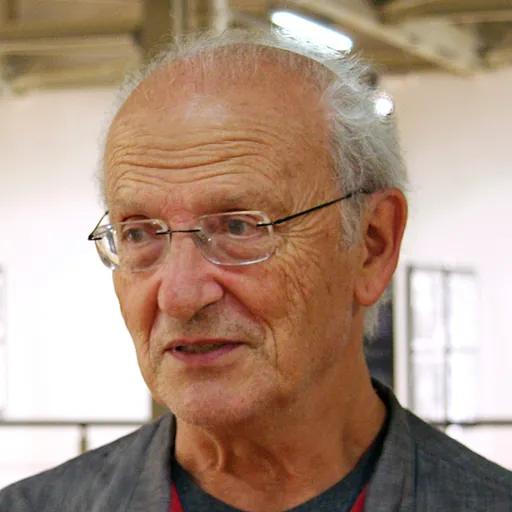
About Jean Giraud
Lived 1938 – 2012 (aged 73). Jean Giraud was a French comics writer, screenwriter, postage stamp designer, painter, penciller and draftsperson.
Jean Henri Gaston Giraud (; 8 May 1938 – 10 March 2012) was a French artist, cartoonist, and writer who worked in the Franco-Belgian bandes dessinées (BD) tradition. Giraud garnered worldwide acclaim predominantly under the pseudonym Mœbius (; ) for his fantasy/science-fiction work, and to a slightly lesser extent as Gir , which he used for his Western-themed work. Esteemed by Federico Fellini, Stan Lee, and Hayao Miyazaki, among others, he has been described as the most influential bande dessinée artist after Hergé. the only child to Raymond Giraud, an insurance agent, and Pauline Vinchon, a clerk. When he was five years old, his parents divorced and he was raised by mainly his grandparents in the neighboring municipality of Fontenay-sous-Bois (much later, when he was an acclaimed artist, Giraud returned to live in the municipality in the mid-1970s, but was unable to buy his grandparents' erstwhile house ). Giraud later explained that his parents' divorce lay at the heart of his choice of separate pen names. Playing an abundance of American B-movie Westerns, Giraud, frequenting the theater there as often as he was able to, developed a passion for the genre. In 1954, at age 16, he enrolled in the École Supérieure des Arts Appliqués Duperré, a college of art and design (which he left after two years without graduating, disenchanted as he was with the courses, prevalent atmosphere, and academic discipline, though he came to somewhat regret the decision in later life). At college, he befriended future comic artists Jean-Claude Mézières and . With Mézières in particular, in no small part due to their shared passion for science fiction and Westerns, Giraud developed a lifelong friendship, calling him "life's continuing adventure" in later life.
Career
Western comics Fleurus (1956–1958) At 17, Giraud drew Frank et Jeremie, a series of humorous Morris-inspired Western comic shorts for the magazine Far West (published from February to June 1956), his first freelance commercial sales. Magazine editor Marijac thought Giraud was gifted with a knack for humorous comics, but none whatsoever for realistically drawn comics, and advised him to continue in the vein of "Frank et Jeremie". After his return to France, he worked as a full-time tenured artist for Catholic publisher , to whom he was introduced by Mézières, who had shortly before found employment at the publisher. ) and Un géant chez lez Hurons("A Giant among the Hurons"). Several of his Western comics featured the protagonist Art Howell, and are considered Giraud's first realistic Western series. For Fleurus, Giraud illustrated his first three books. During this period, his style was heavily influenced by his future mentor, Belgian leading comic artist Joseph "Jijé" Gillain, who at that time was a major source of inspiration for the generation of young cartoonists interested in realistically drawn comics. during the Algerian War. He managed to receive a transfer out of frontline duty due to his graphics background, obtaining an illustrator position on the army magazine 5/5 Forces Françaises. Algeria was Giraud's second acquaintance with more exotic cultures, which inspired many of his future science fiction comics. Jijé was then known for his tendency to act as a mentor for young artists, going as far as welcoming them into his family home in Champrosay.
For Jijé, Giraud created several other shorts and illustrations for the short-lived magazine Bonux-Boy (1960/61), his first comic work after military service, and his penultimate one before embarking on Blueberry. Jijé used Giraud as an inker on his Western series Jerry Spring, which Giraud had used as a model for his "Art Howell" character. the fatherless Giraud gratefully stating in later life, "It was as if he had asked me «Do you want me to be your father?», and if by a miracle, I was provided with one, a [comic] artist no less!". Spurred on by Jijé, who considered the opportunity a wonderful one for his pupil, Giraud accepted. He considered the assignment a daunting one, having to create in oil paints historical objects and imagery. It was, besides being the best-paying job he had ever had, a seminal appointment. as well as for his 1968 side project "Buffalo Bill: le roi des éclaireurs" history book written by , for whom Giraud provided two-thirds of the illustrations in gouache, including the cover. In the Pilote era, Giraud provided art in gouache for two Western-themed LP covers, as well as the covers for the first seven volumes of the French-language edition of the Morgan Kane Western novel series, written by Louis Masterson. Much of his Western-themed gouache artwork of this era, including that of Blueberry, has been collected in the 1983 artbook Le tireur solitaire.
Pilote (1963–1974) In October 1963, Giraud and writer Jean-Michel Charlier started the comic strip Fort Navajo. for the Charlier-co-founded Pilote magazine, in issue 210. While the Fort Navajo series had originally been intended as an ensemble narrative, it quickly focused on having Blueberry, whose facial features were based on actor Jean-Paul Belmondo, as its central figure. At this time the similarity between the styles of Giraud and Jijé (who in effect had been Charlier's first choice for the series, but who was reverted to Giraud by Jijé) was so close that, when "Fort Navajo" started its run, Pilote received angry letters accusing Giraud of plagiarism. Jijé encouraged his former pupil to stay the course, propping up his self-confidence. and a year later, during the production of "Mission to Mexico (The Lost Rider)" on plates 17–38, when Giraud left to travel the United States, and Mexico. While the art style of both artists had been nearly indistinguishable from each other in "Thunder in the West", after Giraud resumed work on plate 39 of "Mission to Mexico", a clearly noticeable style change was observable, indicating that Giraud was now well on his way to develop his own signature style, eventually surpassing that of his former teacher Jijé, who, impressed by his former pupil's achievements, has later coined him the "Rimbaud de la BD". With the fifth album, "The Trail of the Navajos", Giraud established his own style. After the May 1968 social upheaval in France, Giraud and other key comics artists staged a protest in the editorial offices of Dargaud, the publisher of Pilote, demanding and ultimately receiving more creative freedom from editor-in-chief René Goscinny becoming an active member of his group and partaking in their gatherings.
Tahiti (1983–1984) From 1985 to 2001 he also created his six-volume fantasy series Le Monde d'Edena, (The Aedena Cycle). The stories were strongly influenced by the teachings of Appel-Guéry and Guy-Claude Burger's instinctotherapy. In effect, Giraud and his family did join Appel-Guéry's commune on Tahiti in 1983, until late 1984, when the family moved to the United States, where Giraud set up shop first in Santa Monica, and subsequently in Venice and Woodland Hills, California. Giraud's one-shot comic book "La nuit de l'étoile" was co-written by Appel-Guéry, and has been the most visible manifestation of Giraud's stay on Tahiti, aside from the artbooks "La memoire du futur" and "Venise celeste". Concurrently collaborating on "La nuit de l'étoile" was young artist Marc Bati, also residing at the commune at the time, and for whom Giraud afterwards wrote the comic series Altor (The Magic Crystal), while in the US. It was under the influence of Appel-Guéry's teachings that Giraud conceived a third pseudonym, Jean Gir – formally introduced to the public as "Jean Gir, Le Nouveau Mœbius" in "Venise celeste", though Giraud had by the time of publication already dispensed with the pseudonym himself – which appeared on the art he created while on Tahiti, though not using it for his Aedena Cycle. Another member of the commune was Paula Salomon, for whom Giraud had already illustrated her 1980 book "La parapsychologie et vous". Having to move stateside for work served Giraud well, as he became increasingly disenchanted at a later stage with the way Appel-Guéry ran his commune, in the process dispensing with his short-lived third pseudonym.
During his stay on Tahiti, Giraud had co-founded his second publishing house under two concurrent imprints, Éditions Gentiane (predominantly for his work as Gir, most notably Blueberry) and (predominantly for his work as Mœbius, and not entirely by coincidence named after the series he was working on at the time), together with friend and former editor at Les Humanoïdes Associés, , for the express purpose to release his work in a more artful manner, such as limited edition art prints, art books ("La memoire du futur" was first released under the Gentiane imprint, and reprinted under that of Aedena) and art portfolios. Both men had already released the very first such art book in the Humanoïdes days,
After having arrived in California, Giraud's wife Claudine set up Giraud's third publishing house Starwatcher Graphics in 1985, essentially the US branch of Gentiane/Aedena with the same goals, resulting in the release of, among others, the extremely limited art portfolio La Cité de Feu, a collaborative art project of Giraud with Geoff Darrow. However, due to their unfamiliarity with the American publishing world, the company did not do well, and to remedy the situation Claudine hired the French/American editor couple Jean-Marc and Randy Lofficier, whom she had met at the summer 1985 San Diego ComicCon, as translators and editors-in-chief for Starwatcher, also becoming shareholders in the company.
It was for the Marvel/Epic publication effort that it was decided to dispense with the "Jean [Gir]aud"/"Mœbius" dichotomy—until then strictly adhered-to by the artist—as both the artist's given name and his Blueberry creation were all but unknown in the English speaking world. This was contrary to his reputation as "Mœbius", already acquired in the Heavy Metal days, and from then on used for all his work in the English speaking world (and Japan), though the dichotomy remained elsewhere, including native France.
A two-issue Silver Surfer miniseries (later collected as Silver Surfer: Parable), written by Stan Lee and drawn by Giraud (as Mœbius), was published through Marvel's Epic Comics imprint in 1988 and 1989. According to Giraud, this was his first time working under the Marvel method instead of from a full script, and he has admitted to being baffled by the fact that he already had a complete story synopsis on his desk only two days after he had met Stan Lee for the first time, having discussed what Giraud had assumed was a mere proposition over lunch. This miniseries won the Eisner Award for best finite/limited series in 1989. Mœbius' version was discussed in the 1995 submarine thriller Crimson Tide by two sailors pitting his version against those of Jack Kirby, with the main character played by Denzel Washington, emphasizing the Kirby one being the better of the two. Becoming aware of the reference around 1997, Giraud was later told around 2005 by the movie's director Tony Scott, that it was he who had written in the dialog as an homage to the artist on behalf of his brother Ridley, a Mœbius admirer. An amused Giraud quipped, "It's better than a big stature, because in a way, I can not dream of anything better to be immortal [than] being in a movie about submarines!" Even as late as 1997, Giraud had created cover art for two DC comic book outings, Hardware (Vol. 1, issue 49, March 1997) and Static (Vol. 1, issue 45, March 1997), after an earlier cover for Marvel Tales (Vol. 2, issue 253, September 1991). Another project Giraud embarked upon in his "American period", was for a venture into that other staple of American pop culture, trading cards. Trading card company Comic Images released a "Mœbius Collector Cards" set in 1993, featuring characters and imagery from all over his Mœbius universe, though his Western work was excluded. Images were especially created by Giraud the year previously.
Although Giraud had taken up residence in California for five years – holding a temporary residence (the O-1 "Extraordinary Ability" category, including the "International Artist" status ) visa – he maintained a transient lifestyle, as his work had him frequently travel to Belgium and native France (maintaining a home in Paris), as well as to Japan, for extended periods of time. His stay in the United States was an inspiration for his aptly called Made in L.A. art book, the latter of which having seen a translation in English by Epic.
Giraud's extended stay in the US, garnered him a 1986 Inkpot Award, an additional 1991 Eisner Award, as well as three Harvey Awards in the period 1988–1991 for the various graphic novel releases by Marvel. It was in this period that Giraud, who had already picked up Spanish as a second language as a result from his various trips to Mexico and his dealings with Jodorowsky and his retinue, also picked up sufficient language skills to communicate in English.
The changes in his personal life were also accompanied with changes in his business holdings during 1988–1990. His co-founded publishing house Gentiane/Aedena went into receivership in 1988, going bankrupt a short time thereafter. The American subsidiary Starwatcher Graphics followed in its wake around the turn of the millennium, with the mini art portfolio "Mockba - carnet de bord" becoming the company's first recorded publication. Apart from being a publishing house, it was concurrently an art gallery, located rue Falguière in Paris, organizing themed exhibitions on a regular basis. In 1997, the company was renamed Moebius Production. The company, in both publishing and art gallery iterations, is as of 2023 still being run by Isabelle Giraud who had taken over the function of publishing editor and co-ownership from Claudine (explaining the renaming of the company), after the latter's marriage with Giraud was dissolved in 1994, and her sister Claire.
The first thing Giraud did creatively upon his return was to finish up on the Blueberry album "Arizona Love" on his own after his longtime writing partner Jean-Michel Charlier had died on 10 July 1989. Due to his intimate twenty-five year familiarity with both the series and its writer, it was a foregone conclusion that Giraud would from then on take on the scripting of the main Blueberry series as well, especially since it was already agreed upon in the "contracts signed with Jean-Michel" that "the survivor would take over the series". Nonetheless, he did embark on the Marshal Blueberry spin-off series in 1990 as writer (leaving the artwork firstly to William Vance and subsequently to ), wanting to pay homage to the legacy of his late writing partner by creating a story in his spirit, or as Giraud had put it, "{A]nd said to myself: Well, I'm going to see if I'm able to write a story à la Charlier. So I wrote this scenario, not too bad, but quite traditional, quite classic." In similar vein, Giraud took up the writing for the other Charlier/Gir western creation, Jim Cutlass, that Charlier had actually been in the process of revitalizing in the year before his death, and for which he had already contracted for the artwork, besides having already started on the scenario. After having added six more volumes (published at Casterman) to the once one-shot series, the series folded in 1999 due to the fact that it was not nearly as commercially successful as Blueberry had been.
Under his "Mœbius" pseudonym, Giraud concurrently continued to work on The Aedena Cycle and the Madwoman of the Sacred Heart trilogy, both of which started in the US and completed in 2001 and 1998 respectively, after which he concentrated on Blueberrys "OK Corral" cycle, started in 1994 upon his return to France. While Giraud was in the midst of "OK Corral" cycle, he also embarked on a new sequel cycle of his acclaimed Incal main series, called Après l'Incal (After the Incal). Yet, after he had penciled the first outing in the series, "Le nouveau rêve", he found himself confronted with "too many things that attract me, too many desires in all the senses", causing him to be no longer able to "devote myself to the bande dessinée as befitting a professional in the traditional sense". Despite repeated pleas to convince Giraud otherwise, it left writer Jodorowsky with no other recourse than to start anew with a new artist. This insight had repercussions though, as Giraud, after he had finished the "OK Corral" cycle in 2005, no longer continued to produce comics and/or art on a commercial base, but rather on a project and/or personal base, usually under the aegis of his own publishing house Mœbius Production.
As Mœbius Production, Giraud published from 2000 to 2010 Inside Mœbius (French text despite English title), an illustrated autobiographical fantasy in six hardcover volumes totaling 700 pages. Pirandello-like, he appears in cartoon form as both creator and protagonist trapped within the story alongside his younger self and several longtime characters such as Blueberry, Arzak (the latest re-spelling of the Arzach character's name), Major Grubert (from The Airtight Garage) and others.
Jean Giraud drew the first of the two-part volume of the XIII series titled "La Version Irlandaise" ("The Irish Version") from a script by Jean Van Hamme, to accompany the second part by the regular team Jean Van Hamme–William Vance, "Le dernier round" ("The Last Round"), published in 2007. The contribution was also a professional courtesy to the series' artist, Vance, who had previously provided the artwork for the first two titles in the Giraud-written Marshall Blueberry spin-off series.
Late in life, Giraud also decided to revive his seminal Arzak character in an elaborate new adventure series; the first (and last in hindsight) volume of a planned trilogy, Arzak l'arpenteur, appeared in 2010. He also added to the Airtight Garage series with two volumes entitled "Le chasseur déprime" (2008 ) and "Major" (2011 ), as well as the art book "La faune de Mars" (2011 ), print run by Mœbius Production. By this time, Giraud created his comic art on a specialized graphic computer tablet, as its enlargement features had become an indispensable aid, because of his failing eyesight.
Creating comics became increasingly difficult for Giraud, as his eyesight started to fail him in his last years, having undergone severe surgery in 2010 to stave off blindness in his left eye, and it was mainly for this reason that Giraud increasingly concentrated on creating single-piece art, both as "Gir" and as "Mœbius", on larger canvases on either commission basis or under the aegis of Mœbius Production.
Death Giraud died in Montrouge, on 10 March 2012, aged 73, after a long battle with cancer. His death was expedited by a lymphoma-induced pulmonary embolism. Fellow comic artist François Boucq (incidentally, the artist pegged by Giraud in person for the artwork of the canceled Blueberry 1900 project) stated that Mœbius was a "master of realist drawing with a real talent for humour, which he was still demonstrating with the nurses [...] in his hospital bed a fortnight ago". Giraud was buried on 15 March, in the Montparnasse Cemetery, after the funeral services, held in the Saint Clotilde Basilica. Besides friends and representatives from the Franco-Belgian comic world, the French government was represented by its Minister of Culture, Frédéric Mitterrand, nephew of the former President of France François Mitterrand, who had personally awarded Giraud with his first civilian knighthood twenty-seven years earlier. Giraud left his estate to his second wife Isabelle and his four children.
Biographies Throughout his entire career, Jean Giraud gave numerous interviews, but it is the series of interview sessions conducted over the course of four decades by comics specialist Numa Sadoul that stand out for its all encompassing scope of Giraud's entire career, from the mid-1970s onward until the latter's death in 2012. It resulted in three consecutive, chronologically organized interview books, Mister Mœbius et Docteur Gir (1976), Entretiens avec Mœbius (1991), and Docteur Mœbius et Mister Gir (2015), the latter two being each an edited, updated and expanded version of the previous one – and each title incidentally, featuring an entirely different selection of art. Excepting parts of the first book in Schtroumpf: Les cahiers de la BD (issue 25, July 1974), none of the later interviews had seen prior magazine publication. The Schtroumpf interview excerpt was by Giraud poured into a humorous eight-page autobiographical black & white comic (entitled "Entretien avec Jean Giraud", in english "Mœbius Circa '74"), which was a precursor to Giraud's autobiographical Inside Mœbius comic books (what he later himself realized, "Merde, that is exactly like the comic I have done with Numa!"). Posthumously published, the 2015 title was fully sanctioned and endorsed by Giraud's widow Isabelle and has therefore become the closest approximation of an "official biography".
Noteworthy were the testimonials Sadoul collected from seminal persons in Giraud's life and career (his mother, first wife Claudine, his mentor Jijé...), as well as the fact that Giraud spoke very freely about the aspects of his life and career including the more contentious ones, such as his mind-expanding substance use, his extremely strained relationship with the aforementioned Philippe Charlier, his fear of a painful death because of his progressing cancer... Author Sadoul acknowledged that the three series of interview sessions were snapshots in time of Giraud's life and career, causing the artist to occasionally contradict himself in later life but chose not to redact or edit such earlier made statements in order to reflect truthfully the spiritual development the artist had undergone throughout his career. Despite the worldwide renown Giraud/Mœbius has acquired, Sadoul's biography has until late-2023 only seen three other-language editions, a German, a Japanese and an English-language release.
Text autobiography Histoire de mon double, published as an unillustrated paperback in 1999 was the "biography written by Giraud on Mœbius & vice versa", but constituted what Sadoul has coined a "snapshot in time", aside from the obvious fact that the last phase of the artist's career was not covered. Giraud himself considered his "enhanced" autobiography on which he had worked for a year, a "funny" piece of work, conceding that accuracy was left to be desired as he could not be bothered to correct mistakes made therein, finding "flavor" in the small inaccuracies.
A more traditional first-time biography, titled "Jean Giraud alias Mœbius", by French BD publicist Christophe Quillien, was shortly afterwards published on 17 May 2024.
Illustrator and author Giraud had throughout his entire career made illustrations for books, magazines, music productions ), but also promotional art for commercial institutions such as banks and corporations. A notable early example of the latter, concerned the Blueberry art he created in 1978 for the Spanish jeans manufacturer Lois Jeans & Jackets; Aside from being traditionally run as an advertisement in numerous magazines, it was also blown up to gigantic, mural-like dimensions and as posters plastered on walls and billboards. As book illustrator, Giraud illustrated for example the 1987 first edition of the science fiction novel "Project Pendulum" by Robert Silverberg, and the 1994 French edition of the novel "The Alchemist" by Paulo Coelho. The subsequent year Giraud followed up in the same vein as the Coelho novel, with his cover and interior illustrations for a French 1995 reprint of "Ballades" from the French medieval poet François Villon, itself followed by similar work for 's 2001 new-age novel "La mémoire de l'âme". Much of this non-comic art, has been reproduced in the artbooks that were released over the years.
Giraud was in mid-1990s approached by two video game developers to provide the box cover art for the video games that were released in 1995; the first one concerned the Fade to Black video game developed by the US Delphine Software International, whereas the second one concerned Panzer Dragoon video game developed by the Japanese Sega Corporation. And while Giraud was by now the well established Mœbius artist in both countries, he was only asked to contribute the box cover art for the two video game releases, and nothing beyond. A few years later though, he was also asked to contribute to later games as a concept artist.
In 1999, Giraud's illustrations appeared in a soft cover edition of Dante Alighieri's La Divina Commedia, published by the Nuages Gallery in Milan. As "Mœbius" he illustrated the "Paradiso" volume, while the two others, "Inferno" and "Purgatorio", were illustrated by Lorenzo Mattotti and Milton Glaser respectively. The edition was published under the Mœbius name. Giraud's illustrations for "Paradiso" take heavy inspiration from the engravings of the Divine Comedy by Gustave Doré, with compositions often approaching an exact match. Giraud acknowledged this influence directly, praising Doré's work and remarking how he sometimes literally used tracing paper to sketch compositions. Though another prominent example of Giraud's non-comic book work, the influences from his science fiction and fantasy comics shine through.
An out-of-the-ordinary latter-day contribution as such, constituted his illustrations as "Mœbius" for the Thursday 6 March 2008 issue of the Belgian newspaper Le Soir. His illustrations accompanied news articles throughout the newspaper, providing a Mœbiusienne look on events. In return, the newspaper, for the occasion entitled "Le Soir par (by) Mœbius", featured two half-page editorials on the artist (pp. 20 & 37).
Under the names Giraud, Gir and Mœbius, he also wrote several comics for other comic artists, and the early ones included Jacques Tardi and Claude Auclair.
As author on personal title, Giraud has – apart from his own bande dessinée scripts – written philosophical poetry that accompanied his art in his Mœbius artbooks of the 1980s and 1990s. He also wrote the "Story Notes" editorials for the American Epic publications, providing background information on his work contained therein.
Films Tron was not a big hit. The movie went out in theaters in the same week as E.T. and, oh, that was a disaster for it. There was also Blade Runner and Star Trek that summer so it was a battle of giants. Tron was a piece of energy trying to survive. It is still alive. It survives. And the new movie is what Steven wanted to do back then but at that time CG was very odd and we were pioneers. I almost did the first computer-animated feature after that, it was called Star Watcher, we had the story, we had the preparation done, we were ready to start. But it came apart; the company did not give us the approval. It was too far, the concept to do everything in computer animation. We were waiting, waiting, and then our producer died in a car accident. Everything collapsed. That was my third contribution to animation and my worst experience. Les Maîtres du temps is a strange story, it's a small movie, and cheap — incredibly cheap –it was more than independent. When I saw the film for the first time I was ashamed. It's not a Disney movie, definitely. But because the movie has, maybe a flavor, a charm, it is still alive after all that time. More than 35 years now and it is still here. — Giraud, Burbank, California, 2011, on his animation movie experiences. It was not until the mid-1970s that Giraud received an invitation of Alejandro Jodorowsky to work on his planned adaptation of Frank Herbert's Dune, which was however abandoned in pre-production. Jodorowsky's Dune, a 2013 American-French documentary directed by Frank Pavich, explores Jodorowsky's unsuccessful attempt. Giraud, a non-English speaker at the time, later admitted that the prospect of travelling to Los Angeles filled him with trepidation, initially causing him to procrastinate. It was colleague Philippe Druillet who pushed him to up and go. Jodorowsky set up a pre-production unit in Paris consisting, besides Giraud, of Chris Foss, a British illustrator, Dan O'Bannon, an american visual effects supervisor and H. R. Giger, a Swiss artist. Giraud created over 3,000 pieces of artwork for the storyboard but the project fell apart for financial reasons. Giraud's presence was not always required on the project, giving him ample time to pursue his other work, especially for Métal Hurlant, and to finish up on Blueberrys "Angel Face", which he ultimately did in record time. resulting in what Giraud had coined "two weeks of work and ten years of fallout in media and advertising".
Still, Alien led to two other movie assignments in 1982, this time as both concept and storyboard artist. The first one concerned the Disney science fiction movie Tron, whose director Steven Lisberger specifically requested Giraud, after he had discovered his work in Heavy Metal magazine. For the latter, Giraud was also responsible for the poster art and the comic adaptation of the same title, with some of his concept and storyboard art featured in a "making-of" book to boot. Excepting Les Maîtres du temps, Giraud's movie work had him travel to Los Angeles for longer periods of time.
Outside his actual involvement with motion pictures, Giraud was in this period of time also occasionally commissioned to create poster art for, predominantly European, movies. Movies for which Giraud, also as "Mœbius", created poster art included, Touche pas à la femme blanche ! (1974 as Gir, three 120x160 cm versions), S*P*Y*S (1974, unsigned, American movie but poster art for release in France), (1975, unsigned), Les Chiens (1979 as Mœbius, rejected, used as cover for Taboo 4), Tusk (1980 as Giraud, a Jodorowsky film), and (1983 as Mœbius).
As his two 1982 movies coincided with the end of his Métal hurlant days and his departure for Tahiti shortly thereafter, this era can be seen as Giraud's "first Hollywood period", especially since the next project he embarked on entailed a movie in which he was very much invested as initiator, writer and producer as well, contrary to the movies he hitherto had worked upon as a gun-for-hire.
While Giraud was residing in Appel-Guéry's commune, he, together with Appel-Guéry and another member of the commune, Paula Salomon, came up with a story premise for a major animated science fiction movie called Internal Transfer, which was endowed with the English title Starwatcher – after which Giraud's American publishing house was named. Slated for the production was Arnie Wong, whom Giraud had met during the production of Tron (and, incidentally, one of the animators of the vaunted "Taarna" segment of the Heavy Metal movie), and it was actually Disney whom Giraud offered the production first. Disney, at the time not believing in the viability of such a production in animation, declined. Another member of the commune fronted some of the money for the project to proceed, and the production was moved to Wong's animation studio in Los Angeles. It was this circumstance that provided Giraud with his alibi to leave Appel-Guéry's commune and settle in California – and the reason why he had to decline Ridley Scott for his Legend movie. Much to Giraud's disappointment and frustration though, the project eventually fell apart for several extraneous reasons, most notably for lack of funding.
His definitive return to France in 1989 marked the beginning of Giraud's third and last movie period. In January 1992, the French newspaper Le Monde reported on a computer animated movie that was under development at the company Vidéosystem. It actually concerned a second attempt to get Starwatcher on the silver screen, but just like its 1984 predecessor, it eventually failed to come to fruition. Afterwards, Giraud made original character designs and did visual development for Warner Bros.' partly animated 1996 movie Space Jam. 1997 saw his participation as concept artist on Luc Besson's science fiction epic The Fifth Element, which was of great personal importance for Giraud as it meant working together with his lifelong friend Jean-Claude Mézières, coming full circle after their very first aborted 1957 attempt at creating a motion picture. The 2005 documentary made for this occasion was testament to the great friendship both men had for each other. Concurrently, Giraud's oldest child, daughter Hélène, was employed on the movie in a similar function, albeit uncredited, though Giraud had stated with fatherly pride, "Yes, she had cooperated in a truly engaged manner. She started at the crack of dawn, and only went home in the evening, after the whole team had stopped working." Giraud's experience on the movie was however somewhat marred by the 2004 lawsuit publisher Les Humanoïdes Associés (ostensibly on his behalf like the earlier 1981 intent which Giraud had then successfully prevented) and Alejandro Jodorowsky leveled against Besson for alleged plagiarism of L'Incal, a lawsuit they lost.
2005 saw the release of the Chinese movie Thru the Moebius Strip, based on a story by Giraud who also served as the production designer and the co-producer, and which reunited him with Arnie Wong, whereas his stint as concept designer on the 2012 animated science fiction movie Strange Frame, has become Giraud's final recorded motion picture contribution.
Movie adaptations
In 1991 his graphic novel short, "Cauchemar Blanc", was cinematized by Mathieu Kassovitz, winning Kassovitz (but not Giraud) two film awards. With , Giraud saw his ambitions as a full-fledged animation movie maker at least in part fulfilled. A 2002 series for French television broadcaster France 2, it consisted of fourteen four minute long animated vignettes, based on Giraud's seminal character, for which he did the writing, drawings and co-production. Young daughter Nausicaa had voice-over appearances in three of the episodes together with her father.
"The Lost Dutchman's Mine" story cycle of the Blueberry series was adapted for the screen in 2004, by Jan Kounen, as Blueberry: L'expérience secrète. Three prior attempts to bring Blueberry to the silver screen had fallen through two decades earlier; in 1986 Charlier disclosed how American actor Martin Kove had actually already been signed to play the titular role – with whom Kove shared a remarkable resemblance at the time – for the first two early-1980s attempts, which were both based on the "Confederate Gold" cycle. It was Kove who introduced the two Blueberry creators to would-be American film producers on both occasions. The first attempt failed because American producers intended a complete script rewrite turning Blueberry into a completely unrecognizable standard western. The second attempt suffered even worse as its American producer, "inspired" by the success of the 1981 movie Raiders of the Lost Ark, wanted to turn the project into a Raiders 2.0, set in the Yucatán peninsula, complete with Aztec warriors and pyramids and featuring a daring escape in a zeppelin-type airship. Helped by his background in law, an aghast Charlier instructed Giraud to sabotage the project as much as possible and the Blueberry creators eventually managed to buy back the rights for US$30,000. Already mentioned by Charlier in his 1986 interview, Kove had even traveled to Europe to shoot some test-footage scenes from the comic series in this role in order to entice potential investors, and that some of it was still in his possession as it turned out decades later. Convinced that the project was a viable one, Kove has also revealed in 2014 that he, together with the two Blueberry creators, tried to save it by putting up his own money as well when the project was falling apart due to arguments about funding among European/American would-be producers – to no avail however, which was a slightly different version of events as had been related by Charlier. The third (and last) attempt concerned a European only endeavor, which had at one point actually involved Sergio Leone, according to Charlier, and was actually conceived as a television movie series and slated to be produced by the Swiss/French/Belgian production/distribution company Technisonor, more faithfully adhering – than the later 2004 film adaptation – to the main comic series and intended to span the "Iron Horse" through the "Rehabilitation" story cycles. That 1983 attempt petered out without so much as a whimper, most likely due to lack of interest on the part of European investors.
2010 saw the adaptation of "La planète encore" ("The Still Planet"), a short story from the Le Monde d'Edena universe – and which had won him his 1991 Eisner Award – into an animated short. Moebius Production served as a production company, with Isabelle Giraud serving as one of its producers. Giraud himself was one of the two directors of the short and it premiered at the «Mœbius transe forme» exposition at the Fondation Cartier pour l'art contemporain in Paris.
In November 2021 it was announced Oscar winner Taika Waititi would direct the screen adaptation of Jodorowsky/Moebius's graphic novel The Incal and co-write the script with frequent collaborators Jemaine Clement and Peter Warren.
Video games
Two years after he had provided box cover art for two video games, Giraud was approached for more substantial video game contributions when developer Arxel Tribe asked Giraud to become a concept designer for their 1997 Pilgrim: Faith as a Weapon game they had in development. It actually reunited Giraud with Paulo Coelho on whose 1987 work The Pilgrimage the game was based and who also responsible for its adaptation, and for whom Giraud had illustrated his Alchemist French-edition novel three years earlier. As Mœbius, Giraud designed among others the costumes for the game.
Seven years later the Japanese 2004 video game Seven Samurai 20XX was released for which Giraud was asked to provide the character concept designs. This was his last known video game contribution.
Essentially, the work he had been asked to perform for these two video games, did not differ that much from the movie work Giraud had done since the 1979 movie Alien in a near-similar function.
Exhibitions
Part of the "many desires" that increasingly attracted Giraud later in life, steering him away from creating traditional bandes dessinées, was his personal fascination and involvement with the many exhibitions dedicated to his work, that started to proliferate from the mid-1990s onward not only in native France, but internationally as well, causing him to frequently travel abroad, among others to Japan, for extended periods of time, with the prestigious high-profile 2010 «Mœbius transe forme» exposition in Paris becoming the apotheosis. Summer 1991: Exposition at the , Montréal, Canada 26 April-16 August 1995:«Mœbius: a retrospective» exposition at the Cartoon Art Museum, San Francisco, US December 1995: «Wanted: Blueberry» exposition at the Arthaud Grenette mega-bookstore, Grenoble, France. 19 September-9 October 1996: «Jean Giraud Blueberry» exposition at the Stardom Gallery, Paris, France, for the occasion of the upcoming release of the "Blueberry's" artbook by Stardom. August 1997: «Giraud/Mœbius» themed , France; co-produced with Stardom. A special festival guide, illustrated by Giraud – having received the festival's most prestigious comic award the previous year – and featuring a large interview with the artist, was published for the occasion by the festival organization. 10 October–9 November 1997: «Mœbius: Infinito» grande exposition, Deposito ferroviario ai Lolli, Palermo, and on 7 February–29 March 1998, Palazzo Querini Stampalia, Venice, Italy; The softcover artbook "Mœbius: Infinito" published for the occasions 29 November 1997 – 11 January 1998: «Mœbius: Visoni de fine mellennio» grande exposition, , Milan, Italy; The softcover artbook "Moebius: Visoni de fine mellennio" published for the occasion December 1998-January 1990: Musée d'art contemporain de Lyon, France 30 June-14 November 1999: «1 Monde Réel» exposition at Fondation Cartier, Paris, France 26 January-3 September 2000: «Trait de Génie Giraud» exposition, , Angoulême, France; The 48-page illustrated exhibition catalog "Trait de génie Giraud Moebius" published for the occasion. Enhanced with elaborate background information and an in-depth interview with the artist, the book edition was limited to 2000 copies. May–June 2000: Große Austellung, Erlangen, Germany May 2000: Collective exposition on contemporary comics at the Bibliothèque nationale de France, Paris, France October 2001: Grande exposition, Montrouge, France 17 January–7 March 2003: «MOEBIUS: WORLDS» exposition in the , Karlsruhe, Germany June 2003: Great exposition, Kemi, Finland 16 November-31 December 2003: «Giraud-Moebius» exposition, , Liège, Belgium 4 March-28 April 2004: «L'Elixir du Docteur Gir/Moebius» exposition, Galerie Arludik, Paris, France 1 December 2004 – 13 April 2005: «Giraud/Mœbius & Hayao Miyazaki» exposition at the Musée de la Monnaie de Paris, France 15 March-15 April 2005: «JEAN GIRAUD: Exposition de dessins et planches originales de "DUST" le nouvel album de Blueberry aux editions Dargaud», Galerie Arludik, Paris, France; small exhibition for the occasion of the 28th Blueberry album release. June 2005: Exposition «Mythes Grecs» at the Stardom/Mœbius Production Art Gallery, Paris, France December 2005: «Jardins d'Eros» exposition at the Stardom/Mœbius Production Art Gallery, Paris, France February 2006: Exposition "sur le thème du Rêve" at the Centre d'arts plastiques contemporains de Bordeaux, France October 2006: «Boudha line» exposition at the Stardom/Mœbius Production Art Gallery, Paris, France May 2007: Exposition, Seoul, South-Korea May 2007: «Hommage au Major» exposition at the Stardom/Mœbius Production Art Gallery, Paris, France February 2008: «La citadelle du vertige» attraction from Futuroscope (Poitiers), France; inspired by the Garage hermétique universe. June 2008: «Fou et Cavalier» exposition at l'Espace Cortambert/Mœbius Production, Paris, France 15 January-14 June 2009: «Blueberry» exposition at the Maison de la bande dessinée, Brussels, Belgium May 2009: Exposition at the Kyoto International Manga Museum, Japan November 2009: «Arzak, destination Tassili» exposition at the SFL building located at 103 rue de Grenelle, Paris, France (Co-production of Espace Cortambert/SFL/Mœbius Production) 12 October 2010 – 13 March 2011: «Mœbius transe-forme» exposition at the Fondation Cartier pour l'art contemporain, Paris, France, which the museum had called "the first major exhibition in Paris devoted to the work of Jean Giraud, known by his pseudonyms Gir and Mœbius." A major and prestigious event, it reflected the status Giraud had by then attained in French (comic) culture. A massive, similarly titled limited edition deluxe art book was released by the museum for the occasion. June–December 2011: «Mœbius multiple(s)» exposition at the Musée Thomas-Henry, Cherbourg-Octeville, France Posthumous exhibitions 15 September 2019 – 29 March 2020: «Mœbius: Surreale Comicwelten» exposition at the , Brühl, Germany. A massive 272 page hardcover "Mœbius: Wanderer zwischen den Welten (="Wanderer between worlds")" art book, akin to the 2010 Parisian museum release, was released as a deluxe limited German/English bilingual edition exposition catalog by the museum for the occasion. (No ISBN mentioned but assigned the by the German National Library) The exposition though, was prematurely closed on 14 March 2020 due to the COVID-19 pandemic crisis. 10 July 2021 - 4 October 2021: «MOEBIUS - Alla ricerca del tempo» exposition at the Museo Archeologico Nazionale di Napoli (MANN), Naples, Italy. Exhibition organized around the theme of historical Italy, and in a sense an elaborate expansion of the earlier June 2005 «Mythes Grecs» exposition. Originally slated to open on 10 April 2021, the exhibition's opening was postponed by three months due the COVID-19 pandemic. For the occasion, a 176-page hardcover art book was released as a deluxe, limited edition French/Italian bilingual exposition catalog in a joint venture effort by publishers Moebius Production and Comicon Edizioni – hence its dual ISBNs, the French one, and the Italian . 25 October 2021 - 5 December 2021: «Hell, Purgatory, Paradise. Divine illustrations» exposition at the Accademia di Belle Arti di Firenze, Florence, Italy. The exhibition was held to celebrate the 700th anniversary of Dante's death, and included the illustrations of Giraud, Lorenzo Mattotti, and Milton Glaser previously compiled in a 1999 illustrated edition of the Divine Comedy.
Stamps In 1988 Giraud was chosen, among 11 other winners of the prestigious Grand Prix of the Angoulême Festival, to illustrate a postage stamp set issued on the theme of communication.
Personal life During his stint at Hachette, Giraud met Claudine Conin, an editorial researcher at Hachette, who described her future husband as being at the time "funny, uncomplicated, friendly", but also "mysterious, dark, intellectual", recognizing that he had all the makings of a "visionary" long before others did. Married in 1967, the couple had two children, (b:1970) and Julien (b:1972). Hélène has worked as a graphics artist in the animation industry, earning her a 2014 French civilian knighthood, the same her father had received in 1985. Claudine managed the business aspects of her husband's art work, and made occasional contributions as a colorist. The 1976 feminist fantasy short story, "La tarte aux pommes", was written by her under her maiden name. A character in Giraud's Blueberry series, Chihuahua Pearl, was in part based on Claudine's looks. The 1973 fantasy road trip short story "La déviation", created as "Gir" Isabelle's sister, Claire, became a regular contributor as colorist on Giraud's latter-day work.
Style Giraud's working methods were various and adaptable ranging from etchings, white and black illustrations, to work in colour of the ligne claire genre and water colours. Giraud's solo Blueberry works were sometimes criticized by fans of the series because the artist dramatically changed the tone of the series as well as the graphic style. However, Blueberry early success was also due to Giraud's innovations, as he did not content himself with following earlier styles, an important aspect of his development as an artist.
To distinguish between work by Giraud and Moebius, Giraud used a brush for his own work and a pen when he signed his work as Moebius. Giraud was known for being an astonishingly fast draftsman.
His style has been compared to the Nouveaux réalistes, exemplified in his turn from the bowdlerized realism of Hergé's Tintin towards a grittier style depicting sex, violence and moral bankruptcy. However, it also negatively influenced his relationship with Philippe Charlier, heir and steward of his father's Blueberry co-creation and legacy, who had no patience whatsoever with Giraud's New Age predilections, particularly for his admitted fondness for mind-expanding substances. As 50% brand co-owner, Charlier jr. has vetoed several later Blueberry project proposals by Giraud, the aforementioned Blueberry 1900 project in particular, precisely for these reasons, as they were to prominently feature, Castaneda inspired, substance-induced scenes, going even as far as to (successfully) threaten Giraud with a lawsuit to thwart his intentions.
In the documentary MetaMoebius (2010), Giraud claims his different styles may stem from his short-sightedness. When drawing without glasses he is more attuned to fine details but disconnected from the external world, but when drawing with glasses on he does not get into details but is more aware of the big picture. He often starts with glasses on to have a global perspective then later continues without glasses.
Influence and legacy
Don’t just read it —
keep it.
Full-length biographies made to live with: read them, listen on the way to work, watch them tonight.
- E-book
- Audio
- Video
Instant download · yours to keep · every purchase keeps this site free
Important facts
People in Jean Giraud's life
Named in this biography and alive at the same time







Related people
Same field, nearest in time





Contemporaries
People whose lives overlapped Jean Giraud's



Frequently asked questions
Who was Jean Giraud?
French comics author (1938–2012)
When was Jean Giraud born?
Jean Giraud was born on 8 May 1938 in Nogent-sur-Marne.
When did Jean Giraud die?
Jean Giraud died on 10 March 2012 in Montrouge.
What was Jean Giraud's occupation?
Jean Giraud was a comics writer, screenwriter, postage stamp designer, painter, penciller and draftsperson.
What nationality was Jean Giraud?
Jean Giraud was French.
Sources & further reading
Cite this page
APA: Biography.guide. (2026). Jean Giraud. https://biography.guide/jean-giraud-comics-writer/
MLA: "Jean Giraud." Biography.guide, https://biography.guide/jean-giraud-comics-writer/.
Chicago: "Jean Giraud." Biography.guide. https://biography.guide/jean-giraud-comics-writer/.
Data last updated: 2026-09-20 · Spot an error? Report a correction.
Page generated 2026-09-27 05:10 UTC