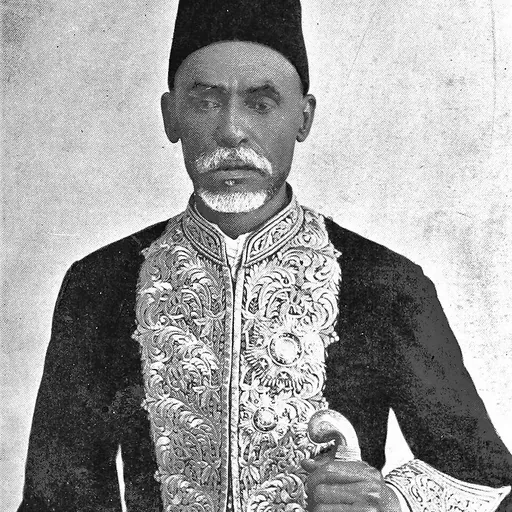
al-Zubayr Rahma Mansur
Slave trader and Sudanese governor
About al-Zubayr Rahma Mansur
Lived 1830 – 1913 (aged 82–83). al-Zubayr Rahma Mansur was a Turkish slave trader.
Al-Zubayr Rahma Mansur Pasha (; c. 1830 – January 1913), also known as Sebehr Rahma or Rahama Zobeir, was a Sudanese slave trader and warlord in the late 19th century. He was later acknowledged by Isma'il Pasha, of the Khedivate of Egypt in granting him the title of Governor over Bahr el Ghazal (today western South Sudan).
His reputation as an archenemy of General Charles Gordon led to him gaining a near-mythic status in the United Kingdom, where he was referred to as "the richest and worst", a "Slaver King" "who [had] chained lions as part of his escort".
Background Born in 1830 as Al-Zubayr Rahma Mansur, he came from the Gemaab section of the Ja'alin, an Arab tribe in northern Sudan.
He began his large-scale business in 1856, when he left Khartoum with a small army, to set up a network of trading forts known as zaribas, focusing his efforts on slave trading and ivory sales. At its height, his trading empire, backed by a personal army, controlled much of the Bahr el Ghazal as well as what are today parts of Chad and the Central African Republic.
In 1871, at the height of his power, Rahma was visited at his headquarters in Deim Zubeir by Georg Schweinfurth, who described the slave trader's court as "little less than princely". Isma'il Pasha of Egypt desired control over the region, but Rahma defeated a mercenary army sent against him. Instead in 1873 Isma'il added the region to his empire by acknowledging Rahma's power and granting him the title of Governor over Bahr el Ghazal.
Eventually Rahma controlled 30 zaribas, and earned the titles of bey and Pasha, after allying himself, and his lieutenant Rabih az-Zubayr, with the khedive Ismail Pasha briefly during the invasion of Darfur, where he led the southern forces. He was referred to as "the Black Pasha", and ultimately wished to become Governor General.
That year, Gordon wrote back home "I have to contend with many vested interests, with fanaticism, with the abolition...with a large semi-independent province lately under Sebehr, the Black Pasha, at Bahr Gazelle". Gessi, together with Taha Mahomet, had earlier been credited with sacking Dem Sebehr, a reputed stronghold of the slaving clan.
In early September, while traveling through Shaka, Gordon was surprised to be extended an invitation to spend two days in Suleiman's house. He accepted, but spent the following days again rejecting Suleiman's pleas for a title of government, but consoled the young chief by giving him a rifle and teaching him its proper use. Eventually, Queen Victoria, Sir Evelyn Baring, William Ewart Gladstone and Nubar Pasha in Cairo, all agreed to allow Rahma the title, but the order was rescinded by the British government, upset with Rahma's slave-raiding practises.
Nevertheless, he was put in charge of all the Black African forces, as well as sharing command of Arab forces with Hussein Pasha. in January 1913 in his home village Geili.
A street in Downtown Khartoum is still named after Zubayr, and the town of Uyujuku in South Sudan is still commonly known as Deim Zubeir.
In popular culture
The 1966 film Khartoum stars Zia Mohyeddin as Zubayr, where he plays opposite Charlton Heston's General Gordon. Toward the beginning of the film, Zubayr is portrayed as a harbinger of doom. He refuses to cooperate with the General in his reconquest of the Sudan, and prophesies his death at the hands of the Mahdi forces.
Don’t just read it —
keep it.
Full-length biographies made to live with: read them, listen on the way to work, watch them tonight.
- E-book
- Audio
- Video
Instant download · yours to keep · every purchase keeps this site free
Important facts
People in al-Zubayr Rahma Mansur's life
Named in this biography and alive at the same time




Related people
Same field, nearest in time


Contemporaries
People whose lives overlapped al-Zubayr Rahma Mansur's



Frequently asked questions
Who was al-Zubayr Rahma Mansur?
Slave trader and Sudanese governor
When was al-Zubayr Rahma Mansur born?
al-Zubayr Rahma Mansur was born in 1830 in Turkish-Egyptian Sudan.
When did al-Zubayr Rahma Mansur die?
al-Zubayr Rahma Mansur died in 1913 in Geili.
What was al-Zubayr Rahma Mansur's occupation?
al-Zubayr Rahma Mansur was a slave trader.
What nationality was al-Zubayr Rahma Mansur?
al-Zubayr Rahma Mansur was Turkish.
Sources & further reading
· Wikipedia: al-Zubayr Rahma Mansur
· DBpedia: Al-Zubayr Rahma Mansur
Cite this page
APA: Biography.guide. (2026). al-Zubayr Rahma Mansur. https://biography.guide/al-zubayr-rahma-mansur/
MLA: "al-Zubayr Rahma Mansur." Biography.guide, https://biography.guide/al-zubayr-rahma-mansur/.
Chicago: "al-Zubayr Rahma Mansur." Biography.guide. https://biography.guide/al-zubayr-rahma-mansur/.
Data last updated: 2026-09-22 · Spot an error? Report a correction.
Portrait: Wikimedia Commons · author & licence
Page generated 2026-09-27 05:03 UTC