
About Agostino Scilla
Lived 1629 – 1700 (aged 70). Agostino Scilla was a French painter, numismatist, writer, philosopher, draftsperson and poet.
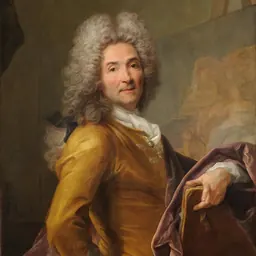
Portrait traditionally attributed to Andrea Sacchi, re-identified by historian Paula Findlen as a self-portrait of Agostino Scilla. Museum of Fine Arts, Boston. Agostino Scilla (10 August 1629 – 31 May 1700) was an Italian Baroque painter, paleontologist, geologist, numismatist, and a pioneer in the study of fossils and in scientific illustration. In addition to his paintings, he published an early text on paleontology: La vana speculazione disingannata dal senso ("Vain Speculation Undeceived by Sense", 1670) which was introduced to English audiences by William Wotton of the Royal Society in 1696. He was among the first to promote a scientific understanding of fossils in contrast to fantastic Biblical and divine interpretations.
Biography The son of a notary in Messina in Sicily, Scilla studied under Antonio Barbalunga in Messina. Thanks to the influence of his master, he was awarded a grant by the Senate in Messina to continue his studies in Rome, where he studied under Andrea Sacchi for four years. On returning to his native city he opened a very popular academy and painted frescoes in the churches of San Domenico and of the Nunziata de' Teatini. Among his canvases are a depiction of Death of San Ilarione painted for the church of Sant'Ursula. His frescos in the Cathedral of Syracuse date from 1657.
After participating in an unsuccessful revolt against Spanish rule, in 1678 he was exiled from Sicily. Scilla worked as a painter in Turin and then Rome for the rest of his life. He was a censor in the Academy of Design in Rome in 1695.
Scilla was an excellent landscape painter ad was much admired for the realism of his portraits. Among his pupils wete the painters Antonio Madiona and Placido Celi. Agostino's brother Giacinto, and Giacinto's son Saverio, were also painters.
Works
Scilla began to study fossils found in the hills of Sicily, sometimes accompanied by botanist Paolo Boccone. His only written scientific work is La vana speculazione disingannata dal senso ("Vain Speculation Undeceived by Sense", 1670). The book was dedicated to the Sicilian nobleman Don Carlo di Gregorio, who founded the Accademia della Fucina (1639–1678) in Messina. In this work Scilla argues for a scientific explanation for fossils, as opposed to them being of fantastic origin or a test of faith from God. He also correctly identified the supposedly magical objects that were called glossopetrae, or "tongue stones", as shark teeth. He was however not the first to do this. Nicolas Steno had made a similar claim about three years earlier but it is not known if Scilla had seen that work. Fabio Colonna in Dissertatio de glossopetris (1616) had burnt these fossils to show that they were made of lime, organic matter, rather than minerals. Scilla is considered to have been the first to use dotted lines to indicate reconstructions in paleontological illustration.
Dorsum Scilla on the Moon is named after him.
Don’t just read it —
keep it.
Full-length biographies made to live with: read them, listen on the way to work, watch them tonight.
- E-book
- Audio
- Video
Instant download · yours to keep · every purchase keeps this site free
Important facts
more
Augustine Scilla, August Scilla, Augustinus Scilla, Augostino ScillaPeople in Agostino Scilla's life
Named in this biography and alive at the same time




Related people
Same field, nearest in time

Contemporaries
People whose lives overlapped Agostino Scilla's





Frequently asked questions
Who was Agostino Scilla?
Italian painter, paleontologist, geologist, and pioneer in the study of fossils (1629–1700)
When was Agostino Scilla born?
Agostino Scilla was born on 10 August 1629 in Messina.
When did Agostino Scilla die?
Agostino Scilla died on 31 May 1700 in Rome.
What was Agostino Scilla's occupation?
Agostino Scilla was a painter, numismatist, writer, philosopher, draftsperson and poet.
What nationality was Agostino Scilla?
Agostino Scilla was French.
Sources & further reading
Cite this page
APA: Biography.guide. (2026). Agostino Scilla. https://biography.guide/agostino-scilla/
MLA: "Agostino Scilla." Biography.guide, https://biography.guide/agostino-scilla/.
Chicago: "Agostino Scilla." Biography.guide. https://biography.guide/agostino-scilla/.
Data last updated: 2026-09-20 · Spot an error? Report a correction.
Page generated 2026-09-27 05:33 UTC