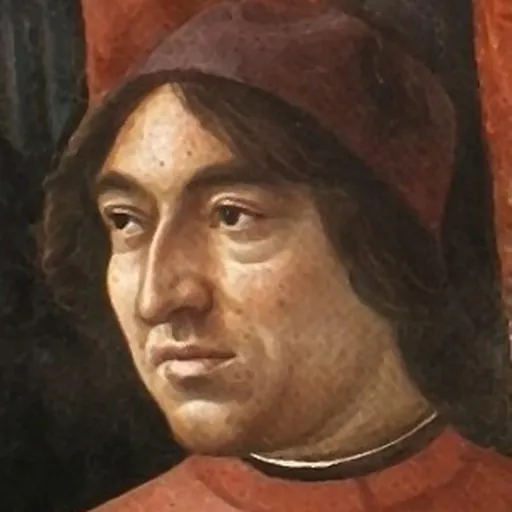
About Agnolo Poliziano
Lived 1454 – 1494 (aged 40). Agnolo Poliziano was an Italian poet, playwright, university teacher, philologist, writer and humanist.
Agnolo (or Angelo) Ambrogini (; 14 July 1454 – 24 September 1494), commonly known as Angelo Poliziano or simply Poliziano, anglicized as Politian,
Final years Style of Niccolò Fiorentino, Angelo Poliziano, 1454-1494, c. 1494, medallion in the National Gallery of Art Poliziano spent his final years without financial or other worries, studying philosophy. Piero the Unfortunate even asked Pope Alexander VI to make him a cardinal.
It is likely that Poliziano was homosexual, or at least had male lovers, and he never married.
Prior to his exhumation in 2007, the circumstances of his death were also sometimes considered to be evidence of homosexuality: some evidence suggested that he was killed by a fever (possibly resulting from syphilis) which was exacerbated by standing under the windowsill of a boy he was infatuated with despite being ill. Forensic tests showed that both Poliziano and Pico likely died of arsenic poisoning, possibly the order of Lorenzo's successor, Piero de' Medici.
Legacy
Poliziano was well known as a scholar, a professor, a critic, and a Latin poet in an age when the classics were still studied with assimilative curiosity, and not with the scientific industry of a later period. He was the representative of that age of scholarship in which students drew their ideal of life from antiquity. He was also known as an Italian poet, a contemporary of Ariosto.
At the same time, he was busy as a translator from the Greek. His versions of Epictetus, Hippocrates, Galen, Plutarch's Eroticus and Plato's Charmides distinguished him as a writer. Of these learned labours, the most universally acceptable to the public of that time were a series of discursive essays on philology and criticism, first published in 1489 under the title of Miscellanea. They had an immediate and lasting effect, influencing the scholars of the next century.
Anthony Grafton writes that Poliziano's "conscious adoption of a new standard of accuracy and precision" enabled him "to prove that his scholarship was something new, something distinctly better than that of the previous generation": By treating the study of antiquity as completely irrelevant to civic life and by suggesting that in any case only a tiny elite could study the ancient world with adequate rigor, Poliziano departed from the tradition of classical studies in Florence. Earlier Florentine humanists had studied the ancient world in order to become better men and citizens. Poliziano by contrast insisted above all on the need to understand the past in the light of every possibly relevant bit of evidence — and to scrap any belief about the past that did not rest on firm documentary foundations ... [But] when he set ancient works back into their historical context Poliziano eliminated whatever contemporary relevance they might have had.
Don’t just read it —
keep it.
Full-length biographies made to live with: read them, listen on the way to work, watch them tonight.
- E-book
- Audio
- Video
Instant download · yours to keep · every purchase keeps this site free
Important facts
People in Agnolo Poliziano's life
Named in this biography and alive at the same time
Related people
Same field, nearest in time


Contemporaries
People whose lives overlapped Agnolo Poliziano's


Frequently asked questions
Who was Agnolo Poliziano?
Italian classical scholar and poet (1454-1494)
When was Agnolo Poliziano born?
Agnolo Poliziano was born on 14 July 1454 in Montepulciano.
When did Agnolo Poliziano die?
Agnolo Poliziano died on 29 September 1494 in Florence.
What was Agnolo Poliziano's occupation?
Agnolo Poliziano was a poet, playwright, university teacher, philologist, writer and humanist.
What nationality was Agnolo Poliziano?
Agnolo Poliziano was Italian.
Sources & further reading
Cite this page
APA: Biography.guide. (2026). Agnolo Poliziano. https://biography.guide/agnolo-poliziano/
MLA: "Agnolo Poliziano." Biography.guide, https://biography.guide/agnolo-poliziano/.
Chicago: "Agnolo Poliziano." Biography.guide. https://biography.guide/agnolo-poliziano/.
Data last updated: 2026-09-23 · Spot an error? Report a correction.
Portrait: Wikimedia Commons · author & licence
Page generated 2026-09-27 05:05 UTC