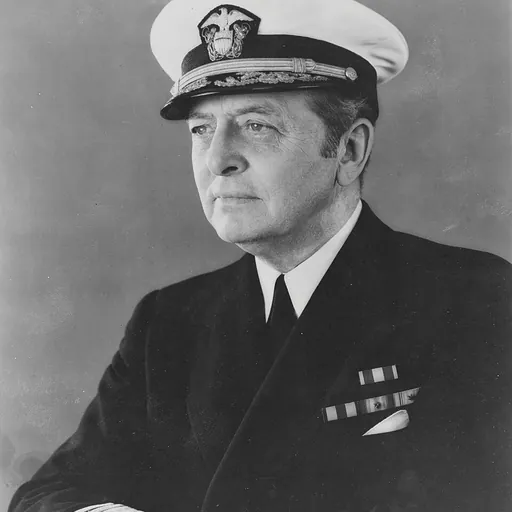
About Adolphus Andrews
Lived 1879 – 1948 (aged 68). Adolphus Andrews was an American military personnel.
Adolphus Andrews (October 7, 1879 – June 19, 1948) was a decorated officer in the United States Navy with the rank of Vice Admiral. A Naval Academy graduate and veteran of three wars, he is most noted for his service as Commander, Eastern Sea Frontier during World War II.
He later served on the Pearl Harbor Court of Inquiry in 1944 and following the War, Andrews served as American Red Cross Commissioner for Pacific area.
World War II Andrews (left) following Winston Churchill during the disembarkation from SS QUEEN MARY on arrival in the USA. Following the completion of his tour with Scouting Force in February 1941, Andrews reverted to his permanent rank of rear admiral and assumed duty as Commandant of the Third Naval District with headquarters at New York Navy Yard. While in this capacity, he also held additional duty as Commander of the North Atlantic Naval Coastal Frontier.
During the end of his tenure in February 1942, the seized ocean liner SS Normandie, which was stationed at New York Navy Yard, caught fire and capsized. The subsequent investigation focused on possible sabotage and connection to New York Mafia Boss Albert Anastasia. Due to the investigation Andrews' nomination to vice admiral was held up by the Senate Naval Affairs Committee after Senators Charles L. McNary and Owen Brewster raised the question of responsibility for the fire. Despite his rejection of advice from the ship's designer that would have saved the ship, Andrews was cleared of any wrongdoing and promoted to the rank of vice admiral backdated to May 1, 1942.
Meanwhile, Naval Coastal Frontiers were grouped in to Sea Frontiers, and the area of the Naval Coastal Frontier formerly under Andrews' command was merged into the Eastern Sea Frontier and he became its commander. For his new assignment, Andrews was re-promoted to the rank of vice admiral on May 1, 1942.
Pearl Harbor Court of Inquiry As member (right) of the Navy Court of Inquiry into the Pearl Harbor Attack, 1944. Other are Admirals Orin G. Murfin (center) and Edward C. Kalbfus.
Following the death of Secretary Knox in April 1944, his successor James V. Forrestal ordered that a Naval Court of Inquiry be convened to investigate the facts surrounding the Japanese attack on Pearl Harbor and to assess any culpability borne by members of the Navy. The Court consisted of Andrews; Admiral Orin G. Murfin, who served as President of the Court, and Admiral Edward C. Kalbfus.
The court convened on July 24, 1944, and held daily sessions in Washington, D.C., San Francisco, and Pearl Harbor. After interviewing numerous witnesses, it completed its work on October 19, 1944. Its report to the Navy Department largely exonerated Rear Admiral Husband E. Kimmel, commander in chief of the Pacific Fleet at the time of the attack. The court found that Kimmel's decisions had been correct given the limited information available to him, but criticized then-Chief of Naval Operations Harold R. Stark for failing to warn Kimmel that war was imminent. The court concluded that "based upon the facts established, the Court is of the opinion that no offenses have been committed nor serious blame incurred on the part of any person or persons in the naval service." Because the court's findings implicitly revealed that American cryptographers had broken the Japanese codes, a critical wartime secret, the court's report was not made public until after the end of the war.
Upon reviewing the report, Forrestal felt that the court had been too lenient in assigning blame for the disaster. The court had found that the Army and Navy had adequately cooperated in the defense of Pearl Harbor; that there had been no information indicating that Japanese carriers were on their way to attack Pearl Harbor; and that the attack had succeeded principally because the advanced tactical effectiveness of the Japanese aerial torpedo bombing technique could not have been predicted. Forrestal disapproved all of these findings, judging that Kimmel could have done more with the information he had had to prevent or mitigate the attack. Forrestal concluded that both Kimmel and Stark had "failed to demonstrate the superior judgment necessary for exercising command commensurate with their rank and their assigned duties."
Retirement
Andrews was relieved of all active duty in December 1944 and assumed position as Commissioner of the American Red Cross for South Pacific areas in June 1945. He subsequently served as a director of the Missouri-Kansas-Texas Railway, the Texas Bank & Trust Company, the Kansas City Wholesale Grocery Company of Kansas City, Mo., and the Bird Shankle Corporation of San Antonio.
He was also a member of the New York City University Club, the Dallas Downtown Club, the Fort Worth Club, the Alibi Club, and the Metropolitan Club and Cevy Chase Country Clubs of Washington, D.C.
Vice Admiral Adolphus Andrews died following a long illness on June 19, 1948, aged 68, at Naval Hospital in Houston, Texas. He is buried with his wife Berenice Platter Andrews (1888–1992) at Fairview Cemetery in Denison, Texas. They had two children: a son, Adolphus Andrews Jr., who served as Marine Corps officer during World War II and a daughter Frances W. Andrews.
Decorations
Ribbon bar of Vice admiral Andrews:
Don’t just read it —
keep it.
Full-length biographies made to live with: read them, listen on the way to work, watch them tonight.
- E-book
- Audio
- Video
Instant download · yours to keep · every purchase keeps this site free
Important facts
People in Adolphus Andrews's life
Named in this biography and alive at the same time
Related people
Same field, nearest in time





Contemporaries
People whose lives overlapped Adolphus Andrews's



Frequently asked questions
Who was Adolphus Andrews?
American Navy admiral (1879-1948)
When was Adolphus Andrews born?
Adolphus Andrews was born on 7 October 1879 in Galveston.
When did Adolphus Andrews die?
Adolphus Andrews died on 19 June 1948 in Houston.
What was Adolphus Andrews's occupation?
Adolphus Andrews was a military personnel.
What nationality was Adolphus Andrews?
Adolphus Andrews was American.
Sources & further reading
Cite this page
APA: Biography.guide. (2026). Adolphus Andrews. https://biography.guide/adolphus-andrews/
MLA: "Adolphus Andrews." Biography.guide, https://biography.guide/adolphus-andrews/.
Chicago: "Adolphus Andrews." Biography.guide. https://biography.guide/adolphus-andrews/.
Data last updated: 2026-09-23 · Spot an error? Report a correction.
Portrait: Wikimedia Commons · author & licence
Page generated 2026-09-27 05:06 UTC