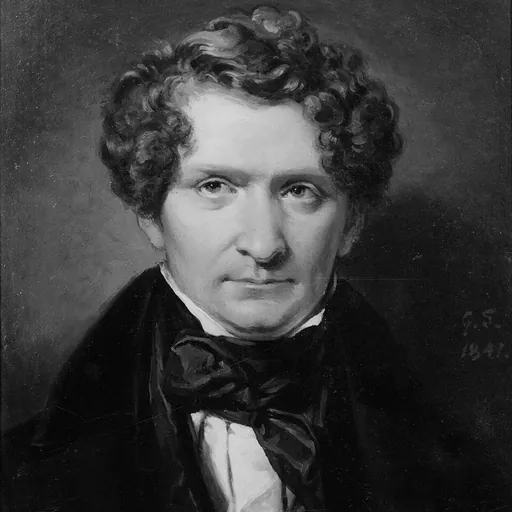
About Adolf Fredrik Lindblad
Lived 1801 – 1878 (aged 77). Adolf Fredrik Lindblad was a Swedish composer, music teacher and music educator.
Adolf Fredrik Lindblad (1 February 1801 – 23 August 1878) was a Swedish composer from the Romantic era. He is mostly known for his compositions of Swedish song or lieder, of which he produced over 200. His other well-known compositions include his Symphony No. 1 in C major, Symphony No. 2 in D major, and an opera titled Frondörerna (The Rebels). He was a well-respected friend of Felix Mendelssohn, and had a collaborative relationship with the famous Swedish soprano, Jenny Lind.
Biography Born of an “unknown father” in the town of Skänninge on February 1, 1801, he spent most of his early life with his mother and foster-father in the Östergötland province. He started his studies in music at a fairly young age, and primarily studied piano and flute. At the age of fifteen, he gained recognition for composing a flute concerto that was performed in the nearby city of Norrköping in 1816. After achieving his first compositional success, Lindblad was sent by his foster-father to work in a shipping office in Hamburg to learn a trade, at the age of seventeen, but he stayed only a year.
Returning to Sweden, he became more determined exclusively on music. Apart from opening a piano school, which he ran until 1861, Lindblad was contracted to become the Swedish Royal family's music instructor. He became the music teacher of the Crown Prince, Oscar I and of the King's children, Prince Gustavus and Princess Eugenie. His songs are described as genuinely Swedish without resorting to folk tunes already in existence.
The success of his Swedish songs is due in part to the assistance of his star pupil, the renowned soprano, Jenny Lind, also known as “the Swedish Nightingale.” She often assisted in Lindblad's vocal compositions, and would perform them regularly in salons and drawing rooms and as encores.
Lindblad's collaborative relationship with Jenny Lind brought many triumphs. For instance, Lindblad brought Jenny Lind to meet the famous opera composer, Giacomo Meyerbeer, while she was studying voice in Paris, precipitating her rise in popularity in Germany and Britain. Lindblad continued to compose larger works including the Symphony No. 2 in D major, two string quintets, three violin sonatas, seven string quartets, and an opera, Frondörerna (The Rebels).
Lindblad strived to bring legitimacy to Swedish music and succeeded in doing so, even though his music was often criticized by the Swedish press for being too harmonically bold. It was not until Ludwig Spohr of Kassel praised Lindblad that the Swedish critics started to appreciate Lindblad. Towards the end of his life, he abstained from composing large works, and spent much of his time composing for friends and fellow musicians who shared a “contemporary Swedish taste.” He died at the age of 77 in Linköping on August 23, 1878.
Style and influences Lindblad's studies under Zelter for a year in Berlin may have been his biggest musical influence. Lindblad also appears to have been influenced by composers of Viennese Classicism such as Mozart, Ludwig van Beethoven, and Haydn. Lindblad's style as a result sounds very late Classical to early Romantic, which is particularly apparent in his Symphony No. 1 in C major and Symphony No. 2 in D major.
Many elements of the First Symphony are reminiscent of Beethoven's Eroica and Weber's First Symphony. The resemblance is heard especially in the opening horn fanfare in the first movement. The particular use of the horn in the "Scherzo" is also comparable to Haydn's Hornsignal Symphony. The third movement, “Adagio e molto,” is described as bearing resemblance to late works of Mozart. In the final movement, Lindblad explores various styles, opening with a fugue and abruptly changing to a lyrical melody played by flutes. A motif is also very similar to the “terrace” motif in Beethoven's Ninth.
In Symphony No. 2 in D major, many of the same influences can be found despite its being composed nearly 25 years after his First. Lindblad employs many stylistic qualities found in late Mozart, Haydn, and Beethoven. When listening to the work, one can hear a short use of a motif similar to the four-note motif of Beethoven's Fifth Symphony. The second movement brings a dance-like quality that could have been influenced by Haydn's “walking” themes with a hint of Romanticism. The "Scherzo" can be argued to be evoking Schumann. In the final movement of Symphony No. 2, Lindblad expresses an appreciation for Mozart by quoting Cherubino's aria from Le nozze di Figaro.
Lindblad's style of orchestration has been praised as excellent, despite Lindblad's not being known to have seriously studied proper orchestration technique.
Lindblad's song style can be compared to the lieder styles of Schubert, Schumann, and Brahms in that many of Lindblad's songs are “strophic or built on a pattern of two contrasting stanzas which return more or less varied.” However, Lindblad composed in a way that made the music stand apart from those other lieder traditions. Without resorting to traditional Swedish folk tunes as a basis for his songs, he was able to color them in a way that is described as genuinely Swedish. Lindblad is credited with being the innovator of the “Swedish style” of song. Performing Swedish lieder in a manner that sounds true to the style demands a certain amount of attention to the nuances of the language and the interpretation.
List of works
Vocal works
Solo songs
Erster Verlust (First Loss) (Johann Wolfgang von Goethe), 1824 Bröllopsfärden (Wedding Trip) (A.F. Lindblad), 1836 Nära (Nigh) (A.F. Lindblad) Jungfrun i lunden (Virgin in the Grove) Apelgården (Apple Garden) Sorg (Grief) På berget (On the mountain) I dalen (In the valley) Aftonen (Evening) (Erik Johan Stagnelius) Mån tro? Jo, jo! (Perhaps? Yes, yes!) (A.F. Lindblad) Buch der Lieder (Heinrich Heine), 1860s 1. Sie haben heut' abend Gesellschaft (You have this evening Society) 2. Wie kannst du ruhig schlafen (As you can sleep quietly) 3. So hast du ganz und gar vergessen (So you have quite forgotten) 4. Ja, du bist elend und ich grolle nicht (Yes, you are miserable and I do not complain) 5. Wir haben viel für einander gefühlt (We have felt much for each other) 6. Lieb Liebchen, leg's Händchen aufs Herze (Sweetheart, her little hands on my heart) 7. Morgens steh' ich auf und frage (In the morning I rise and ask) 8. Still ist die Nacht, es ruhen die Gassen (Still is the night, there lie the streets) 9. Der Asra (The Asra) En sommarmorgon (One summer morning) En sommardag (One summer day) En sommarafton (One summer evening) Höstkvällen (Autumn Evening), (Johan Ludvig Runeberg), 1847 Svanvits sång (The Swan Song), (Per Daniel Amadeus Atterbom), 1822 Nattviolen (Night Violet), (Urban von Feilitzen) Nattväktarsång (Night watchdog's song) Den skeppsbrutne (The shipwrecked) Sotargossen (Chimney-sweep boy), 1836 Gubben vid vägen (The old man by the road), 1838 Krigsinvaliden (War invalid) Skjutsgossen på hemvägen (Pushed the boy on his way home), 1838 En dagakarls visa (One man's view of a day), 1844 Slåttervisa (Cutting display), 1844 En ung flickas morgonbetraktelse (A young girl's morning reflection) Hon skriver (She writes), 1845 Stryknings-visa (An ironing show), (Thekla Knös), 1856 Den flitiga handen (The diligent hand), (Thekla Knös), 1856 Am Aarensee (At Aarensee) Der schlummernde Amor (The slumbering love) A une femme (A woman) Saknad (Missing) Illusion (Illusion) Nio smärre sånger (Nine minor songs), 1851 I höet (In the hay) Bedragen väntan (Betrayed waiting) Sånger (Songs), 1844 Föresats (Purpose) Hjärtats vaggsång (Lullaby of the heart) Mitt liv (My life) (Johan Ludvig Runeberg) Som mörka bäcken rinner (As dark streams flow) (Per Daniel Amadeus Atterbom) Vårbetraktelser under sjukdom (During illness) (Jacob Frese) Till Sophie (For Sophie) Fåfäng varning (Vain warning)
Quartets, trios and duets
Drömmarne (Dream), song cycle for mixed choir and piano (text: AF Lindblad after Thekla Knös), 1851 De till dalens hyddor smyga (The valley's huts to sneak) Lärkan i skyn (Lark in the sky) Med en barnbön på sin mun (With a children's prayer in her mouth) Och drömmar nu gå (And dreams now go) Stilla på himlen molnen de segla (Still in the sky the clouds the sail) Till den gamles bädd de gå (To the old man's bed they go) Ännu en dröm (Still a dream) Om winterqväll (Winter evening), song cycle for mixed choir and piano (text: AF Lindblad), first performed 1845 Väl sommar'n flytt (Well The summer transfer) En vårdag: Giv akt! Nu kommer vår'n (A spring day: Attention!) En vårdag: Fast isen täckt floder och sjöar (A spring day: Solid ice covered rivers and lakes) En vårdag: En fiskare jag ser... (A spring day: A fisherman I see ...) En Sommarmorgon (A summer morning) En sommarafton: Över skogen, över sjön (One summer evening: over the forest, the lake) En sommarafton: Men solen länge re'n (One summer evening: But the sun long) En sommarafton: Det rinner strömmar många (A Summer Evening: The flowing streams many) En sommarafton: Och nu, god natt! (One summer evening: And now, good night!) Herden leder hemåt hjordens... (The shepherd leads the flock back home ...)
Instrumental works
Orchestral Symphony No. 1 in C major Symphony No. 2 in D major
Chamber music
Violin Sonata No. 1 in G major, Op. 9 Violin Sonata No. 2 in D major, Op. 11 Violin Sonata No. 3 in E flat major Trio in G minor for piano, violin and viola, op. 10 String Quartet No. 1 in G major String Quartet No. 2 in B major String Quartet No. 3 in C major String Quartet No. 4 in B minor String Quartet No. 5 in F major String Quartet No. 6 in A flat major. String Quartet No. 7 in A major (final lost) String Quartet No. 8 in F major (only the first movement is preserved) String Quartet No. 9 in G major String Quartet No. 10 in C major String Quintet No. 1 in A major, (performed 1829) String Quintet No. 2 in F major (performed 1885)
Opera Frondörerna (The Rebels)
Don’t just read it —
keep it.
Full-length biographies made to live with: read them, listen on the way to work, watch them tonight.
- E-book
- Audio
- Video
Instant download · yours to keep · every purchase keeps this site free
Important facts
People in Adolf Fredrik Lindblad's life
Named in this biography and alive at the same time




Related people
Same field, nearest in time
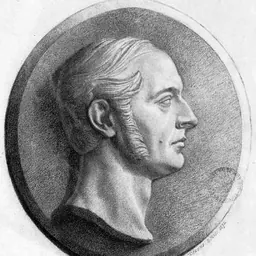

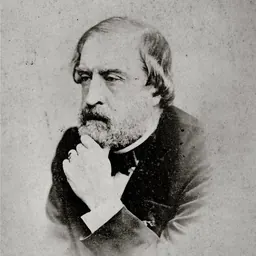
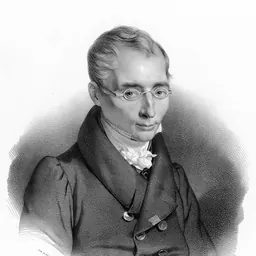
Contemporaries
People whose lives overlapped Adolf Fredrik Lindblad's





Frequently asked questions
Who was Adolf Fredrik Lindblad?
Swedish composer (1801-1878)
When was Adolf Fredrik Lindblad born?
Adolf Fredrik Lindblad was born on 1 February 1801 in Skänninge.
When did Adolf Fredrik Lindblad die?
Adolf Fredrik Lindblad died on 23 August 1878 in Skeda.
What was Adolf Fredrik Lindblad's occupation?
Adolf Fredrik Lindblad was a composer, music teacher and music educator.
What nationality was Adolf Fredrik Lindblad?
Adolf Fredrik Lindblad was Swedish.
Sources & further reading
· Wikipedia: Adolf Fredrik Lindblad
· DBpedia: Adolf Fredrik Lindblad
Cite this page
APA: Biography.guide. (2026). Adolf Fredrik Lindblad. https://biography.guide/adolf-fredrik-lindblad/
MLA: "Adolf Fredrik Lindblad." Biography.guide, https://biography.guide/adolf-fredrik-lindblad/.
Chicago: "Adolf Fredrik Lindblad." Biography.guide. https://biography.guide/adolf-fredrik-lindblad/.
Data last updated: 2026-09-23 · Spot an error? Report a correction.
Portrait: Wikimedia Commons · author & licence
Page generated 2026-09-27 05:08 UTC