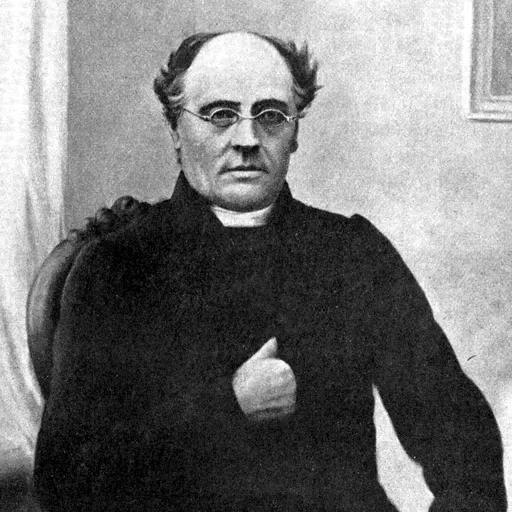
Johan Ludvig Runeberg
Finland’s national poet, author of Finland’s national anthem, Swedish-speaking writer and poet
About Johan Ludvig Runeberg
Lived 1804 – 1877 (aged 73). Johan Ludvig Runeberg was a Finnish and Swedish writer, poet, journalist, hymnwriter and teacher.
Johan Ludvig Runeberg (; 5 February 1804 – 6 May 1877) was a Finnish priest, lyric and epic poet. He wrote exclusively in Swedish. He is considered a national poet of Finland. He is the author of the lyrics to (Our Land, in Finnish). Runeberg was also involved in the modernization of the Finnish Lutheran hymnal and produced many texts for the new edition.
Background Childhood Runeberg was born into a Swedish-speaking family in Jakobstad, on the shores of the Gulf of Bothnia. His parents were sea captain Lorentz Ulrik Runeberg (1772–1828) and Anna Maria Malm (1782–1834). His paternal grandfather Ludvig had moved within Sweden from the west to the east, which is now Finland, and Anna Maria Malm was born to a merchant family from Jakobstad, which probably also had their roots in Sweden.
As a child, Runeberg suffered from scrofula, which led to glandular swelling. His physical development slowed down due to illness so that he did not learn to walk until he was three or four years old. From his father, Johan inherited a manly and brisk character, and from his mother, he inherited sensitivity and artistic talent.
Poetry Many of his poems deal with life in rural Finland. The best known of these is , (Farmer Paavo, in Finnish), about a smallholding peasant farmer in the poor parish of Saarijärvi and his determination, sisu (guts) and unwavering faith in providence in the face of a harsh climate and years of bad harvests. Three times, a frosty night destroys his crops. Every time, he mixes double the amount of bark into his bark bread to stave off starvation and works ever harder to dry off marsh into dryer land that would not be as exposed to the night frost. After the fourth year, Paavo finally gets a rich crop. As his wife exults, thanks God and tells Paavo to enjoy full bread made entirely out of grain, Paavo instructs his wife to mix bark into grain once more, because their neighbour's crop has been lost in a frost and he gives half of his crop to the needy neighbour.
Selected works Runeberg's main works included the idealist poem "" (Elk Hunters, 1832) and the epic (King Fjalar, 1844). The heroic poem (The Tales of Ensign Stål), in Finnish) written between 1848 and 1860, is among the greatest Finnish epic poems outside the native Kalevala tradition, and contains tales of the Finnish War of 1808–09 with Russia. During the war, Sweden ignominiously lost Finland to Russia, and by the order of Alexander I, the Grand Duchy of Finland was established.
Personal life He was married to his second cousin Fredrika Runeberg, née Tengström, who wrote poems and novels. They were the parents of eight children, including the sculptor Walter Runeberg, who was their eldest son. He also had several emotional affairs throughout his life, most notably with Maria Prytz and the younger poet Emilie Björkstén.
Johan Ludvig Runeberg met poet Fredrika Wenman at a school in Vaasa. Runeberg dedicated his poem to Frigga. However, the courtship ended when Runeberg left to study at the Royal Academy of Turku in 1823.
Legacy
Runeberg Day (Finnish: ; Swedish: Runebergsdagen) is celebrated annually on 5 February, the day of Runeberg's birth. A pastry flavored with almonds called Runeberg's torte (Finnish: ; Swedish: ) is generally available in stores from the beginning of January until 5 February.
There is a statue of Johan Ludwig Runeberg by his son Walter Runeberg on Esplanadi in the heart of Helsinki. Runeberg Township in Becker County, Minnesota was also named after Runeberg.
The Runeberginkatu street in central Helsinki is named after him.
Runeberg was selected as the main motif of the Finnish commemorative coin, the €10 Johan Ludvig Runeberg and Finnish Poetry commemorative coin. It was minted in 2004 celebrating the 200th anniversary of his birth. The obverse of the coin features a stylized portrait of Runeberg's face. The reverse features an 1831 font sample from the Swedish-language newspaper , since Runeberg wrote most of his work in Swedish.
Don’t just read it —
keep it.
Full-length biographies made to live with: read them, listen on the way to work, watch them tonight.
- E-book
- Audio
- Video
Instant download · yours to keep · every purchase keeps this site free
Important facts
Family & relationships
People in Johan Ludvig Runeberg's life
Named in this biography and alive at the same time


Related people
Same field, nearest in time



Contemporaries
People whose lives overlapped Johan Ludvig Runeberg's





Frequently asked questions
Who was Johan Ludvig Runeberg?
Finland’s national poet, author of Finland’s national anthem, Swedish-speaking writer and poet (1804–77)
When was Johan Ludvig Runeberg born?
Johan Ludvig Runeberg was born on 5 February 1804 in Jakobstad.
When did Johan Ludvig Runeberg die?
Johan Ludvig Runeberg died on 6 May 1877 in Porvoo, Grand Duchy of Finland.
What was Johan Ludvig Runeberg's occupation?
Johan Ludvig Runeberg was a writer, poet, journalist, hymnwriter and teacher.
What nationality was Johan Ludvig Runeberg?
Johan Ludvig Runeberg was Finnish and Swedish.
Sources & further reading
· Wikipedia: Johan Ludvig Runeberg
· DBpedia: Johan Ludvig Runeberg
Cite this page
APA: Biography.guide. (2026). Johan Ludvig Runeberg. https://biography.guide/johan-ludvig-runeberg/
MLA: "Johan Ludvig Runeberg." Biography.guide, https://biography.guide/johan-ludvig-runeberg/.
Chicago: "Johan Ludvig Runeberg." Biography.guide. https://biography.guide/johan-ludvig-runeberg/.
Data last updated: 2026-09-23 · Spot an error? Report a correction.
Portrait: Wikimedia Commons · author & licence
Page generated 2026-09-27 05:08 UTC