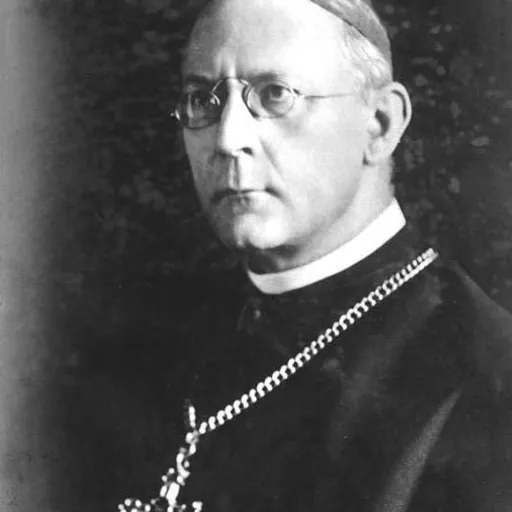
About Adolf Bertram
Lived 1859 – 1945 (aged 86). Adolf Bertram was a German and Polish catholic priest, politician, catholic bishop, archbishop and catholic theologian.
Adolf Bertram (14 March 1859 – 6 July 1945) was archbishop of Breslau (now Wrocław, Poland) and a cardinal of the Catholic Church.
Early life Adolf Bertram was born in Hildesheim, Royal Prussian Province of Hanover (now Lower Saxony), Germany. He studied theology at the Ludwig-Maximilians-Universität München, the University of Innsbruck, and the University of Würzburg, where he obtained a doctorate in theology, and at the Pontifical Gregorian University in Rome, where he earned a doctorate in canon law in 1884. He was ordained a Roman Catholic diocesan priest in 1881. On 26 April 1906 he was elected bishop of Hildesheim, an election that received papal confirmation on 12 June 1906.
Eight years later, on 8 September 1914, the Pope confirmed his election by the cathedral chapter of Breslau as bishop of that see, and he took possession of it on 28 October. Since 1824 the title Prince-Bishop of Breslau was a merely honorific title granted to the incumbents of the see, without a prince-bishopric of secular rule wielded by the incumbent, but granting a seat in the Prussian House of Lords and in the Austrian House of Lords. This, however, was abolished when Austria and Prussia became republican after 1918. Bertram continued to use the title of prince-bishop also thereafter until he was ranked Archbishop of Breslau on 13 August 1930.
Cardinal On 4 December 1916 Bertram was created a cardinal but only in pectore for fear of provoking a negative reaction against the Church on the part of the Allies, especially from the Italian side.
After hostilities ceased, his appointment was published on 5 December 1919, and he was assigned the titular church of Sant'Agnese fuori le mura on 18 December 1919. From 1919 to his death, he was also Chairman of the Fulda Conference of Catholic Bishops, the highest representative of the Catholic Church in Germany.
Silesian uprisings Cardinal Bertram's coat of arms as Prince-Bishop.Throughout the Polish Uprisings against Germany in parts of Upper Silesia, he underlined his pro-German attitude, in line with his previous declaration of being a "German bishop" attached to the German state, which generated controversy and criticism from Poles. In turn, he was called a "German chauvinist" and accused of being "anti-Polish", The Polish government protested Bertram's decision to the Vatican, and the Polish Foreign Ministry began actions opposing the decree. In a widely publicized statement, he criticized as a grave error the one-sided glorification of the Nordic race and the contempt for divine revelation that was increasingly taught throughout Germany. He warned against the ambiguity of the concept of "positive Christianity", a highly nationalistic religion that the Nazis were encouraging. Such a religion, he said, "for us Catholics cannot have a satisfactory meaning since everyone interprets it in the way he pleases".
Nazi dictatorship In March 1933, the president of an interfaith group asked for Bertram's aid in protesting the boycott of Jewish business organised by the Nazis but was refused as he regarded it as purely an economic matter and because, in his opinion, the Jewish press had kept silent about the persecution of Catholics.
On the eve of the Second World War, Nazi Germany and, to a much lesser extent, Poland annexed parts of Czechoslovakia, Sudetenland and Trans-Olza, whose northern part was a component of Bertram's diocese. After the Polish takeover of Trans-Olza, which was never internationally recognised, the Polish government requested the Holy See to depose Bertram from jurisdiction in the newly-Polish annexed area. The Holy See complied, and Pope Pius XI then subjected the Catholic parishes in Trans-Olza to an apostolic administration under Stanisław Adamski, Bishop of Katowice, who wielded that administration until 31 December 1939.
World War II
He ordered Church celebrations upon Nazi Germany's victory over Poland and France, with an order to ring bells all across the Reich upon the news of the German capture of Warsaw in 1939. With his knowledge, the diocese of Breslau issued a statement calling the war with Poland a "holy war" fought to enforce God's orders on how to live and regain "German lost land".
Throughout most of World War II Cardinal Bertram remained in Breslau. Bertram opposed what he called the immorality and "neopaganism" of the Nazi Party. On 23 December 1939 Cesare Orsenigo, Nuncio to Germany, appointed – with effect of 1 January 1940 – Bertram – and Olomouc' Archbishop Leopold Prečan – as apostolic administrators for exactly those Catholic parishes of Trans-Olza, where Pius XI had deposed them in 1938.
In 1940, Cardinal Bertram condemned the propaganda and planning for Operation Lebensborn and Nazi vitalism and insemination plans as "immoral", saying that the Lebensborn programme was institutionalized "adultery".
A few months after his death, Time magazine wrote about Cardinal Bertram:Died. Adolf Cardinal Bertram, 86, outspoken anti-Nazi Archbishop of Breslau and dean of the German Catholic hierarchy, whose tireless resistance to Hitler's "neopaganism" was climaxed last March in his defiance of orders to evacuate Breslau before the advancing Russians; presumably in Breslau. His death left the College of Cardinals with 40 members - the fewest in 144 years.
In early 1941 Bertram as metropolitan bishop of the Eastern German Ecclesiastical Province and speaker of the Fulda Conference of Bishops, rejected Carl Maria Splett's request to admit the Danzig diocese as member in his ecclesiastical province and at the conference.
He was buried at the local cemetery in Ves Javorník (Oberjauernig). His body was exhumed in 1991 and was reburied in the metropolitan cathedral in Wrocław, Poland. He was succeeded as Chairman of the Fulda Conference of Catholic Bishops by Josef Frings.
Legacy It has been claimed that Bertram scheduled a Requiem Mass upon Hitler's death. However, this claim has been disputed by Ronald Rychlak:In point of fact, this is what we know: Bertram was elderly and ill when the war ended. When he died (just weeks later), his papers included a handwritten order scheduling a Requiem Mass for all Germans who died in the war, including Hitler (who was originally reported to have died while fighting the Red Army), and for the protection of the Catholic Church in Germany. This order was never sent, and the Mass was never held. Bertam's personal secretary later reported being unaware of this paper or any such proposed order. In fact, the order itself was crossed through with two broad strokes.
Don’t just read it —
keep it.
Full-length biographies made to live with: read them, listen on the way to work, watch them tonight.
- E-book
- Audio
- Video
Instant download · yours to keep · every purchase keeps this site free
Important facts
People in Adolf Bertram's life
Named in this biography and alive at the same time


Related people
Same field, nearest in time

Contemporaries
People whose lives overlapped Adolf Bertram's


Frequently asked questions
Who was Adolf Bertram?
German cardinal (1859-1945)
When was Adolf Bertram born?
Adolf Bertram was born on 14 March 1859 in Hildesheim.
When did Adolf Bertram die?
Adolf Bertram died on 6 July 1945 in Jánský Vrch.
What was Adolf Bertram's occupation?
Adolf Bertram was a catholic priest, politician, catholic bishop, archbishop and catholic theologian.
What nationality was Adolf Bertram?
Adolf Bertram was German and Polish.
Sources & further reading
Cite this page
APA: Biography.guide. (2026). Adolf Bertram. https://biography.guide/adolf-bertram/
MLA: "Adolf Bertram." Biography.guide, https://biography.guide/adolf-bertram/.
Chicago: "Adolf Bertram." Biography.guide. https://biography.guide/adolf-bertram/.
Data last updated: 2026-09-22 · Spot an error? Report a correction.
Portrait: Wikimedia Commons · author & licence
Page generated 2026-09-27 05:01 UTC