
About Adil Zulfikarpašić
Lived 1921 – 2008 (aged 86). Adil Zulfikarpašić was a Bosnian politician.
Adil Zulfikarpašić (23 December 1921 – 21 July 2008) was a Bosniak intellectual and politician who served as vice president of the Republic of Bosnia and Herzegovina, during the Bosnian War of the 1990s, under the first president of the Presidency of the Republic of Bosnia and Herzegovina Alija Izetbegović. After the war he retired from politics and opened the Bosniak Institute, a museum in Sarajevo focused on the Bosniak culture.
Although a proponent of the Croatian national idea in his early life, Zulfikarpašić later advocated the position that Bosnian Muslims should build their own national identity and advocated the adoption of the Bosniak name. At first there was resistance to this idea, including within the leading political party of Bosnian Muslims—the Party of Democratic Action—but it prevailed in 1993 when the new name was adopted at the Bosniak Congress attended by Bosnian Muslim political and cultural representatives.
Early life Family Zulfikarpašić was born on 23 December 1921 in Foča, a town along the Drina river in the Kingdom of Serbs, Croats, and Slovenes (now Bosnia and Herzegovina). He was a member of the Čengić family through both parents.
His father Husein-beg Čengić-Zulfikarpašić was a landowner and an intellectual, son of Ali-beg Čengić and a grandson of Zulfikar Pasha Čengić, after whom his paternal family was surnamed Zulfikarpašić. Zulfikarpašić wrote that he used the dual surname throughout his elementary school, but that his family dropped the "Čengić" from their surname while he was still in his youth. Husein served as the mayor of Foča for 25 years after the Austrian-Hungarian occupation of Bosnia and Herzegovina in 1878. Adil was born when his mother was 18 years old and his father Husein-Beg was 87 years old. Husein died at 102 when Adil was 15 years old. Husein never had several wives at the same time, and his previous three wives died. Zahida was his fourth wife and originated from the Ratalj branch of the Čengić family. The two of them had another son Sabrija and six daughters. The oldest half-brother of Adil was Alija who was 55 years older than him. Husein died in 1936 aged 102 or 104 years when Adil was 15 years old, while Zahida died in 1956.
Adil's half-brothers were Alija and Hilmo, both of whom moved to the Ottoman Empire after Austria-Hungary occupied Bosnia and Herzegovina. Ibrahim, Hasan, Hivzo, Hamdija, while Sabrija was his full brother. His half-sisters were Arifa, Fatima and Haša, and full sisters Zumreta, Hasiba, Hajrija, Hamijera, Fahra and Šefika.
Education and World War II In his youth, Zulfikarpašić felt close to the Croatian national idea, rather than Serbian. He was also active in the Croatian Peasant Party. While attending gymnasium in Foča he became a leftist and joined a certain group of the League of Communist Youth of Yugoslavia (SKOJ). Eventually, he was expelled for disseminating communist literature, and had to continue his education in Rogatica. Just before his graduation, he was expelled again with other ten colleagues without the right to take the graduation exam. However, a local politician helped to abolish these punishments, so Zulfikarpašić was able to continue his education at the Commercial Academy in Sarajevo. He was again expelled, and continued to educate in Osijek and Banja Luka, where he took private classes since his further education at commercial academies was forbidden. In 1938 he joined the Communist Party of Yugoslavia (KPJ), when he was 17 years old. In 1940 he enrolled at the High Commercial School in Belgrade because Belgrade had more active leftist politics than Zagreb.
After the outbreak of World War II in Yugoslavia in 1941, he joined the Yugoslav Partisans and became a member of the Zvijezda Brigade in Vareš. The following year, he was captured by the Ustaše (the Croatian pro-Nazi forces) in Sarajevo, tortured and sentenced to death. He escaped with the help of the Partisans, and in 1945, with the war ending in victory over the Axis powers, the Communists came into power and Zulfikarpašić was appointed Deputy Minister of Trade.
Exile After becoming disillusioned with Josip Broz Tito's government shortly after the end of the war, Zulfikarpašić fled into exile in Zurich, Switzerland.
On 26 December 1991, Serbia, Montenegro, and the Serb rebel-held territory in Croatia (Serb Krajina) agreed that they would form a new "third Yugoslavia". Efforts were also made in 1991 to include Bosnia and Herzegovina within the federation, with negotiations between Milošević, Bosnia's Serbian Democratic Party, and the Bosniak proponent of union – Bosnia's Vice-President Adil Zulfikarpašić taking place on this matter. Zulfikarpašić believed that Bosnia could benefit from attempting to forge a union with Serbia, Montenegro, and Krajina; and promoted a compromise between the Serbs and Bosniaks, in which Serb Krajina and Bosniak Sanjak from Serbia would be annexed into a Greater Bosnia that within a union with Serbia and Montenegro, would secure both the unity of Serbs and Bosniaks.
Zulfikarpašić returned to Bosnia and Herzegovina and in the lead up to the Bosnian War, as Bosnia and Herzegovina held an independence referendum for independence, he stood alongside the future Bosnian president, Alija Izetbegović. He was a member of Izetbegović's Party of Democratic Action, but soon formed another party because of differing political views, the Muslim Bosniak Organisation with Muhamed Filipović.
Post-war In 2001, Zulfikarpašić established the Bosniak Institute in Sarajevo. In 2002, he was elected an honorary member of the Academy of Sciences and Arts of Bosnia and Herzegovina.
Books Gace, N., Đilas, M. (1998), The Bosniak: Adil Zulfikarpasic, London, Hurst & Company Filandra, Š., Karic, E. (2004), The Bosniac Idea, Zagreb, Globus Imamović, M. (1996), Bošnjaci u emigraciji: monografija Bosanskih pogleda, Sarajevo, Bošnjački institut Zurich, Odjel Sarajevo Zulfikarpašić, A. (1991), Članci i intervjui povodom 70-godišnjice, Sarajevo, Bošnjački institut Zulfikarpašić, A., Gotovac, V., Tripalo M., Banac, I. (1995), Okovana Bosna, Zurich, Bošnjački institut Zulfikarpašić, A. (2005), Osvrti, Sarajevo, Bošnjački institut – Fondacija Adila Zulfikarpašića Zulfikarpasic, A., Bučar, F. (2001), Sudbonosni događaji: historijski presjek presudnih zbivanja i propusta, Sarajevo, Bošnjački institut – Fondacija Adila Zulfikarpašića
Footnotes
Don’t just read it —
keep it.
Full-length biographies made to live with: read them, listen on the way to work, watch them tonight.
- E-book
- Audio
- Video
Instant download · yours to keep · every purchase keeps this site free
Important facts
People in Adil Zulfikarpašić's life
Named in this biography and alive at the same time
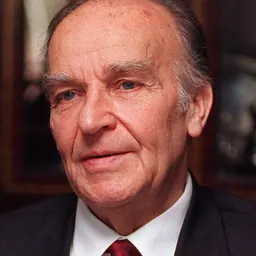


Related people
Same field, nearest in time




Contemporaries
People whose lives overlapped Adil Zulfikarpašić's




Frequently asked questions
Who was Adil Zulfikarpašić?
Vice President of Bosnia (1921-2008)
When was Adil Zulfikarpašić born?
Adil Zulfikarpašić was born on 23 December 1921 in Foča.
When did Adil Zulfikarpašić die?
Adil Zulfikarpašić died on 21 July 2008 in Sarajevo.
What was Adil Zulfikarpašić's occupation?
Adil Zulfikarpašić was a politician.
What nationality was Adil Zulfikarpašić?
Adil Zulfikarpašić was Bosnian.
Sources & further reading
· Wikipedia: Adil Zulfikarpašić
Cite this page
APA: Biography.guide. (2026). Adil Zulfikarpašić. https://biography.guide/adil-zulfikarpasic/
MLA: "Adil Zulfikarpašić." Biography.guide, https://biography.guide/adil-zulfikarpasic/.
Chicago: "Adil Zulfikarpašić." Biography.guide. https://biography.guide/adil-zulfikarpasic/.
Data last updated: 2026-09-20 · Spot an error? Report a correction.
Page generated 2026-09-27 05:29 UTC